

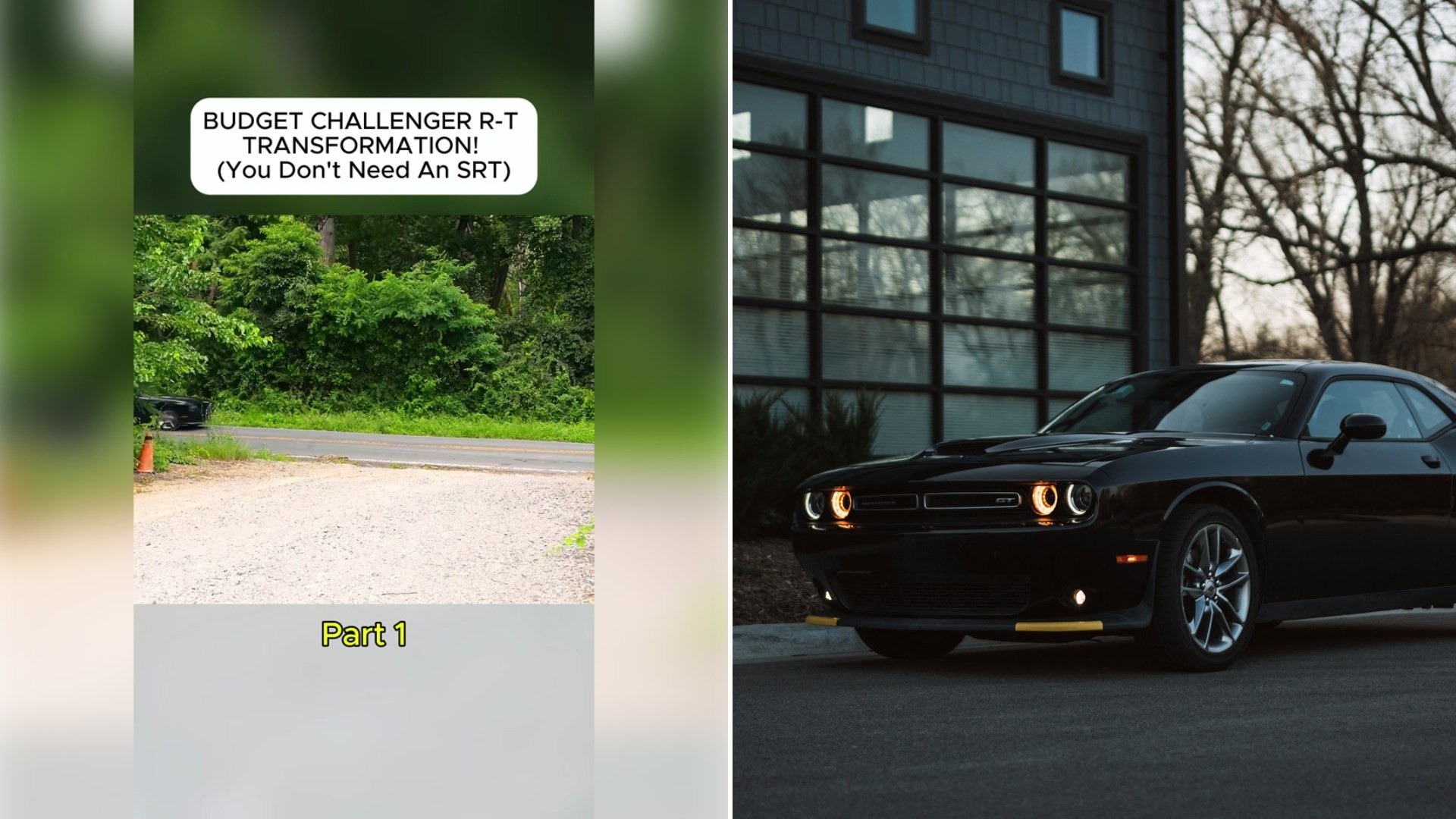
A 2009 Dodge Challenger R/T with a six-speed manual, bought from a Craigslist seller for $6,500, is the starting point of a garage build posted by @usa.iamsparrow. The owner wastes no time deciding what goes first. Within seconds of introducing the car, he has condemned the entire factory exhaust.
“This is my brand new 2009 Dodge Challenger RT,” he says at the top of the video, adding that it has the six-speed manual and the 5.7 Hemi. “I bought this car off Craigslist from an old man for sixty five hundred dollars.” Brand new, in this case, means new to him. A banner pinned to the top of the frame for the whole clip states the mission: “BUDGET CHALLENGER R-T TRANSFORMATION! (You Don’t Need An SRT).” A second label underneath reads “Part 1.”
@usa.iamsparrow
The dark Challenger is shown parked outside for a moment, then it is up on a two-post lift in a crowded home shop, and the exhaust comes first. “This car currently has factory mufflers and what appear to be factory resonators,” he says. “I’m gonna get rid of all of them.” The first one comes out with a short eulogy: “One silly stock muffler. Boop.”
In its place go two-and-a-half-inch sections that he promises “are going to sound real nasty” on the Hemi. He does not buy a finished kit. Working overhead under the car, he builds the run himself out of bends and straight pipe, starting with a pair of forty-fives to “get pretty darn close to where we need to be,” then sliding a straight section on and holding the original tip in place at the end. “And with some minor adjustment,” he says, “we can get that looking pretty much factory.” The plan is a car that looks stock from behind and does not sound it.
The other side puts up more of a fight. Sparks fly as he cuts, and there is a stretch of coaxing a stuck piece out of the car, with a second voice asking, “Is it almost out?” and the reply, “It’s kind of going. Oh yeah, it’s going. There it is.” The replacement goes in faster. “That went on easier than it came off,” he says, and the stock hardware is refitted around it. He welds the joints under the car with a helmet on. Before the engine is started there is one more check, “Safe to say that’s not leaking?” followed by the answer that the joint is welded. The camera then sits behind the car, looking at the twin stock tips under the bumper, and his first verdict on the new sound at idle is that it is tame.
Then the boxes come out. “Amazon’s finest cheap two day shipping coil overs with a name that I’m pretty sure I can’t pronounce,” he announces, turning a red-collared unit over in his hands. “These are gonna be awesome.”
He has help for this part, and he asks one friend whether he has installed coilovers on multiple vehicles before. The advice that comes back is blunt: “I think basically when we install these, we should bottom them all the way out.” Someone raises the question a lot of viewers would ask about suspension from an unpronounceable brand: “Do you guys trust these to a hundred plus miles an hour?” The answer is a shrug in sentence form. “I mean, it doesn’t really matter. It’s just gonna change how it rides, I guess.”
The work itself moves quickly. “First things first. Sway bar off.” A hammer is involved. He takes the other side apart as well so the car can be lowered down evenly, and then the original part is out: “There goes that factory strut.” With the new coilover next to it, the difference is obvious to him right away. “Oh, wow. I can already visualize the drop. I might go out on a limb and say that might be too much.”
He puts it to the group anyway. Should he go all the way down, “and we’ll see how low it actually is, and we’ll worry about adjusting later?” The answer is “Sure.”
Installation is, in his words, “mildly annoying.” Crouched in the wheel well with the red coilover in place, he gets the top started, works his way down to the bottom mount, and wonders out loud, “I don’t even know if the suspension has that much travel.” A moment later it is “Close enough. We need a hammer.” The clip ends on his own assessment of the result: “At this rate, the control arm is already an inch away from the body. So my guess is that’s already too low.”
That is where Part 1 stops, with the ride height still an open question and no finished car yet. The banner’s claim about not needing an SRT is a promise for later parts. What this one offers is an honest look at the first day of a cheap build, and a few things worth copying or avoiding.
The exhaust is the part most owners could repeat. Nothing in it is exotic: the factory mufflers and resonators come out, plain pipe and bends go in, the joints are welded and the stock tips go back on so the car still looks factory from behind. Anyone planning the same job should check local noise and inspection rules before cutting, because a muffler is easy to remove and tedious to put back. His own reaction is also a useful reality check. With everything removed, he still calls the idle tame, so do not judge a straight-piped car by how it sounds sitting still.
The leak check matters more than it looks. Asking whether a joint is leaking before the car comes down off the lift is a two-second habit that saves doing the job twice.
The coilovers are the cautionary half. The question asked in the garage, whether anyone trusts them past a hundred miles an hour, is the right one to ask before ordering, not while the old struts are already on the floor. Suspension holds the car up and keeps the tires on the road, and it is the one place on a budget build where the cheapest two-day option deserves a second thought.
The plan to bottom the coilovers all the way out and adjust later also runs into trouble on camera. By his own measurement the control arm ends up about an inch from the body, and he doubts the suspension has the travel for it. A better order is to set a moderate height first, lower the car onto its wheels, check clearance at every corner, and bring it down in small steps from there. Any change in ride height should be followed by an alignment.
The last lesson is the price of entry. A V8, a manual gearbox and a $6,500 Craigslist ad were enough to start. Everything after that in the video is a lift, a welder, a hammer and friends in the shop.