

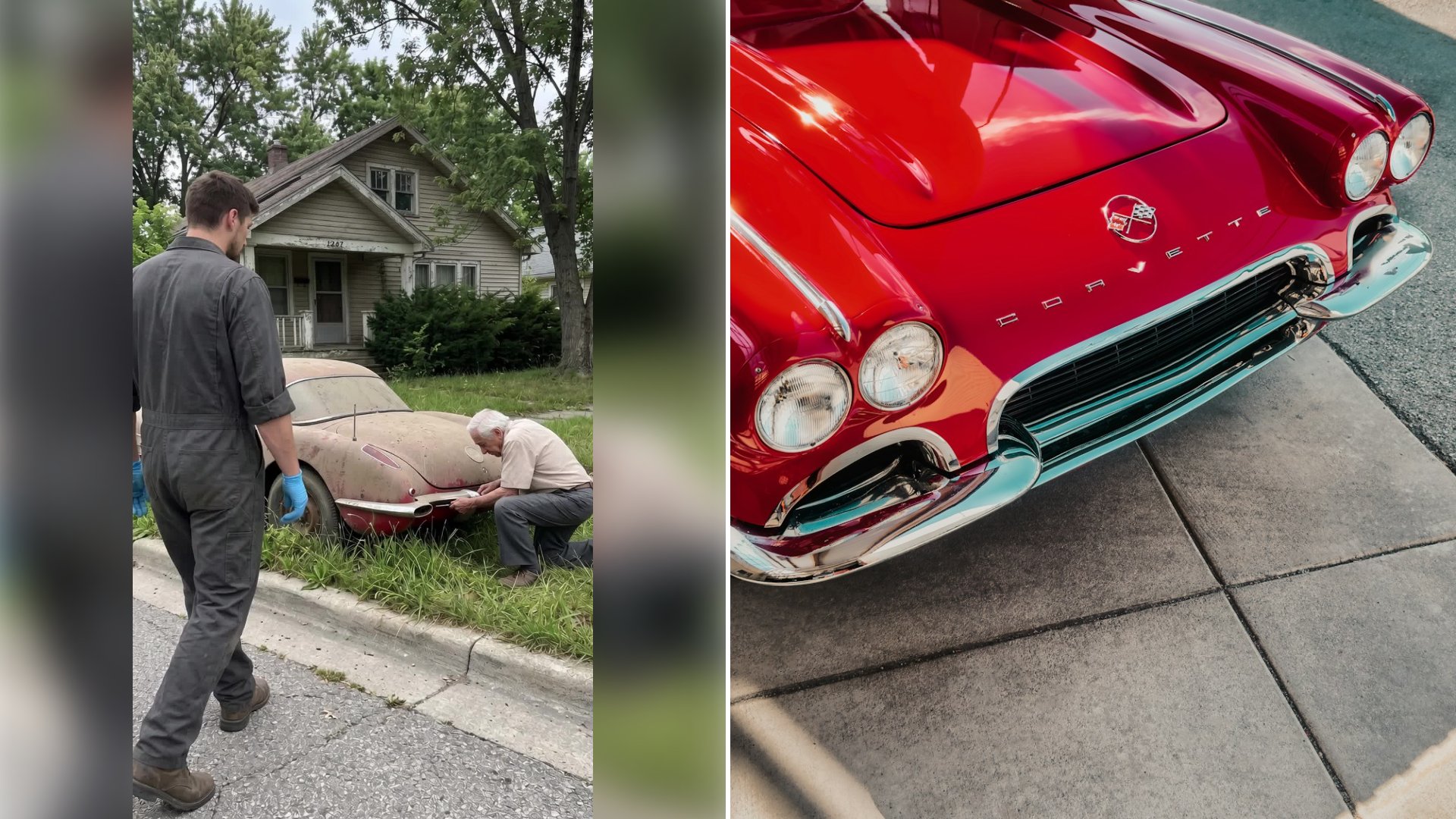
@stories.tyler posted a four minute TikTok that the creator has labeled as AI generated, and that label matters for how to read it: the picture is a single, nearly static scene with a narrator telling a story over it. The caption says a 1959 Chevrolet Corvette C1 was about to be sold for $5,000 until the narrator saw its 83 year old owner removing the license plate, and it is tagged #cardetailing #carwash #carcleaning #restoration #stories.
What is on screen never changes. In every frame sampled across the four minutes, a young man in gray coveralls and blue gloves stands beside an elderly man in a tan shirt in front of a dust covered pale car on a tree lined lawn. No cleaning, engine or soft top is shown; the story arrives entirely through the narration. It opens with the narrator asking, “Sir, why are you taking the plate off this Corvette?” The owner answers, “Because a buyer is coming for it today,” says the price is $5,000 and adds that he just needs it gone. The narrator asks him not to sell yet and to let him show what he is really selling.
@stories.tyler This 1970 Chevrolet Suburban C10 had its elderly owner desperately pulling at the stuck door… so I helped her recover her late husband’s final letter. #cardetailing #carwash #carcleaning #restoration #stories
According to the narration, the Corvette had sat untouched for more than 16 years. Its owner had parked it after a mechanical problem, expecting to repair it someday, but then his wife began needing daily care and the car became the last thing on his mind. Their savings went toward living and care expenses and the car stayed outside. After his wife passed away he could not bring himself to touch it, and when maintaining the house became too much he decided to move closer to his daughter. Several people walked away after seeing the car, until one buyer offered $5,000 and promised to remove it immediately.
The narrator then lists what he says he found: thick dirt that hid the color, an older red repaint that was heavily oxidized, an interior buried in dirt with rodent nests, a soft top gone brittle and splitting along the seams, and under the hood a 283 cubic inch V8 and four speed manual covered in grime. He says nobody knew whether the engine had compression or was even free, so he would not risk starting it before a mechanic inspected it. Chevrolet’s own small block engine timeline dates the 283 Super Turbo-Fire V8 to 1957 and says it had more displacement than the 265 so as to reach one horsepower per cubic inch.
He asked the owner to delay the sale. His crew, he says, washed away years of packed dirt, cleaned the wheels and engine bay, removed the rodent contamination, vacuumed and sanitized the cabin and trunk, cleaned the soft top and polished the red paint. He stresses that it was not a restoration and that the old repaint was far from perfect. The owner, he says, stopped beside the car and said he was about to let it go for $5,000. The narrator reminded him it still needed a complete mechanical inspection and possibly a major overhaul. The owner canceled the deal and arranged temporary storage with help from his daughter. He still plans to sell, because at 83 he does not want to begin another full restoration, but this time he would know what he owned before accepting an offer. The video closes with the narrator asking viewers whether they would sell it as it sits or spend the money to finish the restoration first.
The rodent nests in the story point to a health step that matters on any neglected car. The Centers for Disease Control and Prevention says in its guidance on cleaning up after rodents not to vacuum or sweep rodent urine, droppings or nesting materials, because that can release virus carrying droplets into the air. It says to spray them with a bleach solution of 1.5 cups of household bleach per gallon of water, made fresh, or an EPA registered disinfectant until very wet, let it sit for 5 minutes or as the label directs, wipe it up with paper towels and wear rubber or plastic gloves. For a closed space it says to open all doors and windows for 30 minutes before cleaning.
More from Steel Horse Rides
- Detailer Announces He Is Building a 90s Truck, Then Has a Sun Faded Black Chevy Z71 Chained to a Shop Rack and Cleans Its Maroon Interior With a Brush and a Hot Water Extractor
- Mobile Detailer Clay Bars, Polishes and Ceramic Coats a 51 Year Old FMC Motorhome in a Mobile Home Park, and the Owner Who Paid a $100 Tip Looks at the Finish and Says Wow Yes Sir
- Owner Says the Seats in a 1986 Toyota 4Runner Smell Exactly How You Would Imagine, Then Pulls Out the Carpet and Asks Followers to Pick the Color for the New Kit