
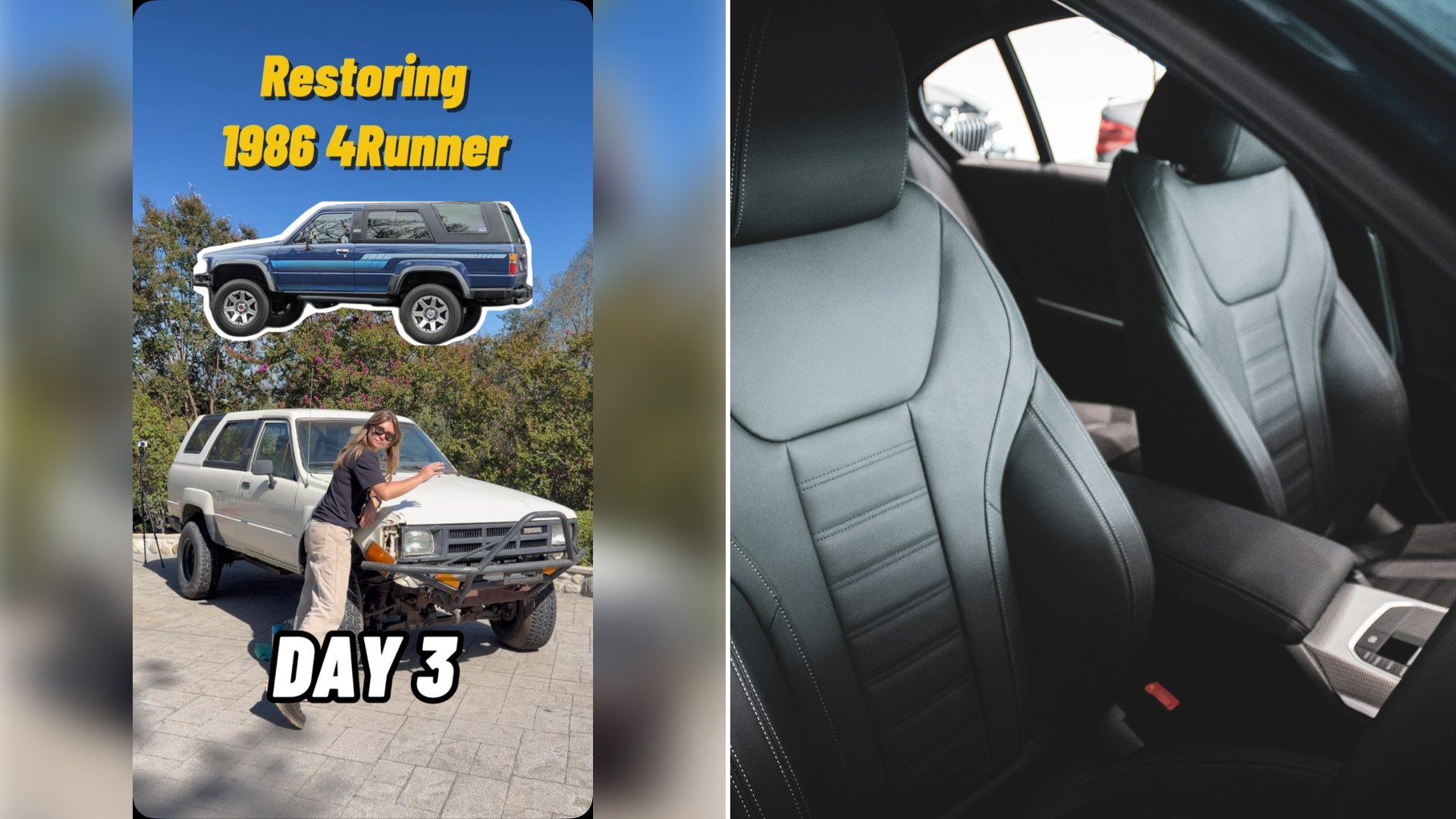

The rear bench comes out of the white 1986 Toyota 4Runner in one awkward armful, and the caption over the clip reads “these seats smell exactly how you would imagine.” That line sets the tone for day 3 of a restoration series posted by @nicoandy on Instagram, where the title card reads “Restoring 1986 4Runner” and the job for the day is the interior.
By the end of the 85 second video, the old carpet is lying in pieces on the paving stones, the seats have been deep cleaned, and the owner is asking followers to choose the color of the replacement carpet. “The nasty carpet and seats are out! What carpet color should I go with?” the caption reads.
The video opens on the stripped cargo area with “DAY 3” written over the bare, ribbed metal floor, then works back through the day. “We’re gonna deep clean all the seats,” the captions announce as the owner kneels beside a front bucket seat with a vacuum hose. Inside the truck the owner sits on the floor unbolting the rear seat, then stops at the shifters to hold a small knob up to the camera. “This is the original emblem for the transfer case shifter,” the caption reads.
Then the carpet comes out. The owner drags the floor covering back from the front footwells, and the camera pans across what had been hiding under it. “Here’s how we’re looking,” the caption says over a floor spotted with orange rust and red residue along the seams, with a purple bundle of wiring running across it. On a close shot of one stained patch near the seat mounts, the red layer is labeled “a carpet glue or something.”
Outside, the old carpet is laid flat on the driveway in its molded shape, matted and stained dark across the footwells and torn at the edges. A chart of carpet swatches pops up on screen, running from black and several grays through blues, browns, reds and greens. “I could do the original gray,” the captions read, and a second shade is named as one that “could work,” leaving the final choice to followers.
“Last thing for today is cleaning these seats,” the next caption says. The owner sprays a front seat, then, in the owner’s words, “went in with this mini carpet extractor,” a small green machine with a hose and a clear tank. “In the extractor you can use any type of fabric cleaner mixed with water if your seats are as dirty as mine,” the caption adds, over a close shot of that tank full of brown, foamy water. For the bench cushions, an on screen graphic shows a full size carpet cleaner.
The finishing touches follow. With a seat tipped onto cardboard and the fabric masked off with green tape, the owner “went over the metal parts with some spray paint,” leaving the brackets and the seat adjuster freshly black. “It’s all about the details guys,” the caption reads. “I am planning to reupholster these seats at some point,” the owner writes, “but that won’t be for a while,” as an inset photo of an interior with green plaid seats appears beside them.
The video closes on what comes next. “For the interior I have to order the carpet kit,” the owner writes, standing in the empty cab, and “let me know what color you guys think I should go with.” Over the center console and seat belt buckles sitting on the rusty floor, the caption adds, “I’m also gonna repaint all the plastic trim.” While waiting for those parts to be delivered, the owner plans to “refresh the front end.” The last frame shows the 4Runner in the driveway with “follow for day 4!” and “episode 4 dropping tomorrow stay tuned.”
The truck itself comes from the 4Runner’s first generation. According to Toyota’s pressroom history of the model, the 4Runner made its debut in 1984, was based on the Hilux pickup, and had a fiberglass top over the cargo area that could be removed. One commenter asked exactly that, whether the top comes off; the video itself does not show it removed.
Several commenters landed on the same tip: with the carpet already out, lay sound deadening on the bare floor before the new kit goes in. One said that treating the doors while changing speakers had already made a big difference in their own vehicle. On the plan for the plastic trim, another commenter urged the owner to dye it rather than paint it, arguing that paint hides the grain of the plastic. A third pointed out that the owner was doing all of this without gloves.
That last point is worth taking seriously with any old carpet. The video does not say the carpet was moldy, but the U.S. Environmental Protection Agency’s guide to mold says porous materials such as carpet “may have to be thrown away if they become moldy,” and for cleanup it recommends long gloves reaching to the middle of the forearm, goggles without ventilation holes and, to limit what you breathe in, an N95 respirator.
If you are about to pull the interior out of an older truck the way the owner did, photograph each seat mount and seat belt anchor before you unbolt anything, and bag the bolts for each seat separately with a label. Small original parts like that transfer case emblem should go in their own bag, because they are the pieces that are hardest to replace.
Once the floor is bare, check it before you plan anything else. Press on orange spots with a screwdriver to tell surface rust from metal that has gone soft, look closely at the seams and around the seat mounts. If the carpet came out damp, get the floor and anything wet dry quickly; the EPA advises drying water damaged areas and items within 24 to 48 hours to prevent mold growth. Old adhesive like the red layer found under this carpet should come off before any sound deadening or new carpet goes down.
Before ordering a carpet kit, confirm it is made for your model year and body style, and keep the old carpet as the owner did, laid flat, so you can compare the shape and the cutouts when the new one arrives. Test fabric cleaner on a hidden spot of the seats, and let cushions dry fully before they go back in. If you are refinishing plastic trim, try your dye or paint on one hidden piece first and see how it treats the grain before you commit to the whole cab.
More from Steel Horse Rides
- Restorer Strips a Dented Barn Find Toyota Sera for Months of Bodywork and Paint to Keep It Factory Standard Then Declares It Manufactured by the Japanese and Perfected by the British
- Owner of a Custom 1990 Honda Accord That Flooded in Storage Says Seeing It Dirty Is Depressing, Then Sees the Sonic Blue Paint and Interior After a Week of Detailing
- Owner Jokingly Calls His Money Losing Vintage Pickup Restoration an Appreciating Asset as He Admits Pouring Fifteen Thousand Dollars Into a Three Thousand Dollar Truck