

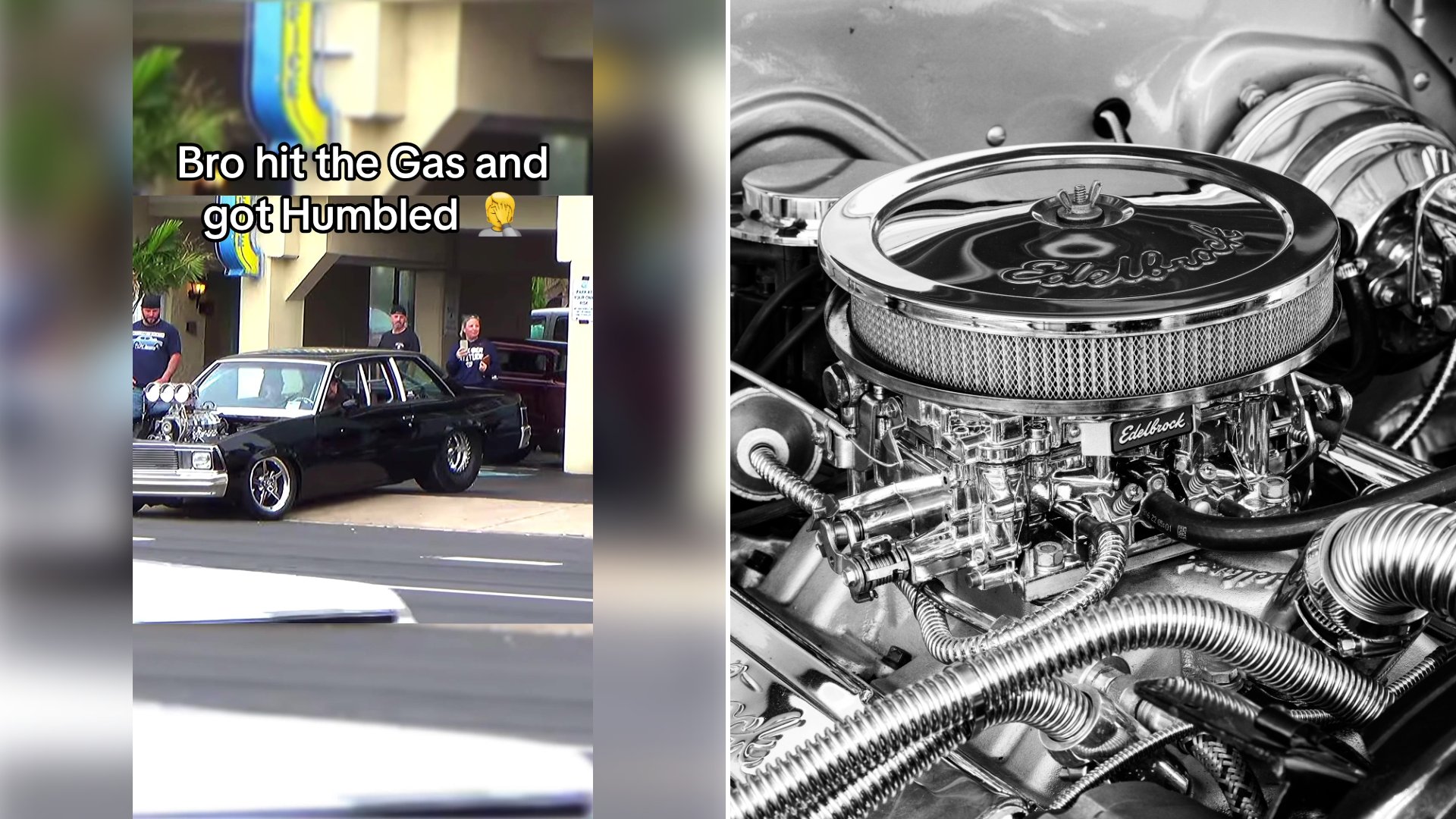
A short clip from the TikTok account @carscoffeeandmischief, which shows as Cars Coffee and Mischief, follows a black classic sedan with chrome engine hardware rising above its hood as it rolls out from under a covered hotel entrance. A few people stand near the entrance watching it go. The caption reads “The moment his horsepower called in sick,” followed by hashtags for musclecar, fail, fullsend, burnout and the account’s own name.
One line of on screen text stays across the whole video: “Bro hit the Gas and got Humbled.” That line and the caption are the only words attached to the clip. Nothing is spoken in a way that shows up as readable captions, so everything below comes from what the frames show.
After the opening shot the camera swings away and back as traffic crosses in front of the lens, including a white SUV, a dark sedan and a maroon vehicle. The black sedan comes into view again along a wide road beside a pale, multistory hotel building and a white fence, with onlookers standing on the sidewalk and on an upper balcony.
The ending is the part the caption is pointing at. In the last seconds the sedan sits in the roadway beside a white fence against a teal wall, and two men are bent behind it pushing it along the pavement. A dark pickup truck passes between the camera and the group. The clip stops there. It does not show the engine being restarted, it does not show what failed, and the creator does not say.
That gap matters, because a gasoline engine only runs when several things keep working together. The U.S. Department of Energy’s Alternative Fuels Data Center describes the basic chain: a fuel pump draws fuel from the tank and pushes it through the fuel line to the fuel injection system, the fuel mixes with air in the engine, and a spark plug fires to ignite the mixture. An electronic control module manages the fuel mixture and the ignition timing. If any link in that chain stops doing its job, the engine quits, and from the outside a fuel problem, an air problem and a spark problem can look exactly alike.
What a driver should do once the engine is out is something the video shows in a rough form. The Federal Highway Administration’s field operations guide for safety and service patrols says a vehicle blocking a lane or sitting in a hazardous spot should be moved before any assistance or repair begins, and that the vehicle should be relocated under its own power or by pushing it to a safe location when possible. The same guide says repairs should be attempted only after cones are placed behind the vehicle along the edge line.
Those instructions are written for trained patrol operators who work with push bumpers, arrow panels and traffic control. The two men in the clip push on foot with a pickup passing close by and no cones visible around them. For a driver in the same position, the guidance points to the order of steps: get the car off the travel lanes first, and only then start looking under the hood.
Ready.gov, the federal emergency preparedness site, adds a short list of what belongs in a car before a day like this one: jumper cables, a reflective triangle or flares, a phone charger and a blanket. Of those, the reflective triangle or flares are the items that make a stopped car easier for other drivers to see. The same page says that if a car becomes hard to control, the driver should pull over, stop the car and set the parking brake.
The clip is a quick, 25 second moment from a stretch of road where people were already watching, and the creator’s own label for it is a fail. The useful part for owners of any car with a built or modified engine is the checklist hiding behind the joke: know that fuel, air and spark all have to be working, keep the triangle and jumper cables in the trunk, and plan for how the car gets out of the lane if it stops. The video shows the push, not the diagnosis.
More from Steel Horse Rides
- Builder Starts a 1996 Chevrolet Impala SS for the Very First Time After a Full Year of Supercharger Work and Shares the Shops Behind the Build and Why It Matters
- Owner Shows Off a Visibly Twin Turbocharged Audi R8 and Why Adding Forced Induction to Its Naturally Aspirated V10 Is a Bigger Job Than It Looks
- Mobile Mechanic Drops the Oil Pan on a Car the Customer Says Just Shut Off on the Highway With No Unusual Noises, and It Comes Down Full of Broken Engine Parts