

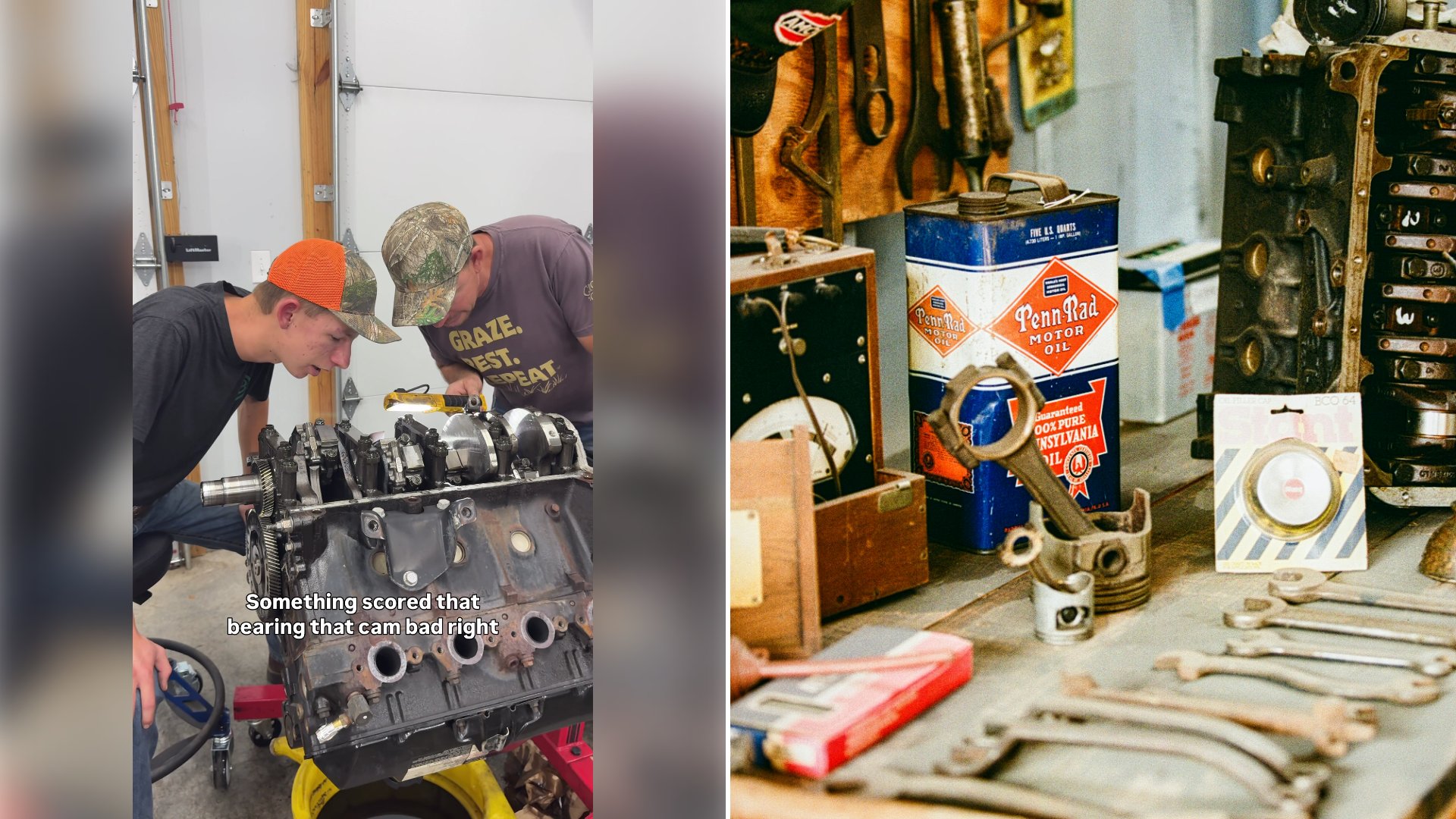
A young mechanic pulls his father over to the bench where he has been tearing down a diesel engine, eager to show off the progress. The video, posted by @stuartfarmstead, follows the two as they go piece by piece through the teardown until the camshaft comes out and something about it stops both of them cold. What started as a proud show-and-tell moment turns into a real diagnostic session, with father and son leaning in over the bench trying to figure out exactly how bad the damage is.
The camshaft is one of the most unforgiving parts in any engine. It controls exactly when the valves open and close, and it does that job under constant friction load for hundreds of thousands of revolutions. When a cam lobe or its corresponding lifter wears unevenly, the timing of that valve event drifts, and the engine starts losing power long before anyone hears a warning noise. Catching it mid-teardown, the way this father and son did, is actually the best-case scenario — it means the problem gets fixed before it chews through the rest of the valvetrain.
@stuartfarmstead
Camshaft wear in diesel trucks has a few common root causes, and most of them trace back to lubrication rather than bad metal. Skipped oil changes, extended intervals with cheap oil, or a worn oil pump can all starve the cam lobes of the thin film of oil they depend on. Once that film breaks down, metal-on-metal contact starts flattening the lobes, which is exactly the kind of wear pattern that shows up as pitting, scoring, or a lobe that no longer has its proper lift profile. High-mileage diesels that tow heavy loads see this more often, since sustained load keeps the valvetrain under higher spring pressure for longer stretches.
The financial stakes on a diesel rebuild are a big part of why this kind of discovery hits hard. A basic diesel engine rebuild, covering a new camshaft, lifters, bearings, and gaskets, typically runs somewhere between four thousand and nine thousand dollars at a shop depending on the displacement and whether the block needs machining. Doing it in a home garage, like this father-son team appears to be doing, can cut that bill significantly, since labor is usually the biggest line item on a professional invoice. Parts alone for a quality aftermarket cam and lifter set can still run several hundred to over a thousand dollars depending on the application.
What makes this clip resonate isn’t just the mechanical problem, it’s the setting. A father watching his son work through a real diagnostic puzzle, in real time, with no script and no guarantee of a clean answer, is the kind of moment that a lot of viewers recognize from their own garages. Whether the fix ends up being a simple lifter swap or a full valvetrain replacement, the two of them now have a much clearer picture of what the engine actually needs before it goes back together.
More from Steel Horse Rides
- Mobile Mechanic Says a Dealership Blamed a Timing Chain for Up to Five Thousand Dollars, Then He Pulls a Clogged VVT Solenoid and Watches Every Camshaft Code Disappear
- Mechanic Shows How One Leaking Injector Dumped Fuel Into Cylinder One of a 76,000 Mile Ferrari F430, Scored the Cylinder Wall and Turned Into a 43,000 Dollar Rebuild
- Mobile Mechanic Drops the Oil Pan on a Car the Customer Says Just Shut Off on the Highway With No Unusual Noises, and It Comes Down Full of Broken Engine Parts