

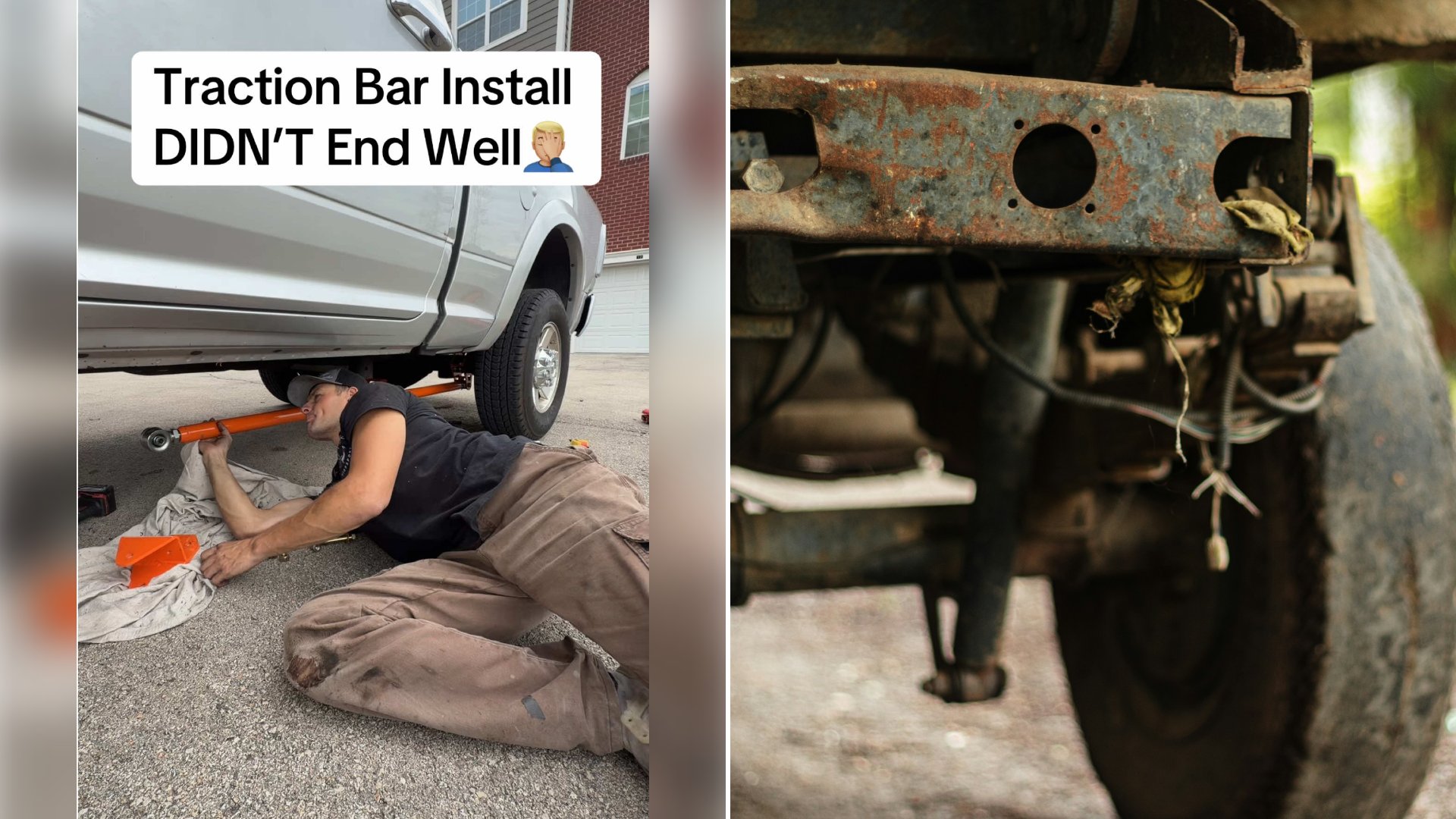
A video making the rounds shows a truck owner attempting what should have been a straightforward traction bar installation, only to end up with visible damage to his truck’s frame by the time the job went sideways. The footage captures the moment things went wrong and the owner’s honest reaction to it, before the clip turns into him asking other truck owners and mechanics online for advice on how to actually fix what he’d just done to his own vehicle.
The video comes from @zac.lucarz, a creator who documents truck modifications and the occasional DIY mishap that comes with doing the work yourself instead of paying a shop.
@zac.lucarz
Traction bars are generally marketed and sold as one of the more beginner-friendly suspension upgrades a truck owner can tackle in a home garage, designed to control axle wrap under hard acceleration and reduce wheel hop, particularly on leaf-sprung trucks that see towing or performance use. Most kits bolt to existing mounting points on the frame and axle, which is exactly why they’re pitched as a weekend bolt-on job rather than something that requires a lift and a full day at a shop. That reputation for simplicity is also exactly why a mistake during installation catches people off guard, since the job looks easy right up until a bracket doesn’t line up the way the instructions suggest or a bolt gets torqued or drilled in the wrong spot.
Frame damage during a traction bar install usually comes down to one of a few common mistakes: drilling a mounting hole in the wrong location or at the wrong angle, over-tightening a bracket against sheet metal that wasn’t designed to take that kind of clamping force, or using a jack or pry bar against the frame rail itself to force stubborn components into alignment. Truck frames are built to handle enormous loads along their intended stress paths, but they’re far less forgiving of a stray drill bit, a bent bracket, or a poorly placed pry point, which is exactly the kind of damage that turns a two-hour bolt-on job into a trip to a frame repair shop.
The cost of fixing frame damage varies enormously depending on severity. A minor issue, like a mis-drilled hole that needs to be properly plated, filled, or relocated, can often be handled by a competent welder for a relatively modest shop bill. More significant damage, such as a bent or cracked frame rail, pushes costs dramatically higher, and in more serious cases can run into the thousands of dollars once a shop has to straighten, reinforce, or in the worst scenarios replace a damaged section of frame entirely. Insurance and warranty coverage typically won’t help here either, since this kind of damage stems from a DIY modification rather than a covered mechanical failure or collision.
What makes this video resonate beyond truck enthusiasts specifically is the honesty of it. Plenty of DIY car content shows the clean install and the finished product; far fewer creators are willing to show the moment a simple job turns into a mistake they have to own, let alone ask total strangers for help fixing it. That kind of transparency is exactly what turns a routine install video into something weekend mechanics actually relate to, since almost everyone who’s wrenched on their own vehicle has a story just like this one buried somewhere in their own garage.
More from Steel Horse Rides
- Nephew Who Gets His Uncle’s 1990 Ford Bronco if He Can Make It Run Finds Oil on the Dipstick, Then Drops the Fuel Tank and Calls It the Worst Thing He Has Done on a Car
- Mechanic Pulling the Fan Out of an Engine Bay Knocks It Into the Radiator, Then Watches Green Coolant Stream Down the Core and Says I Guess We’re Draining the Radiator
- Mobile Mechanic Drops the Oil Pan on a Car the Customer Says Just Shut Off on the Highway With No Unusual Noises, and It Comes Down Full of Broken Engine Parts