

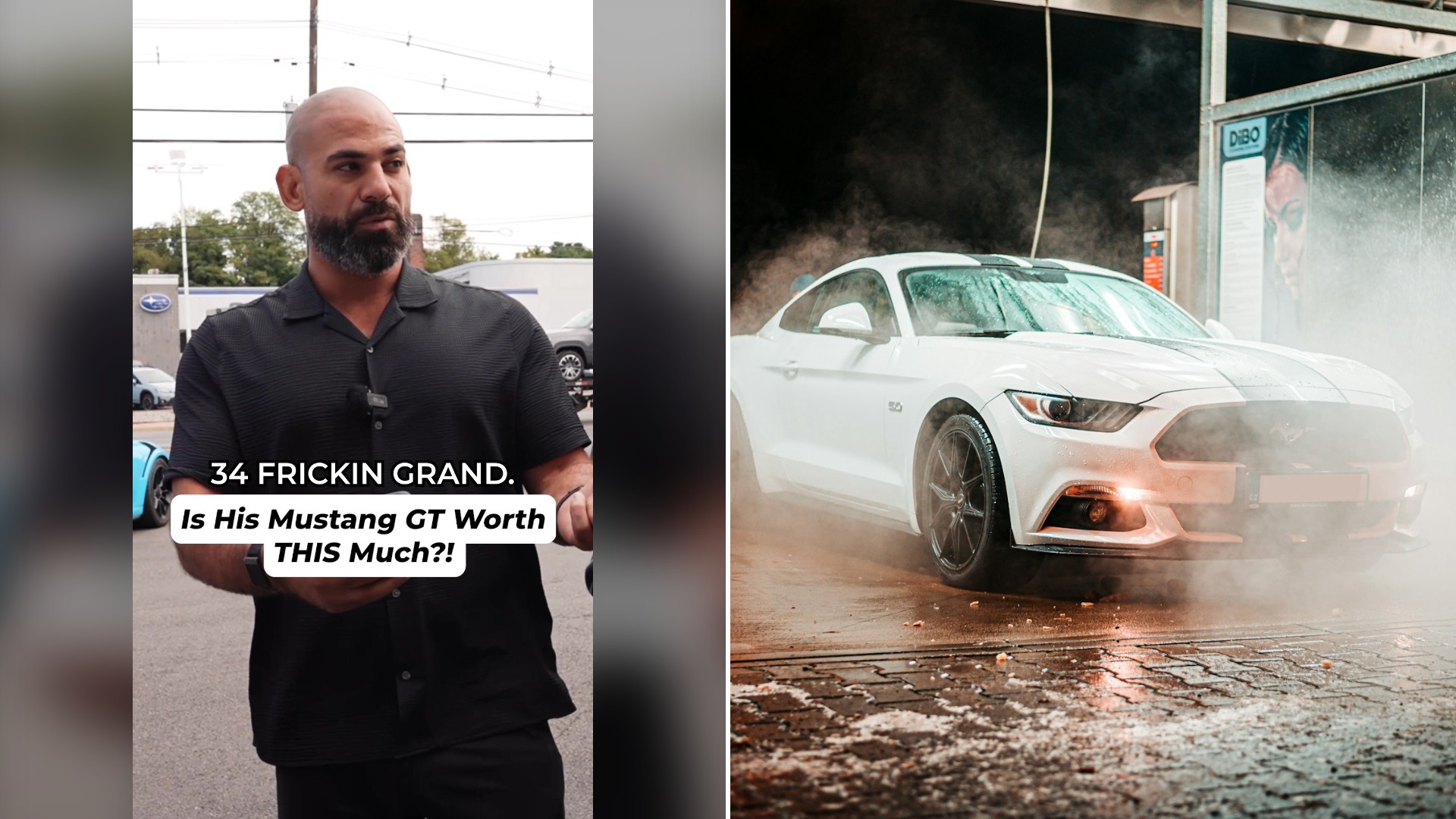
A car dealer and a client squared off over the trade-in value of a Ford Mustang GT, and the whole exchange played out right in the dealership parking lot. In a video posted by @georgejsaliba, the dealer walks around the Mustang, pointing out details that factor into the number he’s prepared to offer, while the client pushes back on whether the figure reflects what the car is actually worth. The back-and-forth frames a simple question that plays out in dealership lots across the country every day: is the asking price fair, or is someone leaving money on the table?
@georgejsaliba
Trade-in negotiations are rarely as simple as checking a book value and writing a check. Dealers calculate what’s called a trade allowance, which is almost always lower than what the car would fetch in a private sale, because the dealer has to recondition it, market it, and still make a margin before it goes back out the door. For a performance car like a Mustang GT, that math gets more complicated. Modifications, aftermarket parts, and non-stock components can cut both ways: some buyers pay a premium for a well-documented build, while a dealer evaluating a trade-in may view the same upgrades as a liability, since they complicate reconditioning and can scare off buyers who want a factory-stock car.
Mileage, service history, and visible wear all play into the number a dealer puts on the table, but so does something harder to quantify: how fast the dealer thinks they can sell it. A Mustang GT in a popular color and trim with clean records might move in days, which makes a dealer more willing to offer closer to market value. A car with a thin paper trail, unusual modifications, or a less desirable configuration can sit on a lot for months, and that uncertainty gets priced into the trade offer as a built-in discount.
For sellers trying to figure out whether a trade offer is fair, the standard advice is to get a second opinion before stepping onto the lot. Pulling comparable listings for the same year, trim, and mileage on sites like Autotrader or Cars.com gives a real-world sense of what similar cars are actually selling for, not just a generic book value. KBB and Edmunds both offer trade-in estimate tools, and running the numbers on more than one of them tends to produce a workable range rather than a single number to anchor on.
It also helps to separate the trade-in value from the private-party value early in the conversation. Industry estimates commonly put trade-in offers somewhere between 10 and 20 percent below what a private buyer would pay, since the dealer is absorbing the reconditioning cost, the marketing cost, and the risk of the car not selling quickly. That gap is the price of convenience: a trade-in closes the deal in an afternoon with no listing photos, no strangers test-driving the car, and no waiting for a buyer to show up with financing in hand. Selling privately can net more money, but it takes more time and more effort, and not every seller wants to deal with that trade-off.
Muscle cars and pony cars like the Mustang GT carry their own quirks in this calculation. Enthusiast demand can push certain model years and trims well above what a generic valuation tool suggests, especially for cars with desirable options like a manual transmission, a performance package, or low production numbers. A dealer unfamiliar with that enthusiast premium may undervalue a car that would actually draw strong interest from a buyer who specifically wants that configuration. That’s part of why getting a trade offer from more than one dealer, or at least cross-checking it against enthusiast forums and marketplace listings, can reveal whether an offer is in line with the market or simply convenient for the dealer’s bottom line.
Whatever number the two sides land on, moments like this are a reminder that a trade-in offer is a starting point for a conversation, not a final verdict on what a car is worth. Doing the homework ahead of time, knowing the private-party comps, and being willing to walk away if the number doesn’t add up are the tools that put a seller in the stronger position at the negotiating table.
More from Steel Horse Rides
- Buyer Risked Five Hundred Dollars On A Mercedes GL450 Worth Close To Fifteen Thousand Dollars And Is Revealing Every Hidden Mechanical Flaw One By One
- Weekly Bank Repo Auction Just Sold An Entire Running Car For Only Three Hundred And Fifty Dollars And The Crowds Reaction Says Everything About How Shocked They Were
- Pinstriper Is Still Applying Real Gold Leaf By Hand The Exact Old School Way Traditional Craftsmen Did It Decades Ago On A Classic Car Engine Turned Panel