

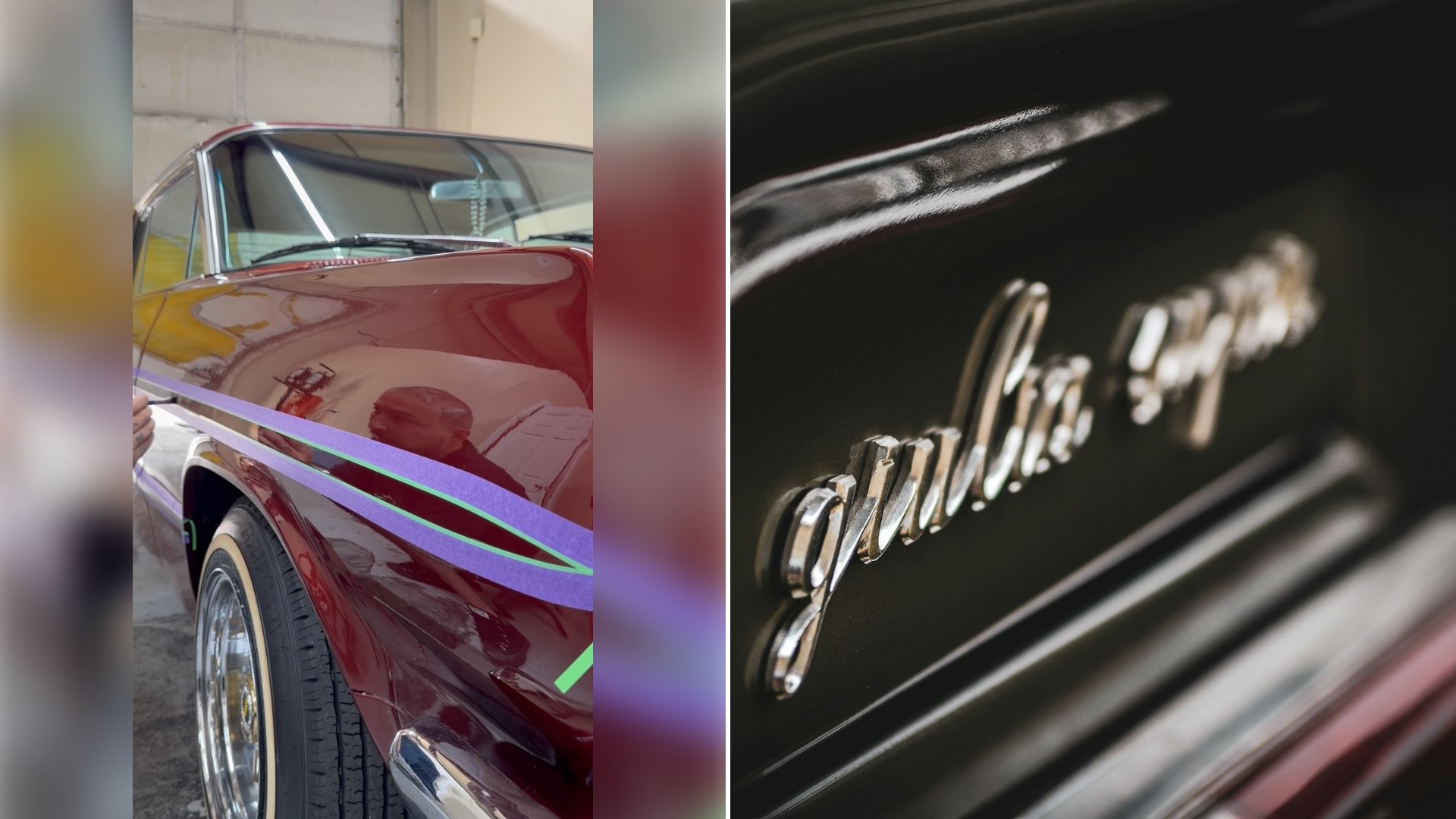
A video from @picasso_pinstriping walks through every step of laying gold leaf onto an engine-turned panel, the caption breaking down the process like a recipe: “From size to shine. Laying down some engine-turned gold leaf the old-school way. Size, gold leaf, burnish, engine turn, the reveal. That final tape pull never gets old. Wait for the finish. Would you run gold leaf on your ride?” The clip pulled in 41,700 likes, 155 comments, and 455 shares.
Hand-applied pinstriping on vehicles traces back to 19th-century horse-drawn carriages, where brushes and striping quills laid down thin, elegant lines on wooden panels long before the automobile existed. The craft migrated straight onto early car bodies and exploded in popularity in the early 20th century as custom builders, hot rodders, and motorcycle enthusiasts adopted it as a signature finishing touch. The two names most associated with the golden age of the craft, Kenny Howard, known as Von Dutch, and Ed “Big Daddy” Roth, turned pinstriping and related gold leaf work into an art form synonymous with custom car culture, and the techniques they popularized, sizing, leafing, and burnishing by hand, are essentially the same ones this video walks through step by step.
Gold leaf specifically survived as a craft because nothing else replicates its particular shine and depth once it’s burnished onto a surface. Vinyl graphics and computer-cut designs took over a large share of automotive striping work decades ago because they’re faster and cheaper, but gold leaf resists that kind of shortcut entirely: it has to be applied by hand, in thin sheets, over a tacky sizing layer, then burnished down and often engine-turned afterward for texture, a sequence that simply can’t be automated or printed. That’s exactly why the finished reveal in a video like this one draws attention; the final tape pull exposes a surface no machine produced.
What keeps the craft alive today is less about nostalgia and more about scarcity of skill. Pinstriping shops that still do this work by hand are a shrinking category, competing against vinyl and digital alternatives that most shops default to because they’re faster, which makes a shop actually documenting the full size-to-shine gold leaf process worth watching for reasons beyond the car itself. It’s a demonstration that a dying craft still has practitioners willing to do it the slow, correct, original way.
More from Steel Horse Rides
- Owner Says the Seats in a 1986 Toyota 4Runner Smell Exactly How You Would Imagine, Then Pulls Out the Carpet and Asks Followers to Pick the Color for the New Kit
- Mechanic Pulls a Snapped Crankshaft Apart in Two Pieces on the Shop Bench, Says the Car Drove In Like That and Jokes the Customer Only Wanted an Oil Change
- Narrator of a Repair Clip Says a Car That Shook Every Time the Owner Hit the Gas Had an Engine Mount Cracked Clean in Half, Then Explains Why the Impact Wrench Is Not the Last Step