

For two years, a 1971 Saab 96 kept popping up on one man’s Facebook feed. It sat outside, rusting quietly, until the owner finally came down on the price. “This thing has caught my eye for the past, I think, two years,” he says.
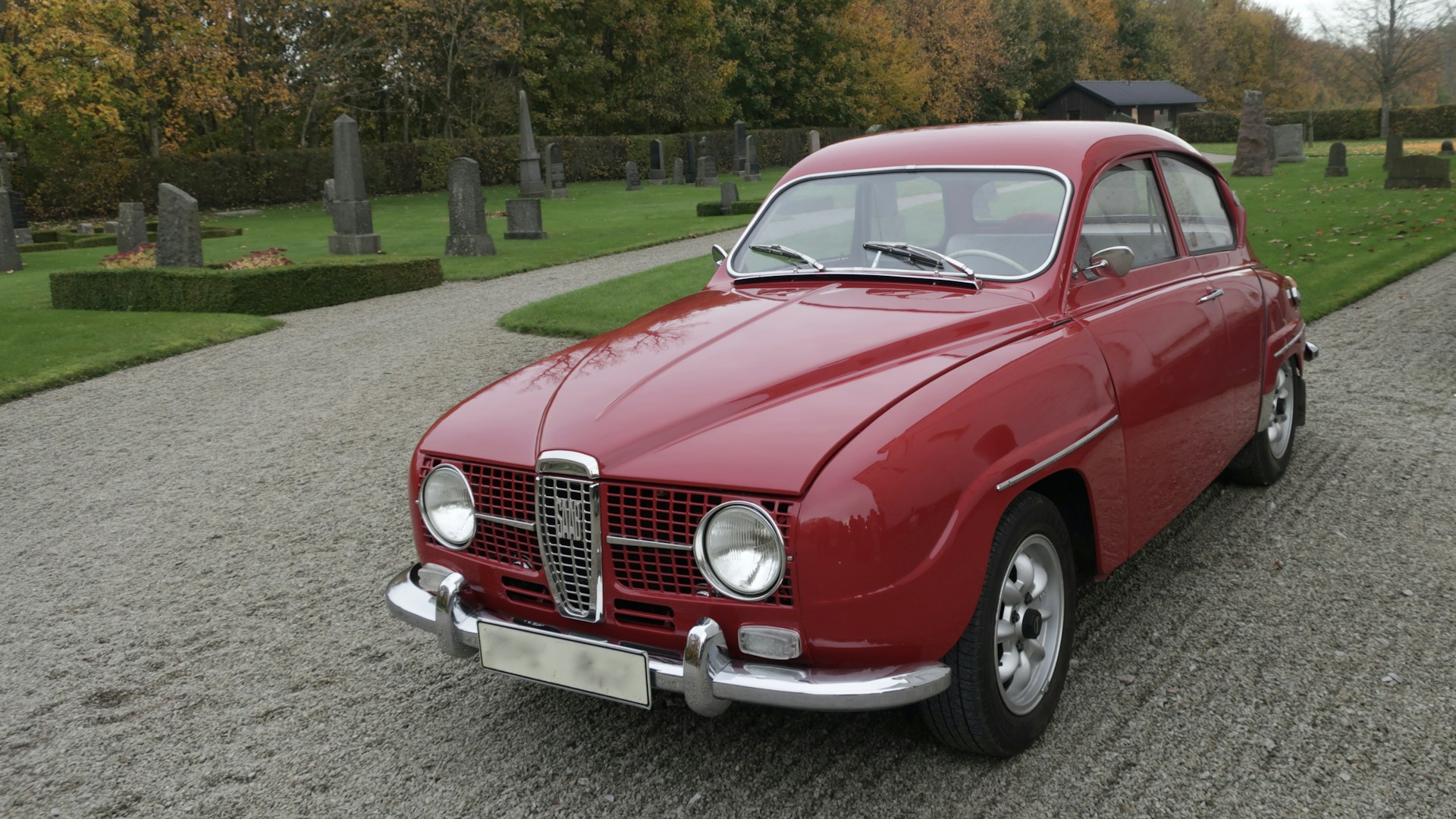
He paid $800, hauled it home on a trailer for the first project on his new 2vintage channel. The goal was simple: get it running again.
An $800 Saab That Will Not Roll Once It Reaches The Garage
The seller threw in a free snowblower, and the car came with its title and keys. He told the buyer it had been parked because the brakes went out, and he believed he had gotten it from the original owner in Red Granite.
Loading the Saab went smoothly with a tractor, but unloading it did not. The car refused to roll. One rear wheel was frozen solid, and the shifter was stuck in reverse.
It took a hammer, a rubber mallet and a fresh bottle of penetrating oil to break the wheel free. “Very rarely do I have to break out the big gun,” he says. Then the little Saab finally rolled off the trailer and straight into the garage.
Only 14,000 Were Imported To The US, And This One Is Still Almost Complete
The Saab is a quirky little car, and he loves the history. The 96 was built from 1960 to 1980. It started with a three-cylinder two-stroke engine, and in 1971 it switched to a four-cylinder 1700cc Ford engine making about 65 horsepower.
The car has a column-mounted four-speed with a freewheel mechanism. Going downhill, it does not engine brake. It spins freely, like a bike. A little lever on the dash turns it on or off.
Only about 14,000 of these cars were imported to the US, which is why finding a complete one is hard. “A lot of people modify these bigger engines in them,” he says. “It’s just really hard to find a complete one that doesn’t have a lot of rust and isn’t complete junk.”
The model got famous in rallying. A driver named Erik Carlsson won the Monte Carlo Rally and the RAC Rally in the same model, which made the little Saab famous. The cars are not fast, but they are nimble and very strong, with frames built to take rollovers.
Cracked Windshield, Mouse Nests And Leather Seats Under The Leaves
The car was in better shape than he expected. It had a few dents, a broken windshield that let rain in for years, and a front end that looked as though it had been hit. The chrome on the bumpers was excellent, and the grille looked good.
The rust was real, and there were holes in the floor. Inside, the seats were covered with leaves and moss, and there was a mouse family in residence. Under the dirt, though, the seats were leather, and one was in good shape.
The odometer showed 21,181 miles. Everything opened, from the gas filler to the trunk, and even the windows worked. “Everything’s moving,” he says. “Better than expected.”
He pulled out the seats, vacuumed out the rust and spiders and cleaned up the engine bay. The engine looked complete, and all the plugs were in place.
A Burned Fuse, A White Wire And A Slow Turn Of The Engine: “That Is Huge”
With the car cleaned out, he started on the electrics. One fuse was burned out, and he bypassed it for now. With a jumper pack hooked up, the wipers and the tail lights came on. “I can’t believe that still works,” he says.
The starter would not crank, though. Power was reaching the solenoid, so he checked the ignition and found a white wire disconnected under the switch. He reconnected it, and the starter worked, though the car was stuck in reverse. When the shifter finally popped into neutral, the engine turned over slowly.
“It does in fact turn over. That is huge,” he says. “So this thing is not locked up. I thought for sure it would be locked up.”
The oil on the dipstick was black but up to the full line, which told him the block was probably not cracked. The distributor points looked clean, and the spark plugs came out easily, with one looking almost brand new. The cylinder walls had good crosshatching, but there was some carbon, a little rust and a chip on one piston.
“I Feel Like A Complete Idiot” When The Missing Wire Finally Shows Up
He cranked the engine over and checked for spark. There was none. He grounded a plug on the other side, then checked each one, and still nothing.
Then he spotted it. “Wow. I feel like a complete idiot,” he says. “We are missing the wire going from the coil to the distributor cap. Why did I not catch that before?”
The wire carries the spark from the coil to the distributor, so without it the engine could never have fired. He grabbed a wire off an old bike and swapped the boot for a better style. He saw spark on three cylinders.
The last one was dead, so he swapped plugs, then moved the wire, and found the plug wire was chewed through. He measured the old wire and found zero resistance, then fitted a new one that read about 2.87 kilo-ohms. “Oh yeah. Look at that,” he says. Spark on all four cylinders.
A 50 PSI Compression Reading Brings The Next Hurdle
He tested compression next. For this engine, he says, you want to see over 120 PSI in each cylinder, and a good number is about 150. The first reading was just 50 PSI.
A squirt of oil in the cylinder raised it to 100 PSI, which suggests stuck rings. The other rear cylinder read nearly 110. The front two cylinders were weaker, at about 50 and then 60 after oil, and then 110 on a retry.
His plan is to soak the cylinders in penetrating oil overnight. He also wants to check the valve covers and the valve clearances in case a tight valve is part of the problem.
Next up are pulling the carburetor and getting fuel to it. His guess is that the car sat for more than 20 years. “The interior was just horrible,” he says.
What To Check Before You Buy A Car That Has Sat For Years
This little Saab is a good reminder that not every dead car is a lost cause. Here are some lessons from the garage.
- Check the oil first. Clean oil at the full line is a good sign that the block is not cracked.
- Pull a spark plug and look in with a camera. Crosshatch marks on the cylinder wall are a good sign.
- Do a compression test, and squirt a little oil in a weak cylinder. If the number jumps, stuck rings are a likely cause.
- Check for spark early. A missing or chewed wire can look like a dead engine.
- Measure the old wire with a meter if it looks suspicious. Zero resistance in a plug wire is a red flag.
- Expect rust and holes in the floor on any car that sat outside for years.
For $800 and a day of work, this Saab went from frozen and silent to spinning smoothly with spark in every cylinder. It is a cheap lesson that the simplest problem, like a missing wire, can hide in plain sight while you chase the big ones.
More Stories You May Like
- 2027 Chevy Colorado Gets 350 HP From Its Turbo Four, But The ZR2 Bison Sinks To Just 15 MPG Combined, The Worst In The Lineup
- Junkyard Expert Compares Two Dodge Chargers From 66 And 67, Spots The Year From One Brake Part, And Explains Why The 8 3/4 Rear Axle Handles About 600 Horsepower
- Mystery V8 In A Seized 1965 GTO Refuses To Turn After A Week Of Soaking, Then ATF And Old Timer Tricks Finally Free It And The Owner Yells She Freaking Turns