

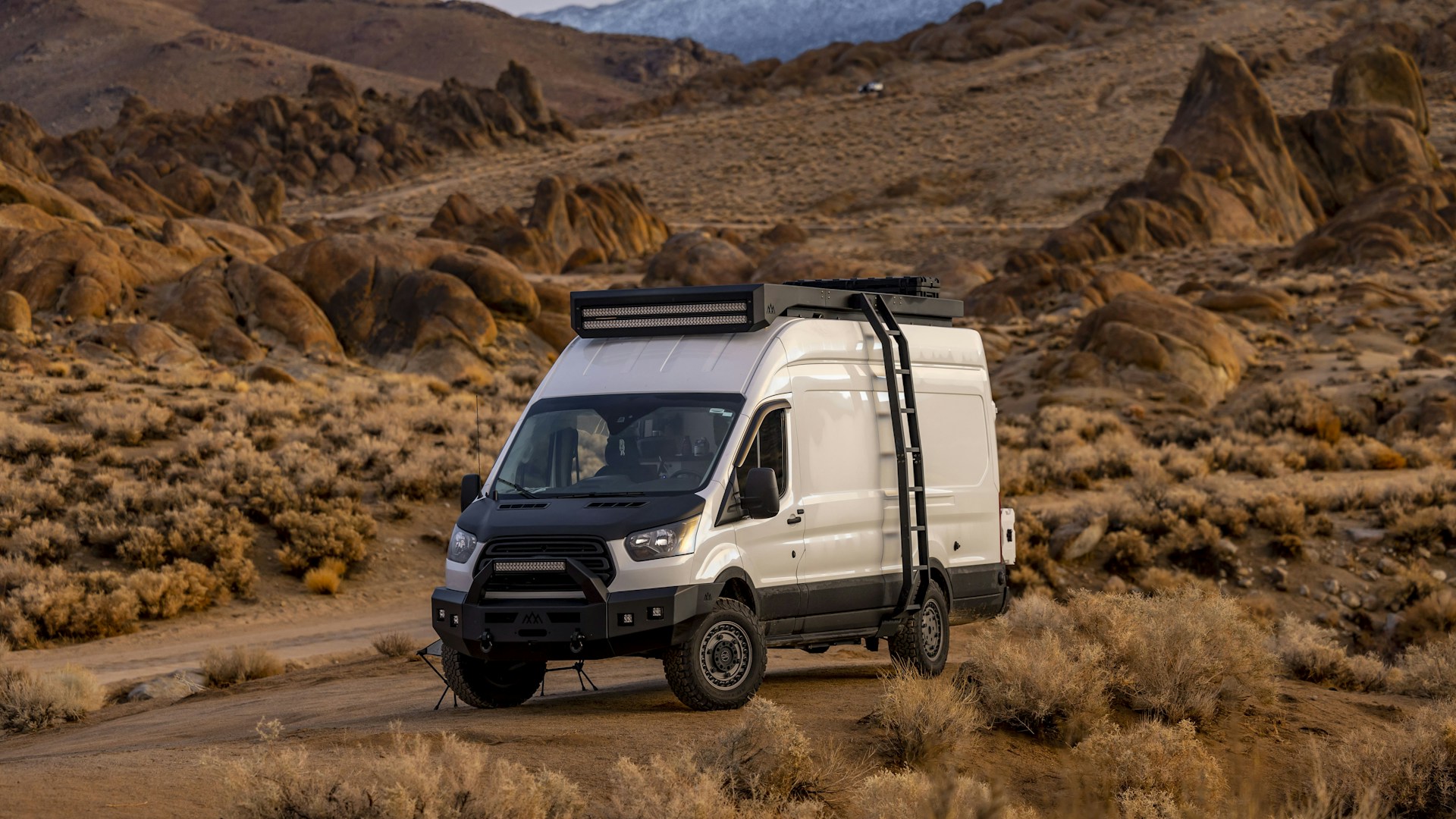
It looks like a slightly worn Ford Transit that has seen better days. Inside, behind a boxed-off section in the middle of the cargo bed, sits the twin turbo V6 that Jaguar built for its XJ220 supercar, and the plain white panel van was exactly how Jaguar wanted to hide it.
The story is told in a video from Duke Video, which looks at the van that served as the development test bed for the XJ220’s engine.
A Secret Supercar Needed A Boring Disguise
Jaguar and its development partner Tom Walkinshaw Racing, known as TWR, chose the humble van to keep the new engine out of sight. The XJ220 was a tightly guarded secret, and when TWR had finalized the engine setup and wanted to run its tests, it needed a vehicle nobody would suspect.
The van is based on a 1989 long wheelbase Ford Transit. Outwardly it looks like a tired working van, and the only giveaways are the ZR performance tires and alloy wheels identical to those that ended up on the XJ220.
Open The Cargo Area And The Twin Turbo V6 Is Waiting
Open the back and you find a twin turbo V6 and racy running gear mounted low down. A magazine writer who rode in it in May 2017 says it carries the registration G134 XVX, is mid-engined with the engine boxed off in the middle of the cargo bed, and still looked like a van inside apart from the boost gauges.
The original running gear was rated at about 540 horsepower. One report says the engine is closely related to the one in the MG 6R4 Group B rally car, since Group B ended in 1986 and MG reportedly sold the rights and design infrastructure to TWR.
From Test Bed To Benetton’s Parts Delivery Van
After TWR finished with it, the van went to the Benetton Formula 1 team, which used it as a parts delivery vehicle. A supercar engine in a van, hauling spares for a grand prix team, is a remarkable second career.
It might have been scrapped after Benetton was done with it, but XJ220 specialist Don Law Racing stepped in. The company, based in Staffordshire, England, is widely described as the world’s leading XJ220 specialist.
Don Law Racing Restored It And Made It Faster
The Laws restored the van and improved it. A 2014 magazine feature says that, as it sat then, the van had XJ220 wheels up front, racing slicks at the rear, 640 horsepower, suspension set up to cope with the van’s baked-in understeer and a top speed north of 170 mph.
It carries a ladder, and the dash is covered in glued-on fast food wrappers and tabloids, glued so they survive the speed. The van has run up the hill at the Goodwood Festival of Speed on multiple occasions, embarrassing prettier machinery along the way.
“Mainly For Carting Bikes”
Justin Law, Don’s son and a former Le Mans driver, told the magazine writer in 2017 that he still used the van as a van, mainly for carting bikes. He said one turbo hose was leaking so he was not getting full boost, yet it was still very fast.
The writer compared the delay-then-rush delivery of power to a 930 Turbo, and noted that a VW T5 driver at the petrol station never glanced twice at the Transit.
The Supercar It Helped Create
The XJ220 was shown in 1988 with a V12 and all-wheel drive, but the production car launched four years later with a twin turbo V6 and rear-wheel drive, which disappointed some buyers. It arrived during a recession, and many who had put down deposits tried to back out.
After a UK court case, a 2026 magazine profile says, many paid a six-figure penalty rather than pay £440,000, just over $600,000 at the time, for the finished car. Jaguar fell short of its 350-car target, with 266 production road cars built, according to Don Law, who says his firm has worked on or supplied parts for every one.
A Record Holder In 1992
The XJ220 reached 217 mph with the rev limiter raised and catalysts removed, making it the world’s fastest production car in 1992 until the McLaren F1 came along. It also set a Nurburgring production lap record that stood for eight years.
The 2014 feature gives the road car 540 horsepower and a 0 to 60 mph time of 3.6 seconds.
How The Law Family Became The XJ220 Experts
The Laws got their start when Justin raced an XJ220 and kept blowing head gaskets. He learned Jaguar had none in stock, so the family made their own, and later supplied them to Jaguar.
Don Law was later approached by Jaguar’s chairman at the time to become the officially approved center of excellence for the supercar, after Jaguar’s relationship with TWR ended acrimoniously.
What The Van Teaches Car Fans
The van is a reminder that the most interesting machines are not always the shiniest ones. A test mule exists to answer questions, and the Transit answered them in a way that kept Jaguar’s secret safe.
It also shows what a dedicated specialist can do. Without Don Law Racing, a bit of motorsport history that served Jaguar, TWR and Benetton might have ended up as scrap.
More Stories You May Like
- Man Pays $1,500 For A 1968 Mercury Cougar With A Torn Apart 390 To See If It Is A Muscle Car Or Yard Art, Then Gets It Running In One Day And Spins It Through The Donut Pit
- Mystery V8 In A Seized 1965 GTO Refuses To Turn After A Week Of Soaking, Then ATF And Old Timer Tricks Finally Free It And The Owner Yells She Freaking Turns
- Classic 1988 To 2000 Chevy Pickups Slid 11% After Doubling In Value To About $30,000, And The 1992 To 1996 Ford Bronco Fell From $61,000 To $58,000