

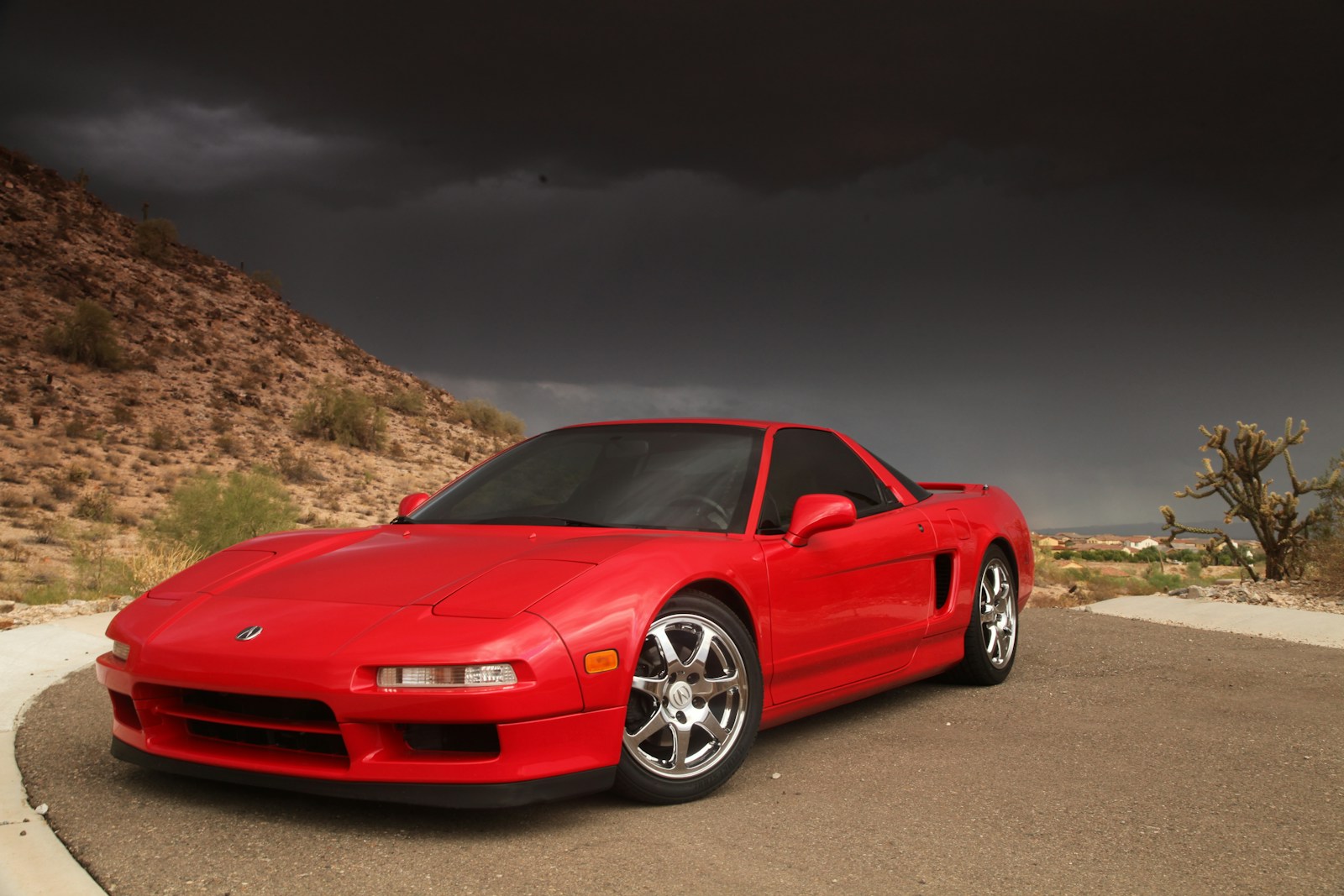
A 2002 Acura NSX with roughly 9,000 original miles sold for $370,000 on Bring a Trailer in April 2025, according to The Drive’s reporting on the sale — a new all-time high for the model on the platform, beating the previous record of $315,000 set just four months earlier by a different NSX in December 2024. For a car that Honda originally sold as the attainable alternative to a Ferrari, that number forces a real reckoning: the NSX isn’t the budget exotic anymore. It’s just an exotic, priced like one.
The Sale That Reset the Ceiling
The specifics matter here. This wasn’t a rare Type R or a one-off factory special — it was a standard NA2-generation NSX finished in Silverstone Metallic with a gray interior, a combination The Drive’s coverage described as an unusually clean and uncommon original spec. It carried a factory-optional supercharger installed by Pikes Peak Acura in Colorado before the car’s first owner ever took delivery, along with a matching exhaust and strut brace. Bidding reportedly went quiet under $260,000 before two buyers pushed it another $110,000 over nearly two days, according to The Drive. That’s not a fluke bid. That’s two people who both knew exactly what they were willing to pay for a nearly unused example. Separate coverage of the same sale confirms the same headline figures — a 2002 NSX, roughly 9,000 original miles, a six-speed manual, and a result that topped every previous NA1/NA2-generation sale on Bring a Trailer.
What “Budget Exotic” Used to Mean
Context is what makes the sale land. Honda launched the NSX in 1991 at a base price of $60,600 — expensive for a Honda, but a fraction of what Ferrari or Lamborghini charged for comparable performance at the time, which was the entire point of the car. By the final model year in 2005, the sticker had crept up to $89,765, still well under supercar money. For most of the 2000s and 2010s, a clean NSX was the default answer to “how do I get exotic-car driving dynamics without exotic-car bills” — used examples routinely traded in the $20,000–$40,000 range.
The Data Behind the Shift
That era is over, and it’s been over for a while — the $370,000 sale is just the most dramatic proof point. Per Hagerty’s valuation data on first-generation NSX values, top-condition examples have gone from roughly $40,000 to more than $100,000 over a five-year stretch, while even rougher #4-condition cars climbed from just over $15,000 to more than $30,000 — Hagerty describes the overall first-gen market as having “more than doubled” in that window. The rarest variants have moved even further: the 1999 Alex Zanardi Edition, of which Honda built only 49, is now closing in on $150,000 for the best examples, per Hagerty.
Why the Market Flipped
Part of it is simple scarcity math — Honda built the NSX in comparatively small numbers over its 15-year run, and clean, unmodified, low-mile examples are a shrinking pool by definition. Part of it is generational: the buyers who grew up with the NSX on their bedroom wall or in Gran Turismo are now in their prime earning years, and Hagerty’s broader collector-car data has repeatedly shown 1990s and 2000s Japanese performance cars climbing as that demographic enters the market with real purchasing power. And part of it is the car itself — an aluminum chassis, a mid-engine layout, and Ayrton Senna’s fingerprints on the suspension tuning were never going to stay cheap forever once people started taking the NSX seriously as a piece of automotive history rather than a used sports car.
The rest of the JDM icon class has followed a similar arc. Supra Turbos, Skyline GT-Rs, and RX-7s that were $15,000 used cars in the early 2010s now regularly clear six figures at auction when the mileage and originality line up, and the NSX has arguably outrun all of them because it never needed a cult movie franchise to build its reputation — it built one on engineering respect alone. That’s a harder thing to manufacture, and it’s part of why the ceiling keeps moving up instead of flattening out.
The New Math
None of this means every NSX on a used-car lot is suddenly worth six figures — mileage, originality, and paperwork matter enormously, which is exactly why a well-documented 9,000-mile example commanded such a premium over a driver-quality car with 80,000 miles on the clock. What it does mean is that the calculation buyers used to make — NSX versus a new Miata, versus keeping the old daily runner — doesn’t hold anymore. The NSX has quietly graduated into the same conversation as the cars it was built to undercut, and the price tags are starting to prove it.