

It started the way a lot of used-car deals start: a guy with a confident voice, a wad of cash, and that slightly performative calm people put on when they’ve already decided they’re going to buy. The seller had the car cleaned up and parked out front, sunlight hitting the hood like it was trying to help close the deal.
The buyer wasn’t some clueless kid, either. He came in acting like he’d done this a dozen times—asked for the title, asked about maintenance, popped the hood without being prompted, and did that little crouch-by-the-tires routine like he was judging a show dog. He took his time, drove it around the block, then drove it again on a faster road, windows down, listening for whatever he thought a bad noise would sound like.
By the time he handed over the cash, the whole vibe was settled. No haggling theatrics, no weird urgency, no “my cousin’s a mechanic” phone call. Just a handshake, a bill of sale, a signed title, and the kind of relief that makes a seller think, okay, this one’s going to be simple.
The Deal Felt Clean—Almost Suspiciously Clean
The seller did what careful private sellers do: printed a basic bill of sale, wrote “sold as-is” in plain language, and made sure both of them signed it. He even snapped a quick photo of the odometer and the paperwork laid out on the kitchen table, not because he was paranoid, but because used-car sales have a way of becoming someone else’s emergency later.
The buyer seemed to appreciate it. He said the car “drove straight,” that the brakes felt good, and that he liked how it shifted. He didn’t ask for any kind of warranty, didn’t try to negotiate a “return window,” and didn’t give off a single hint that he was buying under protest.
Before he left, the seller watched him sit in the driver’s seat for a second longer than necessary, fiddling with the mirrors and the radio presets. It looked like that small moment when someone mentally moves into a new space. Then he started it up, pulled away cleanly, and disappeared down the street like the story was over.
The First Text Came Too Fast
It wasn’t even a full day before the seller’s phone lit up. The message wasn’t about a mechanical issue, not even a “hey, quick question” about the spare key or the owner’s manual. It was a blunt request: the buyer wanted a refund.
At first it sounded like the car had thrown a check engine light or the transmission had started acting weird. The seller asked what was wrong, already bracing for some complicated argument about responsibility. The reply came back quick and weirdly casual: nothing was wrong with it—his wife just hated the car.
That’s the kind of explanation that makes your brain stall for half a second. Not “she’s worried about safety” or “she’s allergic to the air freshener.” Just hated it, like it had personally insulted her the moment it entered the driveway.
The Buyer Tried to Make It the Seller’s Problem
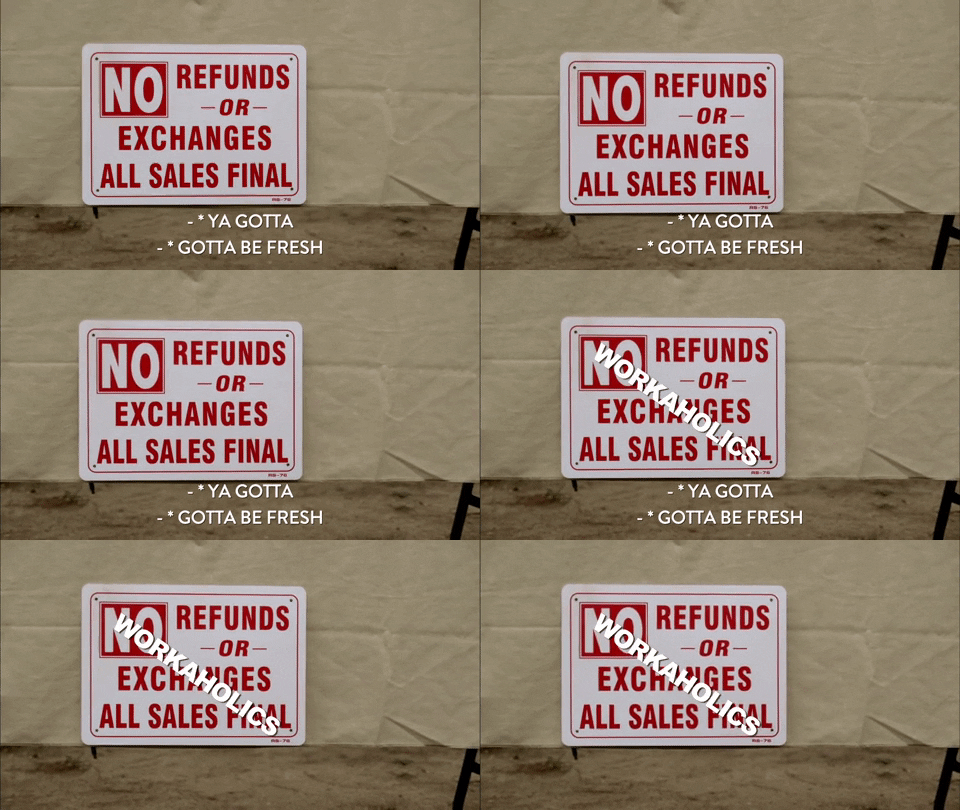
The seller responded the way most people would: he reminded him it was a private sale, he inspected it, he test drove it, and he paid cash. As-is meant as-is, and the seller wasn’t a dealership with a return policy. The buyer came back with a tone shift—less “can you help me out” and more “you’re going to fix this.”
He explained that his wife saw it in person after he got home and immediately started in on him. She didn’t like the color, didn’t like how “old” it looked, didn’t like the interior, didn’t like that it was a sedan instead of an SUV, didn’t like how low it sat—each detail stacking into a picture of a couple having a fight that had nothing to do with the seller.
Then the buyer tried a new angle: he said he felt “misled.” Not about the mileage or the condition, but about how the car “presented.” The seller had to read that twice, because the car wasn’t a magic trick; it was the same car the buyer had stood next to for twenty minutes, the same one he’d driven twice, the same one he’d counted cash for.
The buyer asked if the seller could “just take it back” and resell it, like the seller was running an informal consignment lot. He implied it would be easy, that the seller would basically be doing him a favor and “probably still make money.” It was that specific kind of entitlement where someone acts like your time and risk are imaginary.
The Wife Entered the Story Without Ever Showing Up
What made it messier was how the wife became this invisible third character controlling the plot. The buyer framed everything like he was stuck between two forces: the seller, who “should do the right thing,” and the wife, who was “furious” and “won’t let it go.” The seller never spoke to her, never met her, and never even knew she existed until the refund text.
The buyer sent a couple photos that were supposed to strengthen his case, but they did the opposite. One was the car parked in what looked like a suburban driveway, perfectly normal, no smoke, no puddles, no disaster. Another was the interior, like the seller was supposed to look at a clean back seat and feel guilty.
When guilt didn’t work, the buyer leaned on inconvenience. He said he’d have to “take time off work” to sell it, that he “didn’t have the bandwidth” for listing and meeting strangers, that it was “too stressful,” all of it written like the seller had assigned him a homework project. The seller could practically hear the unspoken part: fix this before my wife makes my life unbearable.
And that’s when the seller got that familiar, creeping feeling private sellers get—the sense that any further conversation is just giving the other person more material to twist. Because once someone is asking for a return over personal regret, there’s no stable ground. If the seller says yes, he’s accepting a car that’s now been driven, maybe altered, and maybe about to become “broken” in the retelling.
The Pressure Turned Into Threat-Adjacent Noise
The buyer didn’t outright threaten, but he started orbiting around threats like a moth around a porch light. He mentioned “small claims court” in a way that sounded more like a bluff than a plan. He talked about “reporting” the seller, without being able to say to whom, for what, or based on which imaginary law that forces private citizens to buy back a vehicle because a spouse changed their mind.
The seller kept his replies short and consistent. Sold as-is, you inspected it, you drove it, no refund. He didn’t get snarky, didn’t take the bait, and didn’t start bargaining over partial refunds, because that’s how you accidentally admit there’s something to refund.
Still, the buyer kept coming back with new versions of the same request. He’d phrase it as “working something out,” then “being reasonable,” then “meeting halfway,” as if the seller was being stubborn for not paying to erase a domestic argument. He even suggested the seller “could keep a small fee” for the inconvenience, like this was an Airbnb cancellation.
The seller finally stopped responding after one last message that tried to reframe the whole thing as a misunderstanding. There was no misunderstanding—there was a guy who made a decision, took a car home, and realized he hadn’t bought his wife into the idea. Now he wanted to outsource the consequences to the only person he could still reach.
What lingered afterward wasn’t fear that the buyer would actually sue, because the facts were boring and solid. It was the uglier, more human tension: the sense that the buyer wasn’t really angry at the seller, he was panicking under pressure, and he’d decided the easiest way to calm the storm in his house was to turn a completed sale into an argument he could keep having. The car was fine, the paperwork was done, and none of that mattered as much as the fact that somewhere, in a driveway the seller would never see, a wife still hated that car—and the buyer was still looking for someone else to blame.