
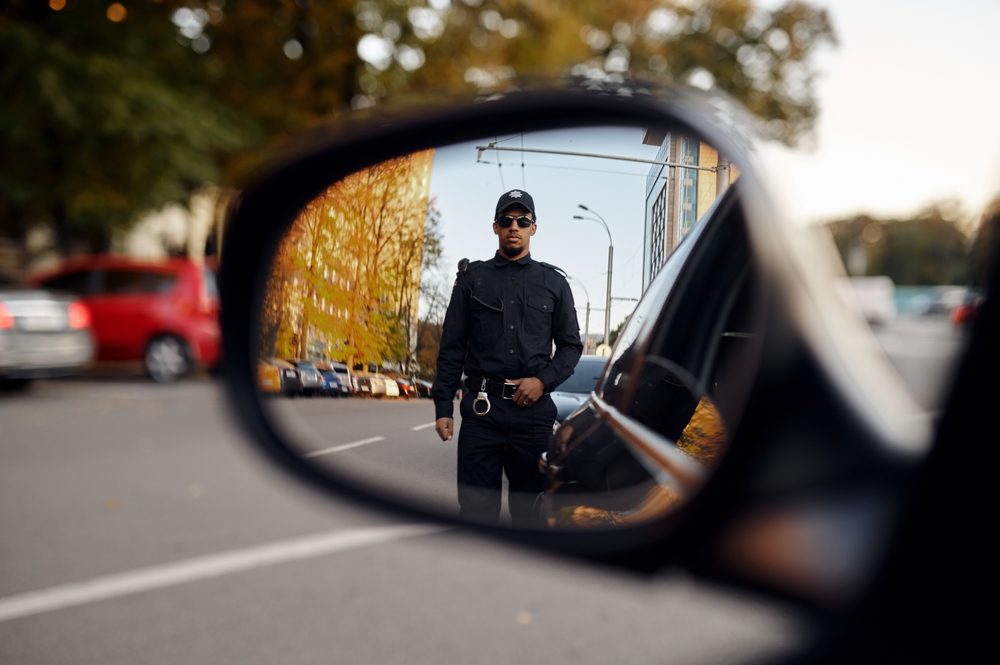

He wasn’t speeding. He wasn’t swerving. He wasn’t even doing that thing where you roll through a stop sign and pretend you didn’t. He was just driving home in a car that looked perfectly normal from the outside—until a patrol car slid in behind him and stayed there a beat too long.
The driver—mid-30s, works a regular job, the kind of guy who keeps his insurance card folded in the glove box like it’s 2009—noticed the tail and did the mental inventory everyone does. License? Good. Insurance? Paid. Registration? He thought so. The lights came on anyway, and his first emotion wasn’t fear so much as annoyance: What now?
He pulled into a gas station lot because it was bright and there were cameras, and he’d learned to do that from life. The officer walked up with that tight, neutral face cops get when they’re already irritated about something that hasn’t happened yet. “License, registration, insurance,” the officer said, and the driver handed everything over like he’d done it a hundred times.

The registration that looked wrong even though it wasn’t
The problem, apparently, was the registration. The driver’s paperwork showed it was current, but the officer’s system was spitting out something else—expired, or “not on file,” or one of those vague database flags that sound like a bureaucratic shrug. The driver watched the officer glance at the paper, then back at his in-car computer, then back at the paper again like the paper was trying to scam him.
“This says you’re not registered,” the officer told him, tapping the screen inside the cruiser like the driver could see it. The driver tried to keep it calm and factual: he’d renewed online weeks ago, the payment cleared, he had the printed confirmation, and he’d even gotten the little email receipt. He offered to pull it up on his phone, the way people do when they can feel the ground shifting under them.
The officer didn’t lean in to look. He just said something like, “That’s not what I’m seeing,” with the tone of someone who’s about to make that your problem. The driver could feel that familiar trap forming—where reality is whatever the database says, and you’re standing there holding evidence that doesn’t count.
“I can tow it right now”
The next part is where it stopped being a routine traffic stop and turned into a small hostage situation. The officer told him the car could be towed on the spot for driving unregistered, and he said it like he was announcing a weather update. Not “might,” not “if we can’t verify,” but “can,” like it was sitting there as a lever he could pull whenever he felt like it.
The driver did the math immediately because he’d been towed before. Towing fee, impound fee per day, “administrative” fee, the inevitable charge for the privilege of having your own property held behind a fence. He told the officer, honestly, that he couldn’t afford that—like, not “it would be inconvenient,” but “that would wipe me out.”
Instead of taking that as information, the officer treated it like attitude. “Should’ve thought of that before driving unregistered,” he said, which is the kind of line that lands differently when the whole dispute is that the driver believes he’s registered. The driver tried to explain again: he had paid, he had confirmation, he had the card, he could show emails, bank statements—whatever.
The officer’s posture didn’t change. He told the driver he could call a tow truck right now, and the driver described it as a threat you’re supposed to hear beneath the words: comply, stop talking, or I’ll make your day catastrophic.
The scramble to prove something the system refused to see
Now the driver’s standing beside his own car in a gas station parking lot, phone in hand, trying to pull up DMV confirmations with sweaty fingers while an officer watches him like he’s performing a magic trick. He finds the email. He finds the receipt number. He finds the exact date the renewal went through. He even finds the screenshot he took because he’s the kind of person who’s learned that “trust the process” is for people who don’t get stuck dealing with the process.
He holds the phone out, and the officer gives it the briefest glance, like he’s looking for a reason to dismiss it rather than a reason to accept it. The officer says the system still shows it as invalid, and the driver should have a physical sticker, and if he doesn’t have one, that’s on him. The driver points out the sticker always comes later in the mail, which is… the entire reason people print the temporary registration in the first place.
This is also where the social awkwardness turns into something sharper. The driver can’t just argue, because arguing is treated like resisting. He can’t be too quiet, because then it looks like he’s hiding something. He’s trying to thread the needle between “advocating for himself” and “not giving the officer a reason to escalate.”
The officer asks if the driver has anyone who can come pick him up, which is another way of saying, “I’m still considering towing this.” The driver says no, not quickly, just no, because who has someone on-call to rescue them from a paperwork glitch? He says he needs the car to get to work, and the officer responds with that flat “Not my problem” energy without using the words.
The quiet power play: waiting, calling, making him feel small
At some point, the officer steps away and makes calls. The driver doesn’t know who he’s calling—dispatch, DMV, another unit—but it takes long enough that the gas station customers start doing that thing where they glance over, then look away, then glance again. The driver stands there feeling like everyone’s seeing him as “guy getting busted,” even though he’s pretty sure he’s done nothing wrong.
The officer comes back and says he still can’t verify it. He says the driver’s “lucky” he’s even checking, like verifying the truth is a personal favor. Then he goes back again, types more, calls again, and the driver’s left in this limbo where every minute feels expensive.
The driver tries to ask what exactly the issue is—expired, suspended, mismatched VIN, whatever. The officer doesn’t give a clean answer. It’s all fuzzy administrative language that somehow justifies a very concrete consequence: your car disappears behind a tow truck, and you’re the one begging to get it back.
And then there’s the way the officer kept repeating the tow option, like he wanted it hovering in the air. Even when the driver wasn’t arguing, even when he was just standing there waiting, the officer would drop another line about how the car “shouldn’t be on the road.” It wasn’t just enforcement; it felt like a pressure tactic.
No tow, but not exactly relief either
Eventually, the officer decides not to tow. He hands the documents back with the vibe of someone granting mercy rather than correcting an error. The driver says it wasn’t framed as, “Okay, you’re good,” but more like, “I’m letting you go this time,” which is a very different message to send when the driver has receipts in his hand.
The officer gives him some kind of warning or citation anyway—something about “failure to display” or “registration not verifiable,” the kind of ticket that lives in the gray zone where you can fight it, but you’ll have to burn a day and maybe lose wages to prove what you already proved on the roadside. He tells the driver to get it fixed “immediately,” which is funny, because what he’s describing isn’t a fixable mechanical problem. It’s a database problem in an office the driver can’t access.
The driver sits in his car afterward for a minute with his hands on the wheel, just breathing, not starting the engine yet. He’s not pumped with adrenaline like he survived a chase. He’s just shaken in a dull, exhausted way, because he spent half an hour trying to avoid financial ruin over a clerical mismatch he didn’t cause.
And that’s the part that stuck: it wasn’t a dramatic arrest, no cuffs, no shouting match. It was a calm conversation where one person held the authority to drop a tow truck into the scene, and the other person had to perform “polite desperation” to keep his life from getting significantly worse. He drove away still registered, still insured, still legal—yet somehow feeling like he’d narrowly escaped punishment for existing in the wrong database at the wrong time.
More from Steel Horse Rides: