

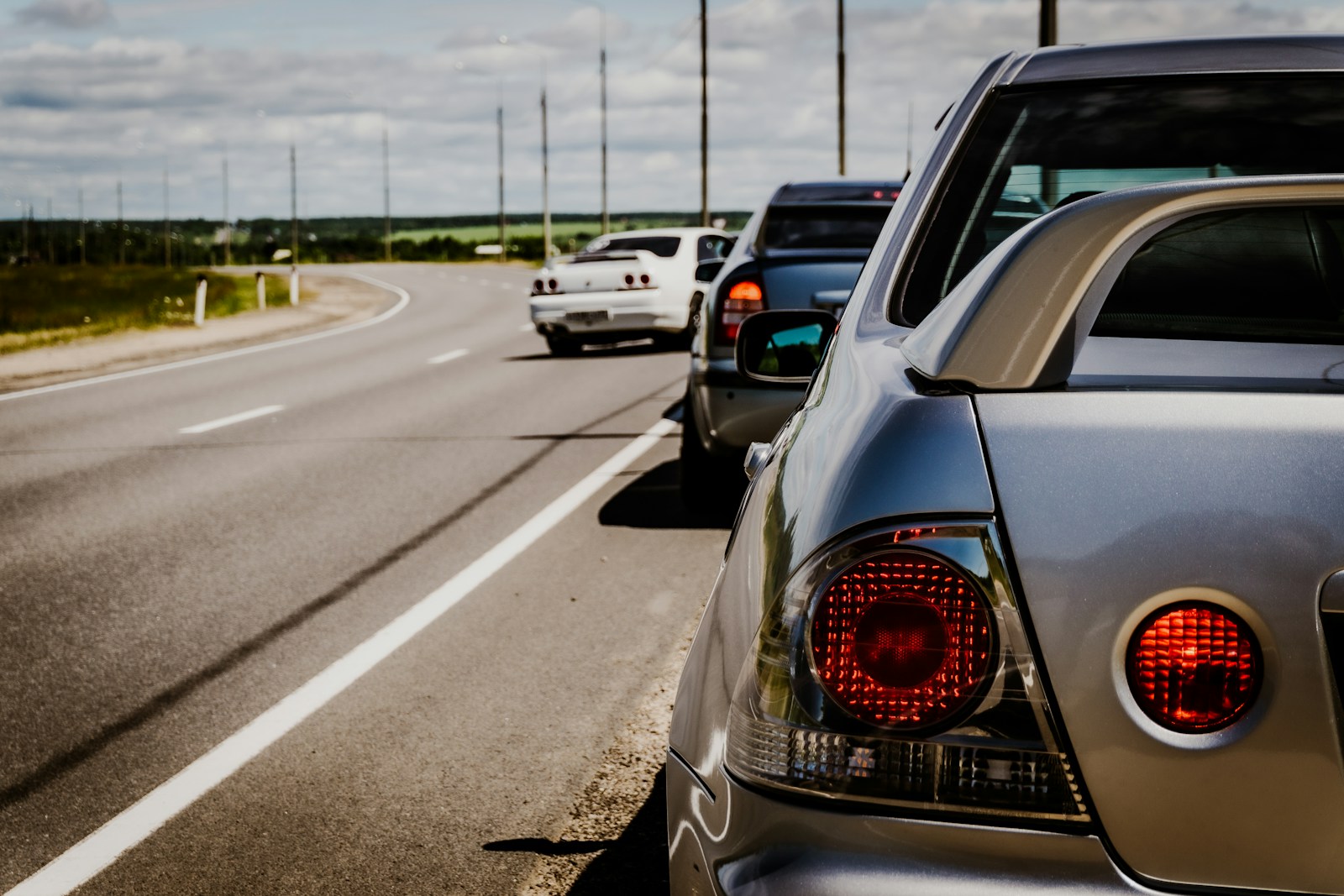
It started the way a lot of dumb car drama starts: two people stopped at the same light, one of them feeling like the road was a stage, the other just trying to get home without getting boxed in by somebody’s ego. The guy in the louder car kept creeping forward, nosing his front bumper into the crosswalk like he was testing boundaries. He’d glance over, smirk, then rev again—short, sharp bursts that made the exhaust pop like punctuation.
The other driver—call him Matt—was in a clean, newer-looking sedan that didn’t scream “race me” unless you knew what you were looking at. No huge wing, no neon underglow, no decals. Just tinted windows, decent tires, and the kind of quiet stance that reads more “adult with a hobby” than “teenager with a YouTube channel.” Matt wasn’t looking for a fight, but the guy beside him was practically vibrating with the need for one.
When the light turned green, the loud-car guy shot forward hard enough to chirp his tires, then slowed half a car length ahead like he was baiting a chase. He did it again at the next light, and again at the next, turning a normal drive into a weird little audition. By the time they hit a long straight stretch with no traffic in front of them, he finally made it obvious—leaned out his window, waved, and yelled something that was half invitation, half insult.
The Invitation He Didn’t Expect to Regret
Matt didn’t bite right away. He stayed in his lane, kept a steady speed, and let the guy play his game alone for a moment. That should’ve been the end of it, the way it usually is when someone refuses to engage. But the loud-car guy took the lack of reaction as disrespect and escalated like he was determined to get a response.
He dropped back, pulled alongside Matt again, and started gesturing—two fingers pointing forward, then tapping his own chest like, “Me. You. Right now.” There was a passenger in his car too, a friend who looked like he’d rather be anywhere else, staring straight ahead with that stiff posture of someone bracing for stupidity. Matt glanced over once, saw the performance, and finally gave the smallest nod, more “fine, if you insist” than “let’s do this.”
They weren’t on some empty highway in the middle of nowhere, either. It was a wide, multi-lane road outside a strip of retail and warehouses, the kind of place where people speed because it feels open even when it’s not. Matt later described it like a pressure cooker: the other guy had been turning the heat up for ten minutes, and now he wanted the lid to blow.
The Race That Lasted About Two Heartbeats
At the next light, the loud-car guy pulled into the lane next to Matt and started doing the whole show: revving high, rocking the car slightly with throttle blips, craning his neck to see if anyone was watching. Matt stayed still, hands on the wheel, eyes forward. It was almost awkward how calm he looked compared to the guy next to him acting like a cartoon.
When the light changed, the loud-car guy launched again—hard, loud, dramatic. For a second, he did get ahead, and you could almost imagine him already narrating his victory to the passenger like it was destiny. Then Matt’s car just… went.
Not in a screechy, out-of-control way. It was clean, quick, and annoyingly efficient, the kind of acceleration that looks unfair because it doesn’t come with theatrics. Within a couple of seconds Matt was a car length up, then two, and the loud-car guy’s noise started sounding less like confidence and more like panic.
Matt didn’t keep pushing forever. He let off before it got truly reckless, eased down, and moved back into normal driving like he’d made his point. That should’ve been the moment everyone pretends nothing happened, takes the L, and goes home. The loud-car guy had other plans.
When the Loser Can’t Lose
At the next intersection, the loud-car guy swerved across a lane to get behind Matt, riding his bumper like he was trying to climb into the trunk. His headlights flashed twice, then again, even though they were already slowing for traffic. When Matt pulled into a gas station—mostly to get away from the tailgating and let the situation bleed off—the loud-car guy followed like it was a chase scene.
They parked at opposite sides of the lot, then the loud-car guy marched over immediately, posture big, shoulders rolled forward, hands moving faster than his mouth could keep up. He wasn’t yelling at first; he was doing that intense, clipped talking that’s meant to sound controlled while clearly being one sentence away from shouting. His friend trailed behind, eyes darting, already looking for an exit route.
Matt stayed by his driver’s door, not approaching, not backing away. He asked, pretty evenly, what the guy wanted. The loud-car guy answered with the first pivot: he didn’t lose—Matt “cheated.”
He pointed at Matt’s car like it was evidence. “That thing’s not stock,” he said, with the kind of certainty that comes from wanting something to be true. He repeated it louder when Matt didn’t react, then added the part that made it extra ridiculous: “I’m pretty sure that’s illegal.”
The Illegal-Modification Accusation Spiral
Matt, still calm, asked what exactly was illegal about it. The loud-car guy didn’t have anything specific—no mention of emissions equipment, no clear accusation like nitrous or an unregistered engine swap. It was just vibes: the car was too quick, therefore it must be unlawful. He talked about “tuning” like it was a felony by itself, like someone had slipped a forbidden chip under the hood.
Matt did, in fact, have modifications. Not the cartoon kind, but the normal enthusiast kind: a conservative tune, better intake flow, upgraded intercooler, the kind of stuff that’s common enough it’s practically a starter pack. The irony was that the loud-car guy’s car was obviously modified too—aftermarket exhaust, aggressive burbles, maybe even a downpipe if you listened closely—because nobody’s factory setup sounded that obnoxious on purpose.
That’s what made the confrontation so weirdly personal. The loud-car guy wasn’t mad that someone broke some sacred rule; he was mad the rules didn’t protect his pride. He kept circling back to the same line: “You can’t do that on the street,” as if Matt had forced him to initiate the exact thing he was now condemning.
He threatened to call the cops, which is always a bold move from someone who just participated in a street race he started. He even claimed he knew “people in vehicle enforcement,” which sounded like the kind of made-up connection someone says when they’re trying to bluff their way back into control. His friend finally muttered something like, “Bro, let’s go,” but it didn’t land.
The Awkward Fallout in a Gas Station Parking Lot
At this point, the gas station felt like it had its own gravity. A couple of people pumping gas started watching without fully committing to watching, doing that thing where they stare at the price screen a little too long while their eyes flick over. Inside the convenience store, someone stood near the window, phone in hand, not filming overtly but definitely ready if it got loud.
Matt didn’t take the bait. He didn’t brag, didn’t taunt, didn’t even argue much beyond asking for specifics and pointing out the obvious: the other guy was the one who initiated everything. That calmness, more than anything, seemed to inflame the loud-car guy, because it gave him nothing to bounce off of. He wanted a shouting match to make the loss feel like a draw.
Eventually the loud-car guy tried a different angle: he demanded Matt pop the hood, like he was entitled to an inspection. Matt laughed—more disbelief than humor—and said no. That “no” landed like a slap, because it underlined the whole reality: this wasn’t a sanctioned anything, and the only authority in the situation was the guy’s own ego.
The loud-car guy’s threats got less coherent after that. He talked about reporting Matt’s license plate, about “getting him flagged,” about how “people like you ruin the scene,” which was rich coming from someone who’d been revving at random lights like he was trying to summon a crowd. The friend finally put a hand on his shoulder and tugged, and that was the first time the loud-car guy looked like he might actually leave.
He didn’t leave cleanly, though. As he walked back to his car, he made sure to say one last line over his shoulder—something about how Matt “better not be around here” and how “they’re cracking down.” It was vague enough to be meaningless but sharp enough to be meant as a warning. Then he peeled out of the lot with a dramatic exhaust crack, like the sound could rewrite what just happened.
Matt stood there for a second after they left, the adrenaline fading into that drained, irritated feeling you get when someone tries to drag you into their fantasy and then punishes you for not playing your role. The whole thing left an aftertaste: not fear exactly, but that unsettling sense that some people will start a fire, lose control of it, and then accuse the smoke of being illegal. And the worst part was knowing the guy didn’t actually learn anything—he drove away still convinced the problem wasn’t his challenge, his race, or his loss, but the fact that reality didn’t cooperate with his story.