

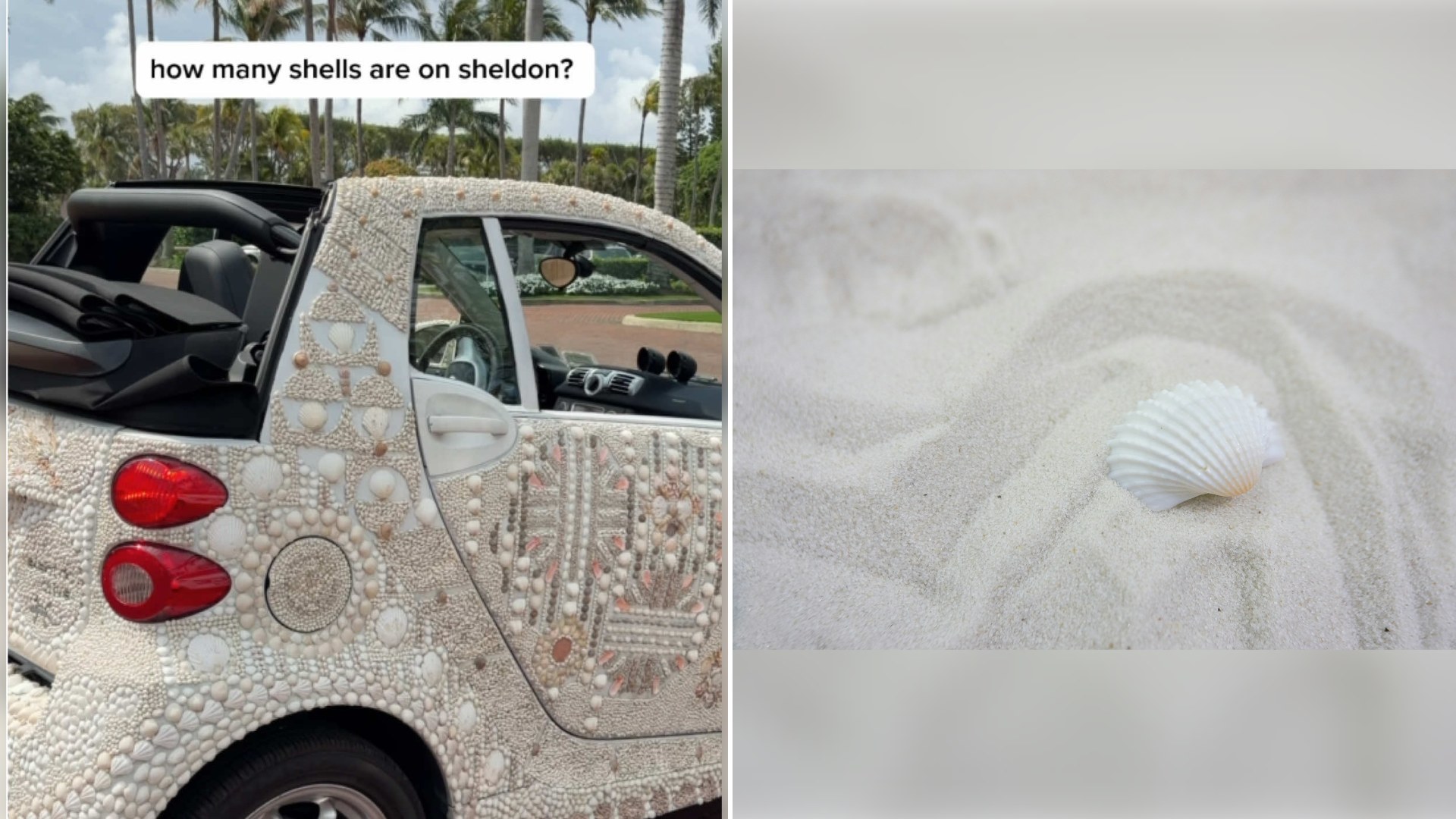
Most commuter cars are meant to disappear into traffic. Not Sheldon. The tiny electric Smart car has become one of the most recognizable vehicles rolling through its owner’s town, and that’s because nearly every inch of its exterior is covered in real seashells. Artist Elena Hahn introduced the car to her @sheldontheshellcar TikTok followers as a years-long labor of love that turned an ordinary 2014 commuter into a rolling piece of coastal art.
In the video, Hahn walks through Sheldon’s transformation from a plain electric city car into a shell-encrusted showpiece. According to the creator, the project involved applying what she describes as thousands of individual shells across the body panels, roof, and mirrors, layering them by hand in a process that reportedly stretched on for years rather than weeks. The exact shell count and total project cost are creator-reported details from the video and haven’t been independently confirmed, but the density of coverage shown on camera suggests an enormous amount of patient, repetitive work.
From Commuter Car to Moving Art Installation
Smart cars are already an unusual sight on American roads thanks to their diminutive footprint, which arguably makes them a fitting canvas for this kind of statement piece. A small, boxy electric car gives an artist a compact, mostly flat set of surfaces to work with compared to the curves of a larger sedan or SUV. Hahn’s video suggests that scale was part of the appeal — a smaller car meant a project that was ambitious but still theoretically finishable by one person over time.
What comes through most in the post is the sheer commitment involved. Covering a car in shells isn’t a weekend craft project; it requires sourcing a huge volume of material, likely sorting shells by size and shape, and adhering them in a pattern that holds up to weather, road vibration, and daily driving. The video frames the build as an ongoing, evolving piece rather than a one-time paint job, which tracks with how the creator describes the multi-year timeline.
Why the Car Resonates Online
Part of what makes Sheldon compelling to watch is the contrast between the car’s mundane origins and its current form. A 2014 Smart car is about as unremarkable a commuter vehicle as exists — cheap to run, easy to park, built for utility rather than flash. Turning that kind of vehicle into a piece of wearable, drivable art plays into a broader trend of car owners using their daily drivers as canvases for personal expression rather than treating them as disposable appliances.
The reaction in the comments, as referenced in the video, points to viewers being especially curious about the practical side: how the shells are attached, whether they survive rain and car washes, and how much weight thousands of shells might add to the vehicle. Those are reasonable questions for anyone who has ever tried to glue anything permanently to a moving car, and they highlight why builds like this tend to take years rather than days.
The Takeaway
If you’re inspired to try a smaller-scale version of a shell-covered or mosaic car project, start with adhesion and weatherproofing rather than aesthetics. Marine-grade epoxy or automotive-rated adhesives matter far more than shell selection, since UV exposure, temperature swings, and car washes will test any bond quickly. It’s also worth checking local vehicle regulations before covering large portions of a car’s exterior, since some areas have rules about reflective surfaces, mirrors, and license plate visibility.
For anyone who simply enjoys spotting unusual builds, cars like Sheldon are a reminder that a vehicle doesn’t have to be expensive or rare to become a local landmark. A distinctive paint job, wrap, or hand-applied material can turn even a budget commuter into something people slow down to photograph — proof that personality, not price tag, is often what makes a car memorable.