

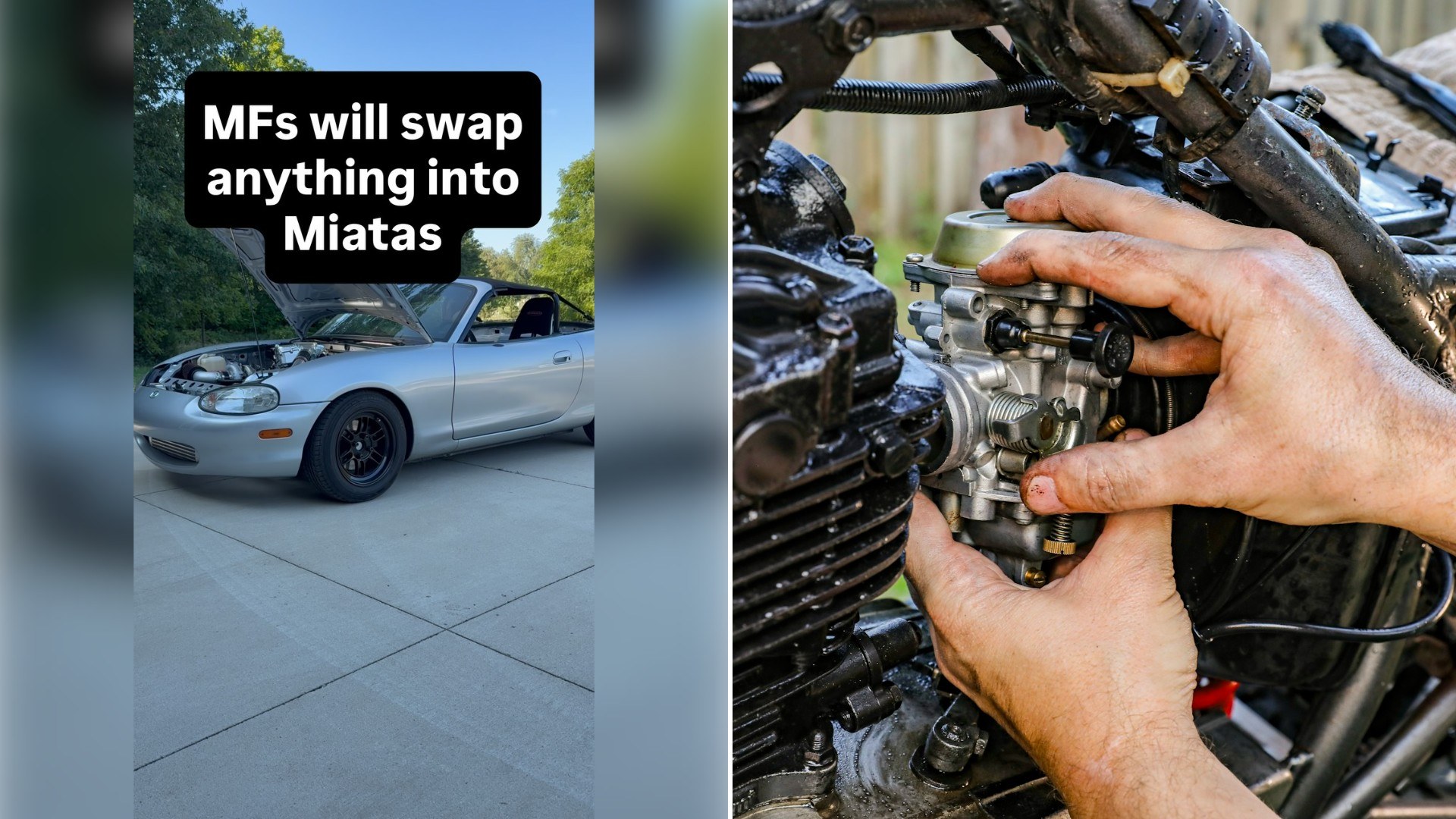
The clip opens on a silver Mazda Miata parked on a concrete driveway with its hood propped open and the top down, under a line of text that reads like a complaint: “MFs will swap anything into Miatas.” Four seconds later the camera is pointed at a black motorcycle parked beside that same car, and the text has changed to a confession: “I’m MFs.”
That is the whole joke in the 38-second reel from @reedmakecar, and the rest of the video is the proof. The camera pans from the bike to the Miata’s nose, where the front bumper cover is off and a green arrow drawn on the screen points down into the open engine bay.
From there the reel runs through the build in a string of quick shots with no narration on screen. The first is a garage floor, where the motorcycle has been stripped down and its engine sits on a wooden pallet next to the bare frame. The next two are close-ups of hand-fabricated stainless exhaust tubing, the pipes bending tightly together and showing the heat color of fresh welds. Then comes the part that takes the project a step past a straight swap: a turbocharger, compressor wheel facing the camera, bolted up to that pipework.
The cabin gets the same treatment. One shot shows the Miata’s interior with an aftermarket steering wheel, a bucket seat and a tall shift lever topped with a white knob rising from the center tunnel. Another looks over the steering wheel at a digital dash display, a color screen built around a large round tachometer with a row of shift lights across the top. The creator’s caption tags Haltech, the engine management brand, and a later shot shows a black and yellow control unit mounted in the car with a wiring harness plugged into it.
The trunk is no longer a trunk. A bare aluminum fuel cell sits where the luggage would go, with fittings and lines on top of it. The rear plate visible in that shot is a vanity plate that spells out HUGERPM.
A shot of the engine itself, with the intake side exposed, shows four round ports in a row, which makes it a four-cylinder. The reel never names the motorcycle it came from, and it does not put a displacement or a power figure on the screen.
Then the car moves. Two shots from the driver’s seat show a hand on the steering wheel and a small stuffed toy hanging from the rearview mirror as open road and grass go by outside the windshield. The video cuts back to the finished engine bay, where the compact engine sits low between the Miata’s strut towers with the turbocharger and a polished intake pipe in front of it, and ends on a roadside view of trees.
His caption is brief: “Build breakdown on YouTube. Link in bio,” followed by the Haltech hashtag. In other words, the reel is the trailer, and the answers to how the drivetrain actually works are in the longer video.
Even as a trailer, the clip is a useful checklist of what a swap like this involves, because almost none of the shots are of the engine alone. The exhaust manifold had to be made from scratch. The fuel system was replaced with a cell in the trunk. The engine is run by a standalone control unit instead of anything Mazda installed, and the factory gauges gave way to a screen that can read from that unit. The shifter is not the Miata’s original. Anyone pricing out an unusual engine swap should budget for every one of those systems, since the engine is only the first item on the list.
A motorcycle engine adds its own complications on top of that. Bike engines carry their gearbox inside the same case, and they send power out through a sprocket meant for a chain instead of a driveshaft, so a builder has to work out how to get that output to the car’s rear axle. Motorcycle gearboxes are sequential and have no reverse gear, which a car needs for parking lots and driveways. Bike engines also make their power at very high rpm and produce little torque low down, and a Miata weighs several times what a motorcycle does. A turbocharger is one way to add the midrange a heavier vehicle needs, and it is on this car.
The reel does not show how this builder handled the driveline or reverse, so those are the questions to bring to the full breakdown before copying any part of it. What the 38 seconds do establish is that the car runs, drives on the road under its own power, and belongs to someone with a sense of humor about the kind of person who would build it.