

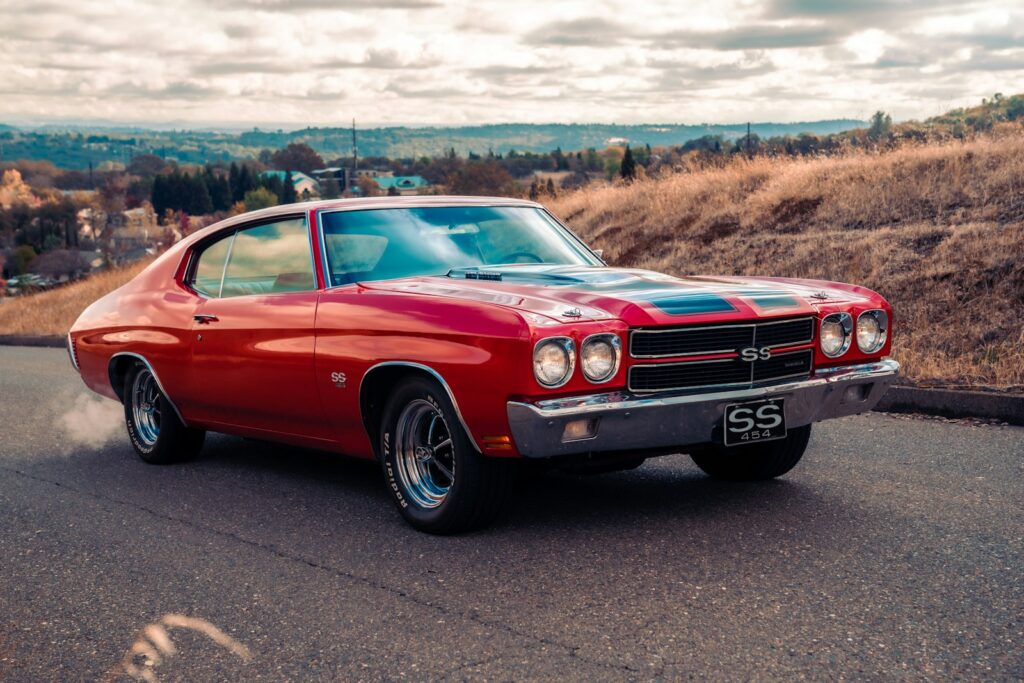
He’d been hunting for that exact car for years: a late-60s muscle coupe in a color that looked like it had been poured out of a hardware-store paint can, all metallic and mean. The seller had it parked at the edge of a tidy suburban driveway like a trophy, hood down, windows up, a little dust on the chrome to make it feel “barn find” without any of the actual barn. The buyer showed up with cash, a friend who “knew cars,” and that itchy optimism people get when they think they’re about to snag a legend.
The seller was ready for him. He had the binder of receipts, the laminated build sheet copies, the practiced phrases. “All original,” he kept saying, like it was a spell that made the price reasonable. “Numbers matching. Survivor. Just needs a good home.”
The buyer did that polite circling thing—hands in pockets, squinting at trim, tapping a tire with the toe of his shoe like it could reveal a secret. The car looked the part from ten feet away, which is exactly the distance sellers prefer. Up close, it still wasn’t bad, but there were little tells: slightly too-new fasteners, an interior that smelled more like fresh vinyl than old sunbaked foam, and an engine bay that was suspiciously clean, the way a kitchen looks right after someone’s been hiding dishes in the oven.
The “All Original” Speech Gets Louder
The seller did most of the talking. Every question from the buyer got answered with the same confident cadence, like he’d rehearsed it in the mirror. “Original carb, original manifolds, original ignition, original everything. The only thing I swapped was the battery, and you know how it is—batteries don’t last.”
The buyer nodded, trying not to look too eager. He asked about rust, asked about the rear quarter, asked about the weirdly straight body lines for something that supposedly hadn’t been touched. The seller laughed at that one and gave the classic line: “They built ‘em better back then.”
Then the buyer did what anyone with a few grand on the line eventually does: he asked if they could pop the hood. The seller hesitated for half a second—just a little stutter, like a buffering video—then smiled big and reached for the latch. “Sure,” he said, “you’re gonna love what you see.”
The Mechanic Shows Up, and the Temperature Drops
Here’s the detail that made the whole thing go sideways: the buyer wasn’t alone. His “friend who knew cars” turned out to be an actual mechanic from a local performance shop, the kind of guy who wears plain work boots and doesn’t waste words on admiration. He’d stayed quiet during the driveway small talk, letting the seller fill the air with confidence.
When the hood popped, the seller leaned in like he was unveiling a sculpture. He even did that little gesture with his hand, palm up, presenting the engine bay. The buyer leaned forward too, trying to see what he was supposed to be impressed by.
The mechanic didn’t lean in. He just stared for a beat, then his shoulders started shaking. Not a polite chuckle. Not a nervous laugh. A real laugh, the kind that comes out when something is so wrong it circles back around to funny.
The seller’s smile froze. The buyer’s face did that slow recalibration people do when they realize they might have been walking into a trap. “What?” the buyer asked, half joking, half not. The mechanic wiped his mouth with the back of his hand like he’d tasted something bitter. “You said this was all original?” he asked the seller, still smiling, like he couldn’t believe he had to confirm it.
Under the Hood, the “Original” Story Falls Apart
The mechanic started pointing without even touching anything at first, like he didn’t want to contaminate the scene. The valve covers were the first giveaway—wrong style, wrong finish, and stamped with a brand that didn’t exist when the car was built. Then he nodded at the intake, which looked clean in a way that screamed “catalog order,” not “survived half a century.”
He finally reached in and gently wiggled a hose clamp, the kind with a modern screw head that’s basically a timestamp. “This is new,” he said, then moved to the wiring, which was bundled too neatly and routed too sensibly for a factory job from that era. He pointed at the ignition setup and gave a quick, almost apologetic laugh again. “This is aftermarket. Like, not even trying to hide it.”
The buyer’s excitement started draining out through his shoes. He’d been picturing the car as a time capsule; now he was seeing it as a costume. “But it runs great,” the seller jumped in quickly, like performance could substitute for honesty. “I upgraded a couple things for reliability. Everybody does that.”
The mechanic didn’t argue about whether upgrades were fine. He argued about the word “original.” He tapped the block casting area, then the accessory brackets. “Even if the block is the right family, this whole setup’s been apart,” he said. “That’s not a survivor engine bay. That’s a rebuild with shiny parts.”
The seller’s tone changed. He started talking faster, explaining more, stacking excuses on top of the earlier certainty. The buyer just kept looking from the engine to the binder of “proof” on the seller’s porch, like he was trying to figure out where the lie started. The worst part wasn’t that parts had been swapped; it was how confidently the seller had sworn nothing had been touched.
The Seller Tries to Pivot, the Buyer Starts Doing Math
Once the “all original” claim cracked, everything else got questioned. The buyer asked about paintwork, and the mechanic pointed out the overspray near a seam that shouldn’t have any. The buyer asked about the interior, and the mechanic ran a finger along the edge of the seat cover where a modern staple pattern gave it away. The car still looked good, but now it looked good in a different category—restomod-ish, driver-quality, not museum “numbers matching” money.
The seller tried to salvage it by reframing. “It’s better than original,” he said, with that defensive brightness people get when they’re losing control of the story. “You don’t want fifty-year-old hoses. You want upgrades you can trust.”
That’s when the buyer finally got sharp. “Then why did you tell me, repeatedly, it was all original?” he asked. Not angry yet, but steady, like he was choosing his words carefully so they couldn’t be twisted. The seller shrugged in a way that was meant to look casual and landed more like dismissive. “Man, that’s just what people say. You know what I mean.”
The mechanic made a little sound in the back of his throat, half sigh, half laugh. The buyer pulled out his phone and started pulling up listings, not dramatically, just quietly doing the calculation every buyer does when the fantasy dissolves. He wasn’t trying to “win” the argument; he was trying to figure out what the car actually was and what it was actually worth.
The seller watched him scroll and got visibly irritated. He started talking about how hard it was to find these cars, how prices were only going up, how he’d had “ten messages” already. It was the classic pressure play, but it was coming too late, because now the buyer had a mechanic standing there who had already laughed the spell right off the car.
The Standoff in the Driveway
The buyer didn’t storm off. That’s what made it feel tense instead of theatrical. He just stood there a long minute, staring at the engine bay like he was mourning something, then asked, “So what’s the real story?”
The seller crossed his arms and said the car had been “freshened up” years ago, nothing major, just maintenance. The mechanic raised an eyebrow, and the seller’s explanation got vaguer with every sentence. He couldn’t produce a clear timeline—who did the work, what was replaced, why the parts didn’t match the claim. The binder of receipts suddenly seemed less like evidence and more like clutter, a prop that worked until someone knew where to look.
Eventually the buyer named a price that matched what he thought the car actually was: a nice driver with modifications, not an untouched classic. It was a significant drop from the seller’s ask, and the seller reacted like he’d been insulted in his own driveway. “I’m not giving it away,” he snapped, like the buyer had asked for a favor instead of accuracy.
The mechanic quietly closed the hood, not slamming it, just ending the inspection. The buyer thanked the seller for his time in that tight, controlled way that means “I’m done here.” The seller tossed out one last line about having other interested buyers, but his eyes stayed on the mechanic, like he was more offended by the laughter than the lost sale.
As they walked back to the buyer’s car, the mechanic didn’t gloat. He just said, “It might be a good car, but it’s not the car he’s selling.” And that was the part that stuck—because the buyer wasn’t leaving mad about aftermarket parts. He was leaving with that sour feeling of being looked in the eye and confidently told a story that fell apart the second someone lifted the hood and didn’t play along.
More from Steel Horse Rides: