

The first line on screen comes from the end of the story. Standing in a dim garage beside a dusty silver sedan, an older man in a dark cap and jacket gives his verdict on the car, and the caption prints it: “It’s totally useless to me.” The video then jumps back to show how two young car flippers came to be standing in front of him.
The reel was posted by @theflippertwins, who summed it up in their caption: “Supercharged e36 m3 with 40k original miles that has sat for 20 years. He’s 86! Squatter stole the keys when they broke into the building. How much would you pay for it?” It starts on a tree lined street, where one of them, in a camo trucker cap and a black hoodie, is on the phone next to a red car with its door and hood open. “I’ll call you when I’m outside,” he says, and then, to the camera, “I’m really curious to see if this is actually a low mile E thirty-six.”
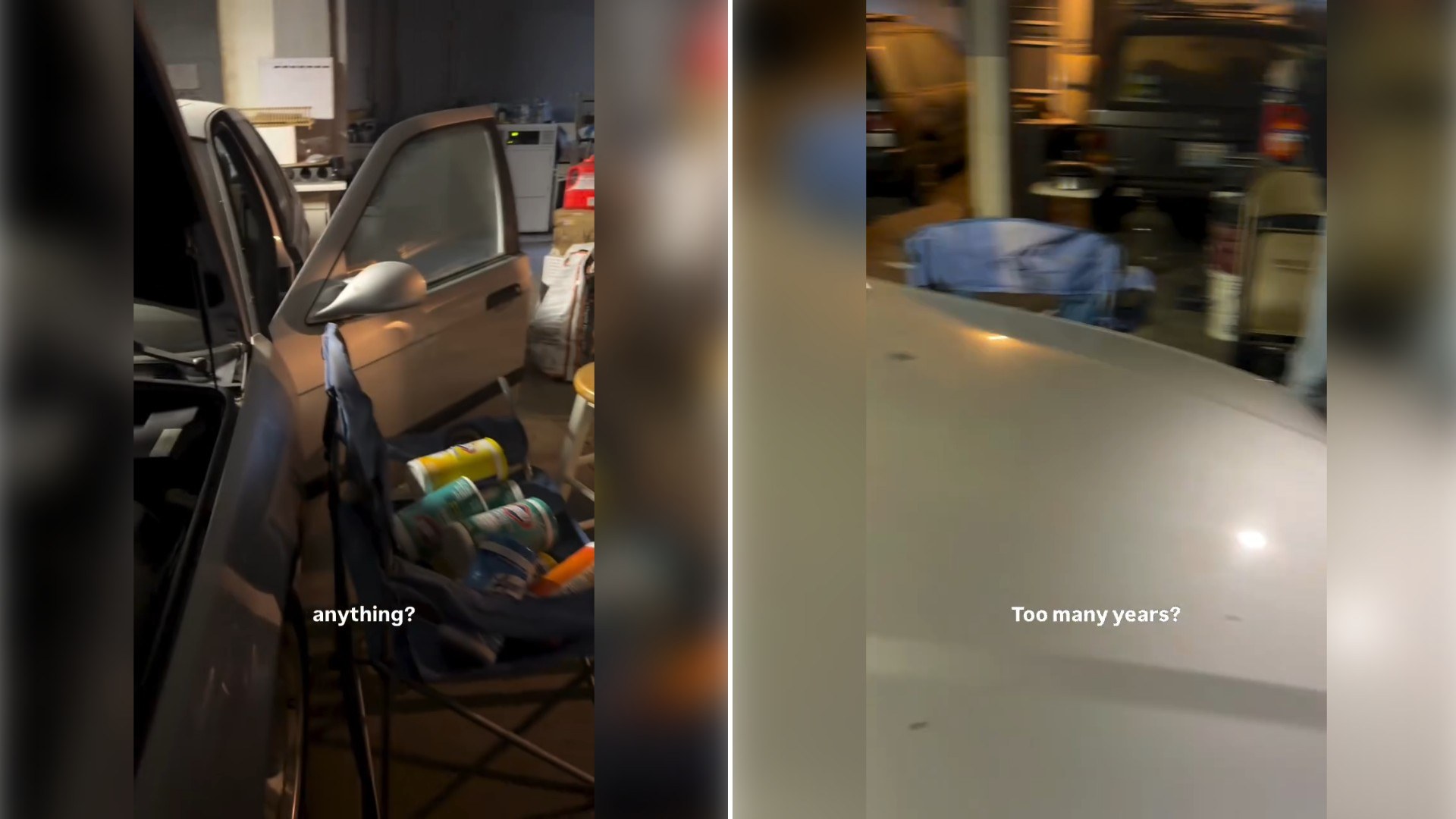
Inside, the questions start before the car is properly in frame. “Do you have tenants in here or no?” is the first thing asked. The garage has a bank of electric meters on one wall, another vehicle parked at the back and a counter crowded with cleaning supplies. The BMW sits in the middle of it under an even coat of dust: a silver four door with an M3 badge on the trunk lid and a pale leather interior.
The timeline comes out in pieces. Asked how long he has had the car, the owner is offered a prompt, “Too many years?”, and answers that it goes back to about 2000. Asked how long it has been parked in that spot, he says, “probably about two thousand two thousand three.” The camera settles on the rear license plate and the caption notes what is on it: “2005 tags.”
Mileage is next. “And how many miles does it have?” The reply is captioned on screen as “49,000 miles,” while the creators’ written caption puts the figure at “40k original miles.” Then comes the question that changes the deal: “you got the key to it or?” The owner’s answer is flat. “Unfortunately I don’t have the keys anymore.”
With the hood up, the camera shows why the car was worth the trip. A brace runs across the top of the engine bay, and a supercharger sits low on one side with wide black ducting feeding it. The owner says the car came that way, and the caption lists what was fitted: suspension, a supercharger and an exhaust. “Got it,” comes the reply.
From there it is a negotiation. “So how much do you want for the car if we take it without the keys,” one of the buyers asks, explaining that they would take it as it is, with no key, and adding, “We just have to go get a key made.” The pitch that follows is “One less headache.” The talk turns to what cars like this sell for, with the line “give me an idea what the prices are” on screen while a second visitor in a gray hoodie bends over his phone.
Then the question is put directly: “Uh do you really want to get rid of it?” The answer is the line the video opened with, this time in full. “It’s totally useless to me because I don’t drive that fast.” The conversation moves on to 14 cars, kept “Not in this building but in another building.”
The last scene leaves the garage. A hand holds up a page filled edge to edge with blue handwriting, and a finger moves down the lines as it is read out. The captions carry the words: “How are you doing today?” and then, “first and foremost I owe you an apology.” The writer mentions recycling aluminum cans and continues, “Somehow I noticed that the entrance door was cracked open,” and “I entered the building without permission.” An older man with a white beard is laughing beside the page when the clip ends.
No price appears in the video and no handshake is shown. The creators leave that part to their audience with the last line of the caption: “How much would you pay for it?”
For anyone looking at a car that has been parked for decades, the order of the questions here is worth copying. How long have you owned it, how long has it sat, how many miles are on it, where are the keys, and what has been changed. Each answer was set against something visible: the tags on the plate, the dust, the interior, the engine bay. The plate was especially useful. The owner’s memory said 2002 or 2003 and the tags said 2005, and both agree that the car has been standing for roughly two decades.
The same care applies to the mileage. Two different numbers are attached to this car within one post, 49,000 in the on-screen captions and 40k in the written one. A buyer in that position should confirm the figure from the car and its paperwork before agreeing on a price.
The missing keys show how a problem can become part of the offer. The buyers did not treat it as a reason to walk away. They named it, said they would take the car as it stood and get a key made themselves, and framed that as “one less headache” for the seller. A car without keys cannot be started for a test, so everything else has to be judged by eye, which is what the camera spends its time doing.
Asking “do you really want to get rid of it?” is the other move to borrow. It gave the owner room to say plainly why he was done with the car, and his reason had nothing to do with its condition.
For owners, the note is the lesson. According to the caption, the keys went missing when someone got into the building, and the letter read at the end describes an entrance door left “cracked open.” A car in long term storage is safer behind a door that is checked and locked, and a spare key kept in a separate place means one bad day does not leave the car stuck where it sits.