

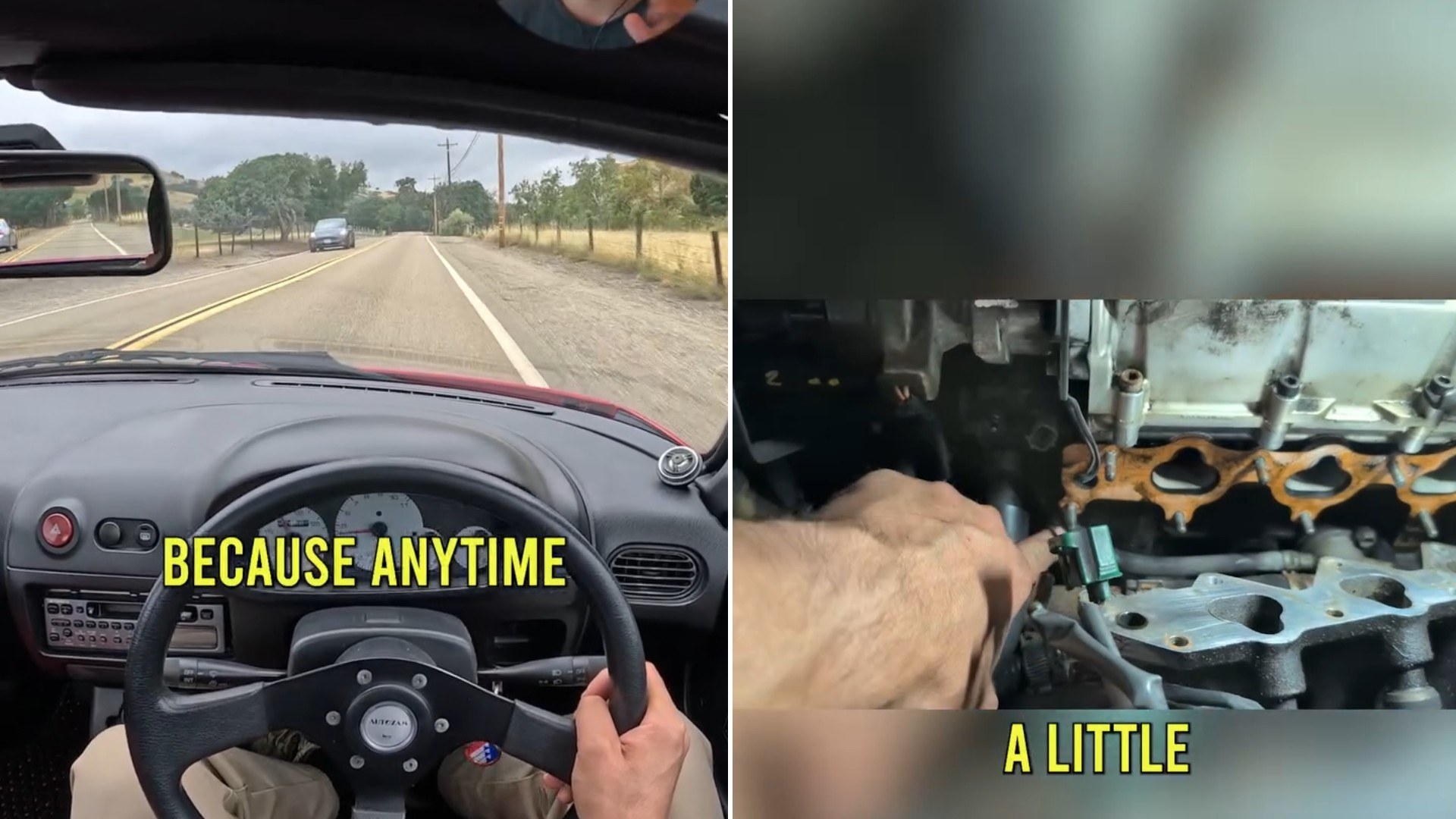
The moment @jubbalandcars wants to talk about is one he has to go back to. “If you rewind,” the on-screen captions begin, as his reel shows the view from the driver’s seat of a red Autozam AZ-1 on a quiet two-lane road. The words that follow piece the scene together: a last pull through a gear, white smoke, the car pulled in so he can take a look.
His first thought is the expensive one. The captions read “concerned about” and then “a head gasket.” The next line needs no assembly: “I’m gutted.” The reason is in the fragments that come after it. This is “someone’s car,” one that was “lent to me” for reviews.
The reel runs 94 seconds. It opens at a gravel pull-off among dry hills, where he bumps fists with another person standing beside the car. Most of what follows is onboard footage. The camera looks over a small three-spoke steering wheel and a set of white-faced gauges at the road ahead, and a circle in the top corner shows him in headphones, telling the story after the fact. The captions flash a few words at a time, so the account arrives in pieces.
The pieces are clear enough. After the smoke, the captions mention “the owner,” an “auto store” and the words “fill it back up.” Then he turns the question on himself. “I’m reflecting,” one caption reads, and the next one ends in a question mark: “differently?” He goes back over how he drove the car. He says he shifted “shy of redline,” and the captions put that redline at 9000.
His written caption makes the same point in one sentence. “Reviewing 30-year-old vintage JDM imports always comes with real mechanical risk,” he writes, “no matter how much mechanical sympathy you practice.”
Then the story turns. “But luckily,” the captions say, “a video” arrived “shortly after” and cleared up “the whole situation.” The reel cuts to that footage. It shows the AZ-1’s engine with the intake manifold removed, the ports in the cylinder head exposed and the old gasket still stuck to them. A hand reaches in and points at a short hose with a green clamp on a coolant pipe that normally sits underneath the manifold. The captions read “manifold off,” “we got lucky,” “look at that,” “coolant pipe,” “a little,” “torn hose” and “old rubber.”
The written caption fills in the mechanics. “White smoke pouring from an engine bay usually points to coolant entering the combustion chamber via a failed head gasket,” he writes, “but dry-rotted cooling components can mimic the exact same symptoms.” In this car, “aging factory rubber hose degradation under thermal expansion caused a sudden leak.” He adds that the leak ended up “saving the engine from major internal damage,” and he points viewers to the full AZ-1 review and diagnosis linked on his profile.
The scare and the answer are useful to any owner of an older car, because the two problems look alike from the driver’s seat and cost very different amounts to fix.
The first clue is where the white cloud comes from. When a hose or another external part of the cooling system leaks, coolant lands on hot metal and flashes to steam, which rises out of the engine bay itself. When a head gasket fails the way his caption describes, coolant gets into the cylinders and leaves through the exhaust, so the cloud comes out of the tailpipe and tends to carry a sweet smell.
The second clue is under the engine cover once everything has cooled down. An external leak usually leaves evidence, such as a wet or split hose, crusty residue around a clamp, a drip trail or a puddle. A head gasket problem tends to show up elsewhere: a milky film under the oil filler cap, bubbles in the coolant reservoir with the engine running, or coolant that keeps disappearing with no leak to be found.
Some hoses cannot be seen at all without taking parts off. The one in this reel only came into view with the manifold removed. That is the argument for replacing every hose within reach whenever a job like that is already underway. The parts are cheap, and the labor has already been done.
What happens in the first minute matters as much as the diagnosis. Pull over, shut the engine off and let it cool before touching anything. Never open a radiator or reservoir cap on a hot engine. Topping up the coolant gets a car moving again, but it does not fix a leak, and driving on with the temperature gauge climbing is how a cheap hose turns into the major internal damage this engine avoided.
There is a lesson about borrowed cars here too. He was driving a car that belonged to someone else, he kept it short of the redline, and he had a camera running the whole time. When something went wrong he could rewind to the exact moment and show what the car was doing. Anyone lending or borrowing an old car should agree on the limits before the drive and should have the conversation about what happens if it breaks before it breaks.
The bigger point is in his first sentence. Mechanical sympathy, meaning gentle warm ups and careful driving, does a great deal for an old engine, but it does nothing for rubber. Hoses age whether the car is driven hard, driven softly or parked. On a vehicle that is 30 years into its factory hoses, replacing them as a set with new clamps is ordinary preventive maintenance. A hose that feels crunchy, mushy or swollen when squeezed cold, or that shows cracks near its ends, is overdue.
That counts double for imports. Hoses for a Japan-only model can take weeks to arrive, so the time to order them is before one fails. A spare set on the shelf, plus a jug of coolant and a few clamps in the car, costs very little next to a tow.
For this AZ-1, the scare ended with “a little torn hose” and an engine that survived. It is about the best outcome white smoke can have.