

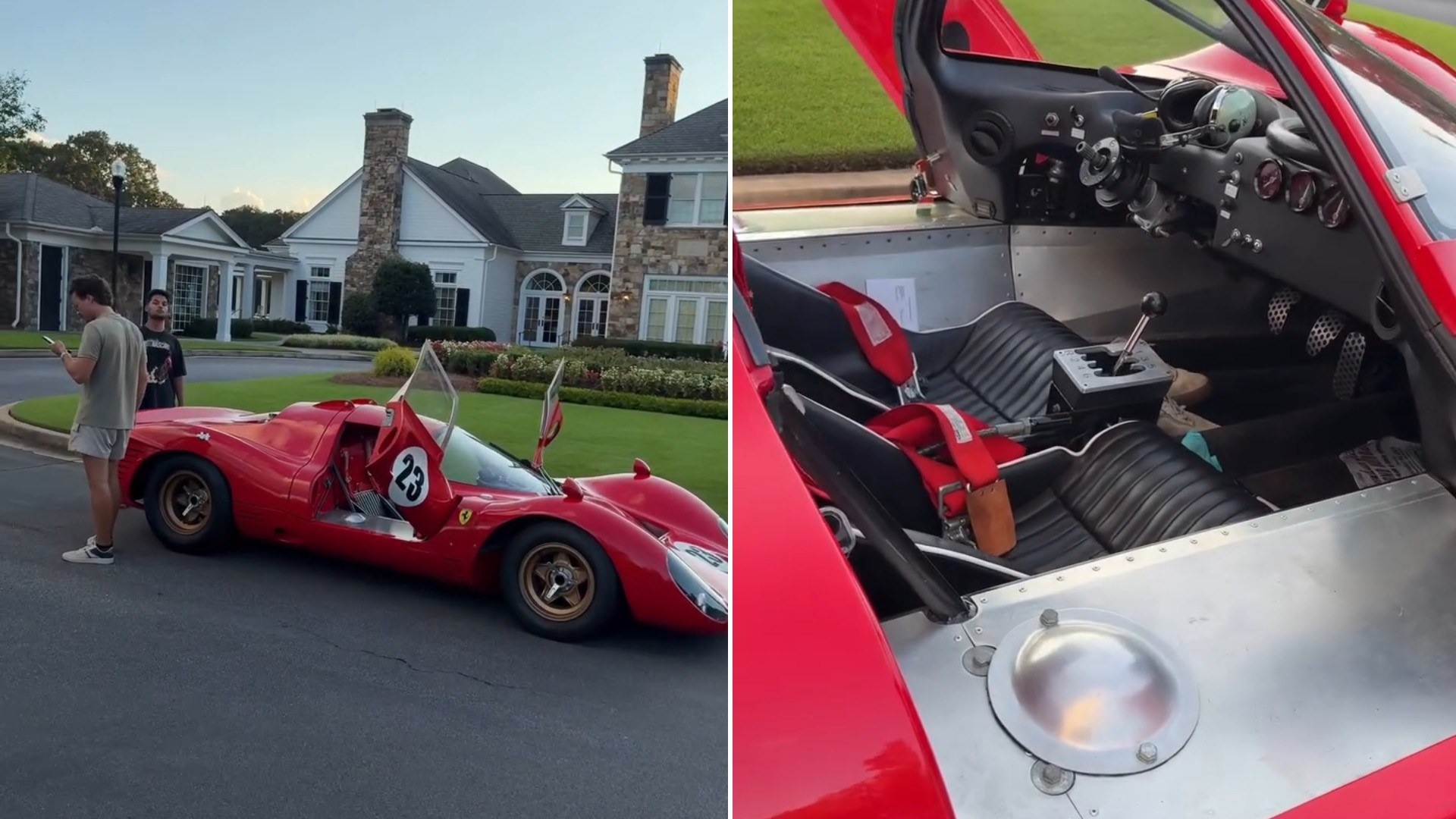
Some cars stop a walk dead. In a 39 second clip filmed on a quiet residential street, a low red race car wearing white number 23 roundels sits at the curb in front of a row of large brick and stone houses with clipped lawns, and a handful of people have already drifted over to stand around it.
The video comes from @gabesrides, who captioned it simply, “P4 at da country club.” There is no title card and no text on screen. It is a handheld walk toward the car in soft early evening light, followed by a slow lap around it while the people nearby talk among themselves.
The opening shot is taken from across the street, and it is the scale that lands first. Against the two story houses behind it the car looks tiny, with a roofline that barely reaches the waist of the people standing next to it. Both doors are already open, hinged upward so they stand above the body like a pair of raised wings.
As the camera closes in on the side of the car, the open door gives a clear view into the cockpit. There is a dark bucket seat with red harness straps laid across it and a wide panel of bare metal running along the sill. Nothing about it reads as a road car interior. It is a tight, purposeful space that a driver has to step over and drop down into.
From there the creator moves forward along the body. A gold wheel fills the frame under a front fender that swells up and over the tire, and the number 23 appears again in a white circle on the door. Then the camera comes around to the nose for the head on view: a small yellow badge at the tip, another 23 roundel in the center of the hood, headlights set behind clear covers, and a curved windshield wrapped around the cockpit.
The people around the car get as much screen time as the car does. They are dressed for a summer evening in T-shirts, shorts and sneakers. One of them, with long blond hair, sunglasses pushed up on the head and a black and red jersey with the number 99 on it, stands on the curb beside the raised passenger side door and chats with the others for several seconds while the camera lingers. On the other side, a man in a tan T-shirt stands inside the arc of the open door and then ducks down toward the cockpit for a closer look. Nobody is in a hurry. The clip ends with one more pass around the front of the car, still parked at the curb with its doors up.
What the video does not do is explain the car. Nothing in the clip or the caption says who owns it, how it ended up on this street, or whether it is an original or a recreation. The caption calls it a P4, the name Ferrari gave its endurance racing prototype of the 1960s, and the shape, the number roundels and the badge on the nose all follow that pattern. Beyond that, the creator lets the pictures speak.
That restraint is a useful lesson for anyone who likes to film cars. The whole thing runs well under a minute and still covers everything a viewer wants to see, because the shots come in a sensible order: a wide view that shows the setting and the size of the car, then the cockpit, then a wheel, then the nose, then the people. If you come across something special, working from far to near like this gives a short clip a beginning, a middle and an end without any editing tricks.
The light helps too. Shot late in the day, the red paint shows its curves without harsh glare or hard reflections, which is exactly when a bright car is easiest to film on a phone. Midday sun would have flattened those same surfaces.
The setting carries its own reminders. This is a residential street, not a show field, so the considerate approach is to stay out of the roadway, keep off the lawns and keep voices down. When a car’s doors are open, as they are here, the inside is on display, but that is not an invitation to lean on the bodywork or reach in. Ask whoever is with the car before getting close, and take your cue from them, the way the people in this clip stay relaxed and give the car room.
And if you want to know exactly what you are looking at, ask. A number on the door and a badge on the nose will tell you what a car is styled after, not its history. The person standing next to it usually knows the rest, and most are glad to share it with someone who shows up curious and polite.