
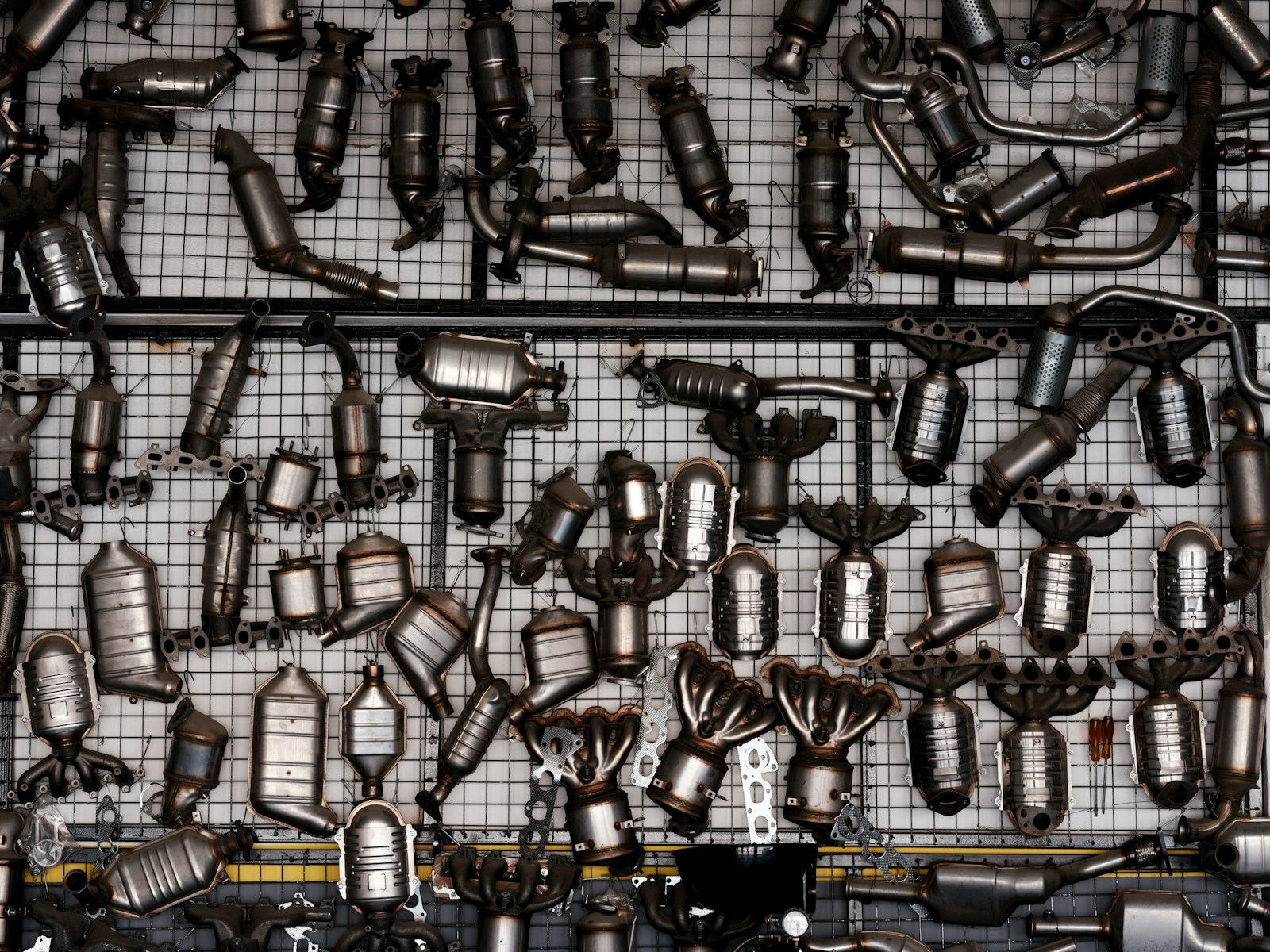

Overall vehicle theft in the United States fell 23.2% from 2024 to 2025 — from 850,708 stolen vehicles down to 659,880 — according to the National Insurance Crime Bureau’s own July 2026 report. That’s nearly 191,000 fewer stolen cars in a single year, with California alone accounting for 45,278 of the drop. Catalytic converter theft didn’t get the memo. Even as full vehicle theft keeps sliding, the crime of sawing a converter out from underneath a parked car in under three minutes has stayed a persistent, largely separate problem — and it’s still concentrated on a predictable short list of hybrids and trucks.

A Different Crime, a Different Trend Line
NICB’s own data shows how fast this specific theft category exploded, on a track that’s held steady even as overall vehicle theft has turned around. Catalytic converter theft insurance claims jumped from 16,660 in 2020 to 64,701 in 2022 — a roughly 288% increase in two years — according to NICB’s own surge report. Zoom out further and the number gets starker: NICB has documented a 1,215% rise in catalytic converter theft incidents since 2019, which the bureau attributes to a combination of soaring precious-metal values inside the converter and, in its own words, “negligible penalties” in many jurisdictions, according to NICB’s own analysis.
Why the Metal Inside Is Worth Stealing
Every catalytic converter contains small amounts of platinum, palladium, and rhodium, and metal recyclers pay for that content regardless of how the converter was obtained. Standard converters fetch $50 to $250 on the scrap market, while hybrid vehicle converters — built with a higher concentration of precious metal to meet stricter emissions requirements — can fetch up to $800, per NICB’s data. Replacing a stolen converter runs the owner $1,000 to $3,500 or more, meaning a theft that takes a thief under three minutes with a battery-powered saw can leave an owner facing a repair bill approaching what a lot of people pay in a car payment or two — with the vehicle undrivable, or illegal to drive, in the meantime.
The Vehicles Still Most at Risk
The National Insurance Crime Bureau has specifically flagged the Toyota Prius as a top target, a pattern that traces directly back to the precious-metal math above: hybrids run their catalytic converters harder and cleaner than a standard gas engine, packing in more recoverable metal per unit. Beyond the Prius, converter-replacement data compiled by Carfax and reported by Kelley Blue Book puts full-size trucks and high-volume SUVs at the top of the target list alongside it: the Ford F-Series, Honda Accord, Honda CR-V, Ford Explorer, Ford Econoline, Chevrolet Equinox, Chevrolet Silverado, and Toyota Tacoma all rank among the most frequently hit. The common denominator across the list isn’t luxury or rarity — it’s high ground clearance that makes the underbody easy to reach, and, in the hybrid’s case, the extra metal riding underneath.
The Gap Between Reported and Real
Insurance claims data almost certainly understates the true scope of the problem, since plenty of owners pay for the repair out of pocket rather than filing a claim. Carfax’s own replacement-record analysis — which counts actual converter swaps rather than just insurance filings — put the 2025 total above 137,000 stolen converters nationwide, in the very same year overall vehicle theft was falling by double digits. That gap, between the theft category everyone’s celebrating the decline of and the one still quietly climbing, is exactly the story the raw numbers tell.
What’s Driving the Disconnect
Vehicle theft overall responds to tools like GPS tracking, kill-switch technology, and coordinated law enforcement task forces — the kind of partnerships NICB credits for 2025’s drop. Catalytic converter theft resists most of that toolkit, because the crime doesn’t require starting the car or bypassing an immobilizer at all; it requires a jack, a saw, and under three minutes underneath a vehicle parked on a public street. Etching a VIN onto the converter, installing a theft-deterrent shield, and parking in a well-lit or garaged spot remain the most effective countermeasures NICB and local law enforcement partnerships continue to promote, precisely because there’s no ignition-based fix for a crime that never touches the ignition.
Two very different theft trend lines are running at once on the same roads: one shrinking because of technology built into the car, and one holding steady because it targets a part of the car that technology hasn’t caught up to protecting.