


The car showed up like a ghost with fresh paint. Not in some dusty barn reveal, not on a trailer pulled into a suburban driveway for a teary reunion, but under bright auction lights—low, clean, and perfect in that way only a six-figure restoration can make something look. People leaned in to admire the panel gaps, the deep shine, the stitched leather that didn’t exist in 1994, and the paperwork that looked, at first glance, impressively thick.
What nobody in the room knew—what the buyer wouldn’t learn until later—was that this Porsche had a different history than the one printed on the placard. Thirty years earlier it had been stolen from a family garage, the kind of theft that doesn’t just take a machine but takes the family’s little private myth about themselves. And now, somehow, it was back, except it wasn’t back in the way anyone wants their stolen car to come back.
The original owner was older now. The buyer was the kind of person who’d saved and searched and finally decided to do something irresponsible-but-joyful with money. Neither of them had done anything that looks like “crime,” and yet both of them were about to spend months being treated like they had.
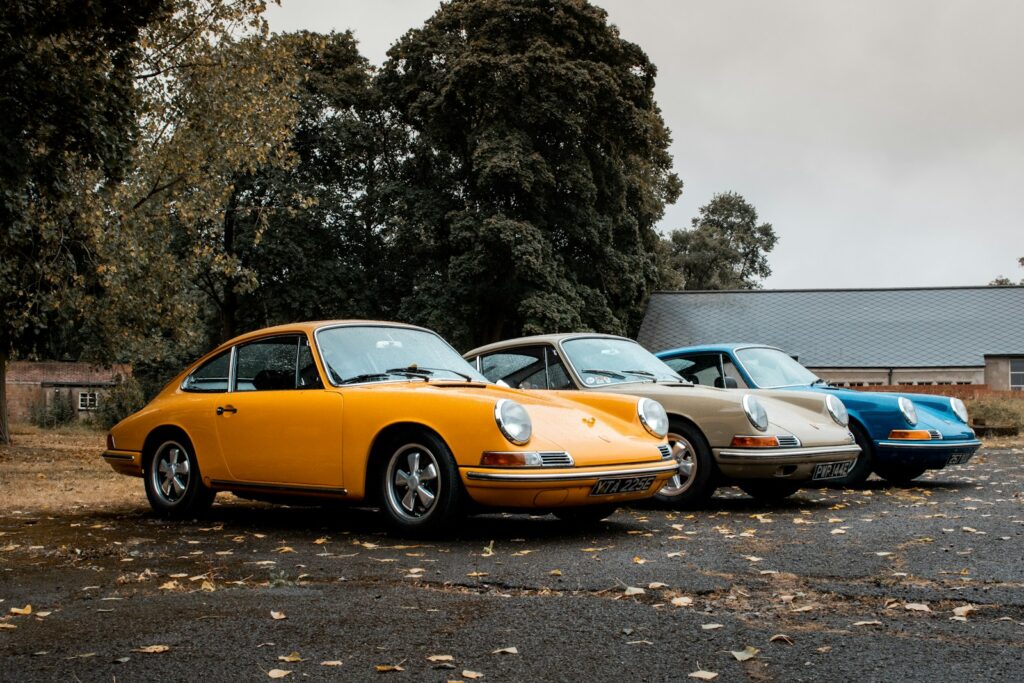
The garage, the empty space, and the file folder that never went away
Back in the mid-90s, the Porsche lived in a tidy family garage under a fitted cover, parked beside holiday decorations and lawn tools and the little everyday stuff that makes a house feel permanent. The owner was the kind of person who kept the title in a manila folder, along with service receipts and an insurance card that was always slightly out of date. The theft wasn’t cinematic—no alarm blaring, no masked guy sprinting down the driveway—just a morning where the garage door was open and the space where the car sat was suddenly wrong.
Cops came, nodded, wrote it up, and asked the questions everyone hates answering: where were the keys, who knew you had it, any enemies, any recent work done. The owner cooperated, called the insurance company, did all the bureaucratic steps, and still kept that folder. Even after the payout, even after years passed and the family moved on, the folder didn’t get thrown out because some part of him didn’t believe something like that could just disappear forever.
Over time the story got told less, but it didn’t get smaller. When people lose cars, they lose weekends, road trips, and the dumb little rituals—checking the oil, washing it on Saturdays, listening to the engine cool down in the garage. The Porsche turned into a sore spot the family learned to step around, and the owner learned to stop expecting the phone to ring with good news.
A beautiful Porsche with a perfect story—until the details didn’t line up
Fast forward three decades and the Porsche is suddenly “out there” again, wearing its rebirth like a tailored suit. It appeared in the collector-car ecosystem with a clean enough backstory: acquired years ago as a project, restored by a reputable shop, brought back to factory-correct condition with tasteful upgrades. The listing bragged about the engine rebuild, the fresh suspension, the receipts that read like a novel written in invoices.
The buyer wasn’t a villain twirling keys around his finger. He was someone who’d done what people always preach: he checked the VIN, ran a vehicle history report, looked over the title, and asked for documentation. Everything looked plausible, if not perfect—there were gaps, sure, but vintage cars always have gaps, and this one had a mountain of restoration photos that made it feel real.
He bought it. He insured it. He posted a few proud pictures for friends and fellow enthusiasts, showing the car in golden-hour light with that particular grin you get when you’ve wanted something for years and it’s finally in your garage. And then the first crack appeared in the story, not from a detective but from a casual observation that wouldn’t leave him alone.
Depending on who tells it, it was either a tiny stamping that looked “off,” a mismatch between a chassis number and a build detail, or a document that had too many clean lines for something supposedly transferred and handled for decades. The buyer did what you do when you’re trying to be responsible: he called the restoration shop to confirm details, asked for clarification, and started pulling the paper trail into one place. He wasn’t trying to accuse anyone—he was trying to reassure himself.
The moment the past grabs the present by the collar
The original owner found out in the most modern, humiliating way possible: a forwarded link, a screenshot, a “hey, is this your old car?” message from someone who remembered the story. The photos weren’t subtle. Same model, same rare color, and a couple of little identifiers that, to the right person, aren’t coincidence—they’re fingerprints.
He did what anyone would do who’s carried a theft for 30 years like a stone in their pocket. He pulled out the old folder. He compared numbers, photos, details, and started making calls. He wasn’t thinking about restoration money or auction rules or how ugly this could get; he was thinking, “That’s mine,” the way you think about something you watched vanish.
When he contacted law enforcement, it wasn’t a triumphant “case reopened” moment. It was slow, procedural, and weirdly cold. The car existed, it was in someone else’s possession, and there was a question of identity: was this actually the stolen Porsche, or just one that looked like it? That question, by the way, is not a philosophical one when it comes to cars—it’s a VIN one, a stamping one, a paperwork one, and sometimes a “somebody got creative with a welder” one.
Eventually the buyer got the call, and it landed like a dropped engine block. One day he’s planning a weekend drive; the next he’s being told the Porsche might be stolen property and he needs to bring it in for inspection. You can imagine the way his stomach must’ve flipped when he heard the words “seized” and “evidence,” words that make even innocent people sound guilty when repeated out loud.
Two decent people, one car, and the bill no one wants to pay
Here’s where the story turns from mystery into a mess. The buyer didn’t steal the Porsche. He didn’t fake the title. He wasn’t the one who took it from the family garage in the 90s. But he was the one holding the keys now, and he’d poured real money into it—either through the purchase price, the restoration itself, or both—money he couldn’t just shrug off.
The original owner wasn’t trying to “score a free restored car,” even if that’s how some people frame it when they want a clean villain. He’d had his property taken, and now it was sitting there—alive again, polished, valuable, and somehow still his in the most fundamental sense. The fact that someone else had loved it back to life didn’t erase the theft, and he wasn’t eager to be told he had to buy his own car back for the privilege of closure.
So the arguments started, not in dramatic shouting matches but in the way these things really happen: tense calls between lawyers, carefully worded emails, and long silences while everyone waits for the next official step. The buyer wanted to be made whole. The owner wanted his car. And the people in the middle—auction house, previous sellers, restoration shop, DMV clerks who processed paperwork years ago—suddenly had a spotlight on every decision they’d made.
Legally, the buyer’s “good faith” didn’t automatically grant him ownership if the car was provably stolen. Morally, the buyer didn’t feel like the universe should ruin him financially because criminals decades ago decided to fund their lives by emptying someone else’s garage. It’s the kind of conflict where both sides can explain themselves in two minutes and still leave you sitting there thinking, “Yeah, but… what now?”
The court fight nobody budgeted for
The Porsche didn’t get to sit in either garage while everyone sorted out their feelings. It ended up in the limbo that stolen-property disputes love: held, inspected, documented, treated like an object that can be paused while human lives keep moving. The buyer had to keep paying insurance, keep dealing with storage or loss-of-use questions, and keep explaining to friends why his “dream car” had become an administrative hostage.
The original owner had to relive the theft in paperwork form. Every detail from the 90s mattered again: the original VIN, old photos, insurance claim numbers, police reports with yellowed edges, and whatever documentation survived three decades of moves and life happening. If any of that was missing, he had to fight the suspicion that time itself had weakened his claim, as if being robbed ages out like a parking ticket.
Meanwhile, the buyer’s lawyers looked up the chain of title like it was a crime scene. Who sold it to whom? When did it re-enter the system? Where did the “clean” title come from? Was it clerical error, identity laundering, or an intentional wash through jurisdictions that don’t talk to each other well? The buyer didn’t want to sue everyone, but he also didn’t have a spare six figures to donate to fate.
The ugliest part was that neither man could really direct his anger at the right target, because the person who actually stole the car was either untraceable, dead, or unprovable. So the anger splashed where it could: at institutions, at paperwork, at the other guy’s “position,” even when both of them were standing in the same place emotionally—staring at a car that had become a weapon.
By the time the case crawled toward a hearing, the Porsche had become less like a vehicle and more like a ledger. Every new invoice and every new legal filing widened the gap between what felt fair and what the law might actually do. And the maddening truth hung over both of them: one of them was going to walk away without the thing he believed he rightfully owned, and the other might still end up paying for a crime committed before some mechanics at the restoration shop even had driver’s licenses.
The last update anyone had wasn’t a satisfying verdict, just the sound of the fight settling into its long shape—motions, claims, counterclaims, and two people living with the same sick uncertainty. The original owner could picture his Porsche back where it belonged, but now it came with someone else’s fingerprints in every seam. The buyer could picture himself compensated and vindicated, but compensation doesn’t recreate trust, and vindication doesn’t give him his dream car back. The Porsche sat somewhere quiet and locked away, restored to perfection, while the people attached to it got worn down instead.
More from Steel Horse Rides: