

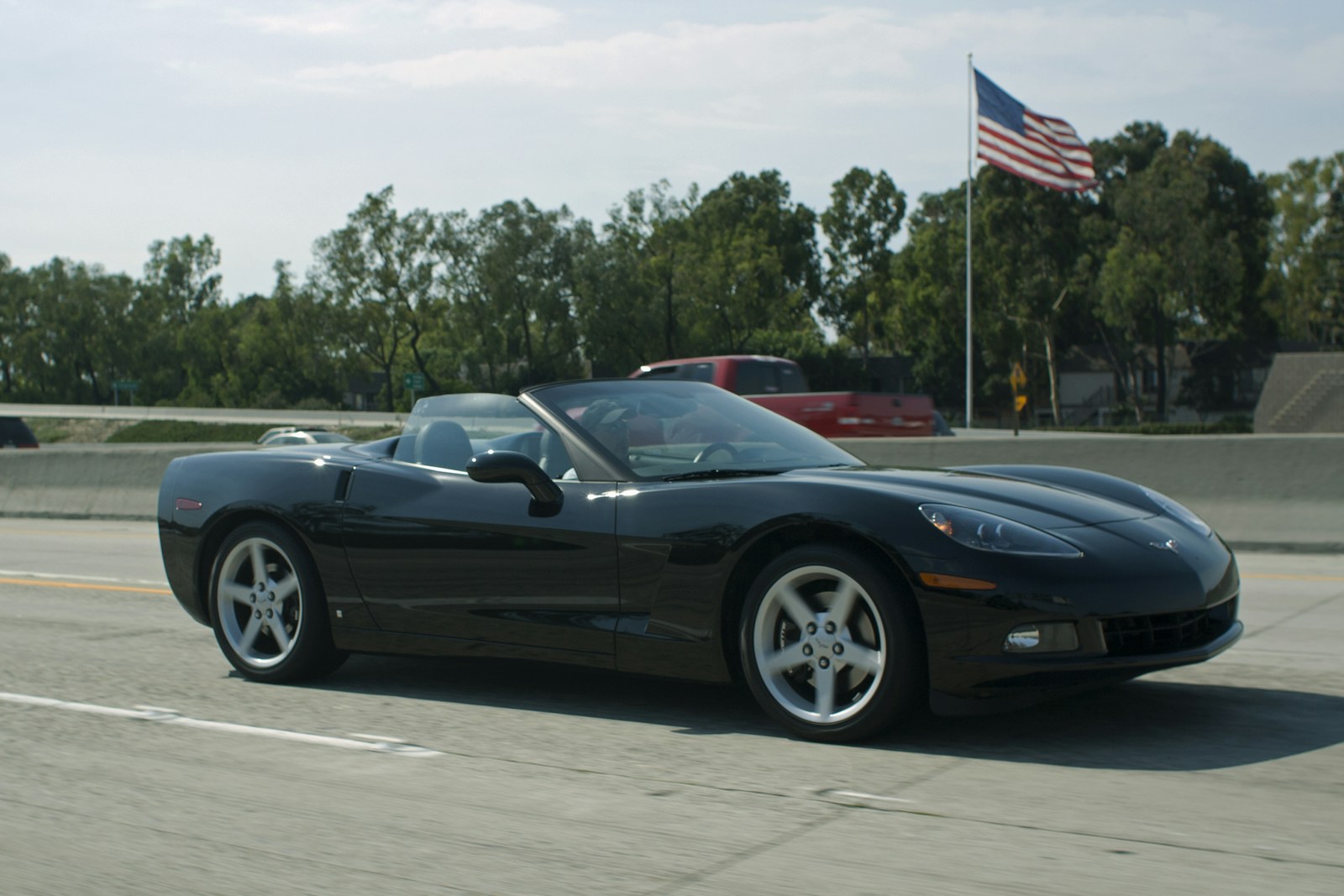
The conventional wisdom about convertibles has always been that the roof costs you money twice: once at the dealership and again three years later when the trade-in offer comes back lower than a comparable hardtop. Kelley Blue Book’s own resale data tells a different story for a specific handful of current models. The 2024 KBB Best Resale Value Awards list the Chevrolet Corvette holding 59.0% of its value after five years, the Toyota GR Supra at 57.2%, and the Porsche 718 Cayman at 54.2%, all comfortably ahead of KBB’s broader industry benchmark.
The Corvette Keeps Beating Its Own Segment
KBB’s most recent Best Resale Value Award cycle put the Corvette’s projected five-year retention at 54%, according to KBB’s 2026 Top 10 award coverage, against an industry average the awards program pegs at 45%. A separate KBB feature on the best convertibles currently on sale goes further, reporting that a 2025 Corvette convertible is projected to retain roughly 61% of its value after five years, the strongest number in KBB’s own non-luxury convertible ranking. Whichever specific figure you pull from KBB’s various award cycles, the Corvette is landing somewhere between nine and sixteen percentage points above the average car on the road, and it happens to be sold with a targa top or full convertible roof on a meaningful share of its build mix.
Convertibles Aren’t All Depreciating the Same Way
The Porsche 718 Boxster tells a similarly counterintuitive story on the luxury side. That same KBB convertible ranking reports the Boxster depreciated just 7% in its first year on the market, a number that would be respectable for a hardtop luxury sedan and is unusually strong for an open-top sports car starting near $77,000. Its hardtop sibling, the 718 Cayman, posted a 54.2% five-year retention figure in KBB’s 2024 awards, meaning the drop-top and the coupe are landing in the same general neighborhood rather than the convertible trailing badly behind, which is exactly the pattern the old depreciation assumption says shouldn’t happen.
The Mazda MX-5 Miata belongs in this conversation too, even without a headline percentage attached to it in these particular award cycles. It’s consistently named among KBB’s top convertible picks, and its combination of low starting price, strong enthusiast demand, and limited annual production has historically kept used examples trading close to what buyers originally paid, the same dynamic that shows up in Corvette and Boxster resale data at a different price point entirely. KBB’s convertible rankings put the current MX-5 Miata’s starting price at $30,430 for the soft-top and $38,450 for the retractable-hardtop RF model, according to the same KBB-sourced coverage, low enough entry pricing that even modest dollar-for-dollar retention translates into one of the cheapest ways to own a car with genuine collector-adjacent resale behavior.
The Ford Mustang convertible rounds out KBB’s non-luxury list in the number two spot, with EcoBoost versions starting around $42,000 and V8 GT models running $50,000 to $60,000 depending on trim, per that same ranking. It isn’t posting Corvette-level retention numbers, but its presence near the top of KBB’s convertible-specific list, rather than buried near the bottom the way the old depreciation stereotype would predict, reinforces that enthusiast-driven convertibles as a category are behaving differently than the reputation suggests.
Why the Old Assumption Is Starting to Crack
The depreciation reputation convertibles carry didn’t come from nowhere. Plenty of drop-top models genuinely do lose value faster than their coupe or sedan counterparts, particularly mass-market convertibles built primarily as fair-weather cruisers rather than genuine performance cars. But the models climbing KBB’s resale rankings share a trait that matters more than the roof configuration: they’re built around a driving experience buyers specifically seek out, not a body style tacked onto a volume model to chase seasonal sales. A Corvette buyer isn’t cross-shopping a sedan. Neither is a Boxster or Miata buyer. That narrower, more committed demand pool is exactly what supports resale value regardless of whether the roof folds down.
Toyota’s brand-wide resale performance backs up the broader point: the company has claimed KBB’s Best Resale Value Brand award for six consecutive years, with average retention around 53% across its entire lineup, convertibles and coupes alike, while Lexus led the luxury brand category at 47%. When the retention gap between “convertible” and “everything else” shrinks to nearly nothing at the brand level, the roof stops being the variable that predicts resale value at all.
What Buyers Should Actually Watch
None of this means every convertible on a dealer lot is a safe bet against depreciation. It means the blanket assumption that drop-tops universally lose value faster deserves retiring, at least for models with genuine enthusiast pull and limited production numbers. The data increasingly points toward demand character, not roof type, as the real driver of how a car holds its value five years down the road.