

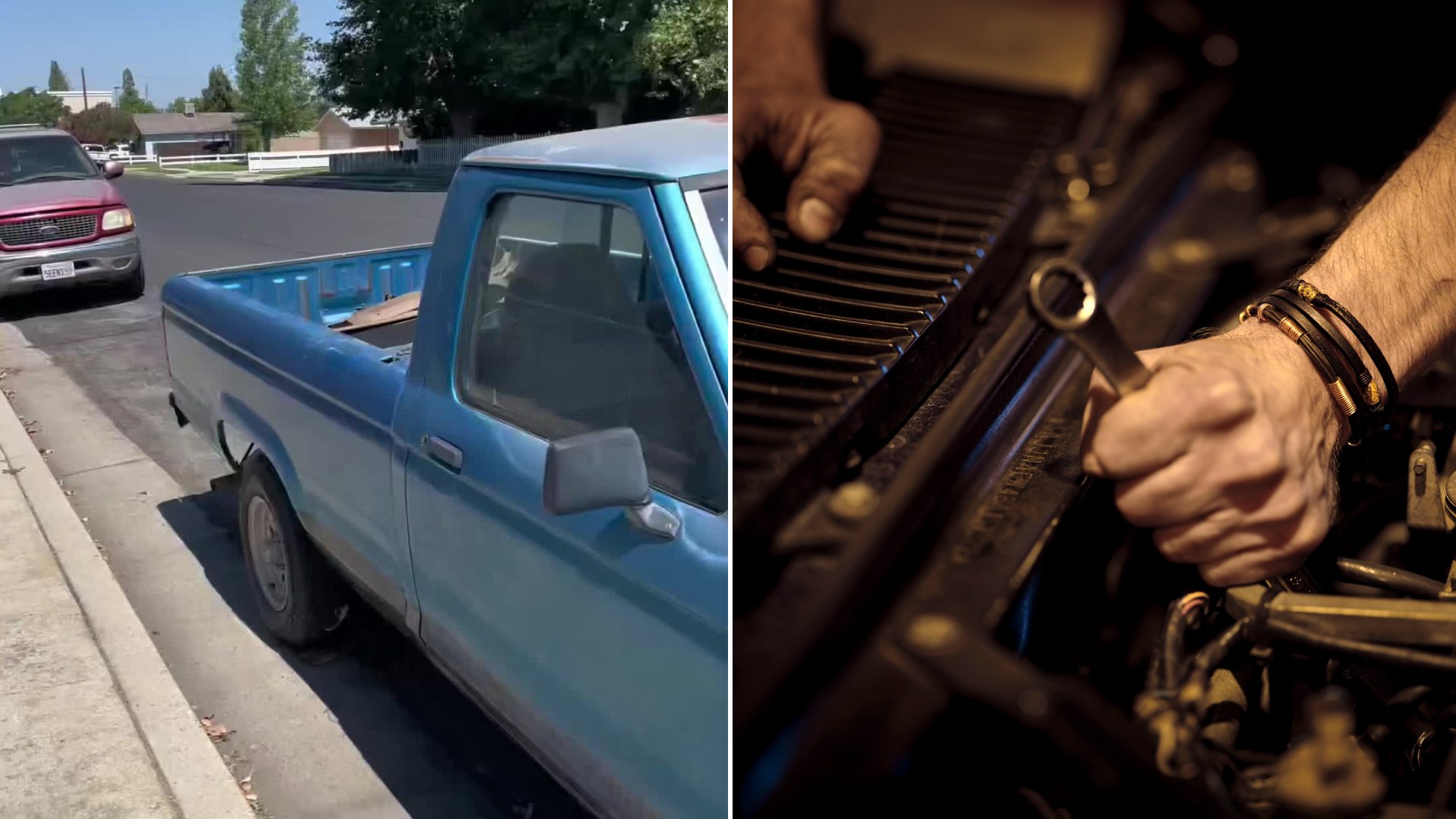
Not every project truck video is a smooth montage of gleaming parts and satisfying reveals. For the TikTok creator behind @jacab_stevens, documenting his Ford Ranger build has meant showing the messier reality of vehicle repair: repeated no-crank and no-fuel problems, and a starter repair that, according to his own narration, took several frustrating attempts before things started working right.
“This Ford Ranger build got serious,” the caption reads, tagged with hashtags referencing DIY work, a build he calls the “Bristow Build,” and his role as a mechanic tackling the project himself. Based on his account of the process, the truck is a neglected, inexpensive project vehicle — the kind of used Ranger that shows up cheap on classifieds precisely because it needs work, work that in this case turned out to be more involved than a quick tune-up.
No-crank and no-fuel issues rank among the most common, and most maddening, problems a DIY mechanic can encounter. A no-crank condition means the engine won’t even attempt to turn over when the key is engaged, which narrows the likely culprits down to a handful of usual suspects: a dead or failing battery, corroded connections, a faulty ignition switch, or, as his narration reportedly points to in this case, problems with the starter itself. A no-fuel condition is its own separate headache entirely, often tracing back to a failed fuel pump, a clogged fuel filter, or wiring issues in the circuit that powers the fuel delivery system. Having both problems surface on the same project, sometimes in overlapping or intermittent ways, is exactly the kind of scenario that turns a straightforward repair into a genuine diagnostic puzzle.
What makes this kind of content valuable to viewers, even when it doesn’t show a perfectly clean success story, is the honesty of the repeated attempts. According to his account of the process, fixing the starter wasn’t a one-and-done job — it took multiple tries before the truck responded the way it was supposed to. That’s a far more realistic depiction of hands-on vehicle repair than the polished, single-take fixes that dominate a lot of automotive content. Starters can fail for more than one reason simultaneously, wiring issues can mimic starter problems and send a mechanic chasing the wrong fix, and sometimes a repair that looks correct on paper simply doesn’t solve the underlying issue the first time around.
Project trucks bought specifically because they’re cheap and neglected come with an implicit understanding that the purchase price is only the beginning of the real investment. A Ranger picked up as an inexpensive project vehicle is, almost by definition, going to need parts, diagnostic time, and plenty of trial and error before it’s reliably back on the road — the repeated no-crank and no-fuel troubles documented here are less a sign that something went unusually wrong and more a fairly typical chapter in the life of any budget project truck being brought back from neglect.
Documenting the frustration alongside the eventual fixes gives followers a more complete picture of what a build like this actually demands — not just mechanical knowledge, but persistence through the attempts that don’t work before landing on the one that finally does.
Takeaway: Diagnosing No-Crank and No-Fuel Problems
When facing a no-crank condition, work through the electrical chain methodically — battery voltage and terminal connections first, then the ignition switch and starter relay, before assuming the starter itself is at fault, since replacing a starter unnecessarily wastes both time and money. For no-fuel issues, check fuel pressure at the rail before disassembling anything, and don’t overlook simple culprits like a clogged filter or a tripped inertia switch. Above all, budget extra time for cheap project vehicles bought specifically because they need work — repeated troubleshooting attempts aren’t a sign of doing something wrong, they’re simply part of the process of diagnosing an older vehicle with more than one issue happening at once.