

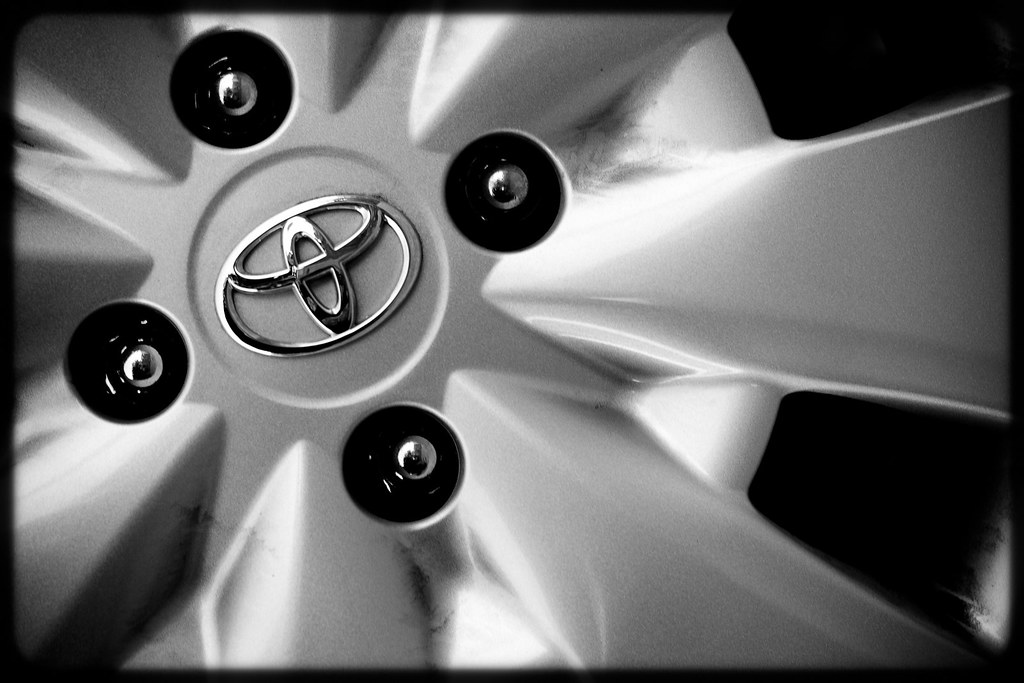
The service advisor did the usual gentle narrowing-down questions. Any warning lights? Any recent work? Any potholes? The customer shrugged and said the only thing that changed was a tire rotation at a quick-service place a few days ago, and that it seemed fine at first. But this morning, something about the front end felt… wrong, and he couldn’t shake it.
So they wrote it up as a vague vibration/handling concern and handed it to a tech who’d seen enough “it feels off” complaints to know they’re either nothing or they’re the kind of nothing that gets people hurt. The Camry went up on the lift, and within a minute the tech’s whole posture changed—the little pause that says, “Oh. That’s not good.”
The kind of “off” you can’t diagnose from the driver’s seat
On the front driver side, three of the five lug nuts were just… gone. Not loosened, not backed off a few threads—missing. The remaining two were there, but the setup looked like it had been driven on long enough for the wheel to start shifting its load in ways it absolutely shouldn’t.
It’s hard to explain how fast the mood changes in a shop when someone finds something like that. A lot of problems are annoying; this one is existential. If that wheel lets go at the wrong time, there isn’t a “pull over and call a tow” moment—there’s a sudden grinding, a drop, a shower of sparks, and the driver discovering physics the violent way.
The tech didn’t do the macho thing and toss the nuts in a tray like it was no big deal. He called the advisor over and pointed without even touching the wheel, like moving it might make it worse. Then he grabbed the paperwork and asked, “You said rotation was where?” in that careful, controlled voice people use when they’re trying not to start a fire.
The awkward walk to the waiting area
The advisor went out to the customer and did that delicate dance: not wanting to scare him, but needing him to understand the seriousness. “So… we found something,” he started, and watched the guy’s face tighten as if he was bracing for a four-figure estimate. Then the advisor said, “Your front driver wheel is missing three lug nuts.”
For a second, the customer didn’t even process it. He blinked like the words didn’t fit together. Then he did what a lot of people do when you tell them something terrifying: he tried to laugh, a short disbelieving sound, and said, “No it’s not. I would’ve noticed that.”
The advisor didn’t argue. He just asked him to come look, which is the smart move because this isn’t a situation where reassurance helps. The customer followed him to the bay, and when he saw the empty studs—those bare, threaded posts staring back—his expression went flat and quiet, like the air got sucked out of him.
His first words weren’t about money or blame. They were about his kid. Apparently he’d dropped his daughter at school that morning and taken the highway afterward, the exact route where a wheel coming off wouldn’t just ruin his day, it would ruin somebody else’s.
How does that even happen?
The tech started walking through the likely timeline out loud, partly for the customer and partly because it’s what mechanics do when they’re trying to make sense of a mess. If a shop runs lug nuts on with an impact and doesn’t properly torque them, they can back off. If they cross-threaded one and forced it, it might not have seated correctly, and the vibration can start a domino effect.
And then there’s the most uncomfortable possibility: someone simply forgot. Rotations are “easy” until they aren’t, and quick-service places thrive on speed. A distracted tech, a rushed lane, a manager yelling about the clock, a torque wrench that never comes off the wall—suddenly “five lugs per wheel” turns into “eh, it’s tight enough,” right up until it isn’t.
What made this one especially unsettling was that three nuts didn’t just loosen and vanish in a parking lot. That’s three pieces of hardware falling off at speed, bouncing into traffic or disappearing into the gutter. The customer kept repeating, “I didn’t hear anything,” like that was the part his brain couldn’t reconcile—because if something that dangerous can happen quietly, what else is he missing on any given day?
They checked the other wheels. The story didn’t magically become less messy. The passenger side wasn’t missing lug nuts, but the torque readings weren’t consistent, and that’s the kind of clue that points back to the last hands on the job.
The phone call nobody wants to make
The customer’s next move was immediate and predictable: he wanted the tire shop called, and he wanted it called right now. Not in a “I’m going to scream” way, but in that controlled, vibrating anger of someone who realizes he trusted strangers with something that keeps his family alive. The advisor offered to document everything and told him they could re-torque and replace hardware, but the customer wasn’t focused on the repair yet.
So he called the tire place himself from the bay, speakerphone on, because he wanted witnesses. You could hear the shop noise on the other end—air tools, someone yelling a name, the kind of background that usually feels normal until it’s attached to a problem like this. He gave them the date of service and explained what was found, and there was a pause like the person on the line was deciding which script to use.
The first response was the standard deflection. “We always torque to spec.” “That’s really unusual.” “Are you sure nobody else touched it?” The customer didn’t take the bait. He just kept repeating the same sentence, slower each time: three lug nuts are missing, and you were the last shop to remove the wheels.
At that point the call turned into logistics and defensiveness. The tire place wanted the car brought back to them for inspection, which made the customer’s eyes narrow because the whole issue was trusting them with the car again. The advisor quietly said they could provide an itemized report and photos, which is the polite shop version of “we’re not letting this turn into a ‘he said, she said’ without receipts.”
Paper trails, torque specs, and the weird intimacy of near-misses
The tech replaced the missing lug nuts, inspected the studs, and checked for damage where the wheel could’ve been moving against the hub. He didn’t sugarcoat it: if the studs were stretched or the threads were compromised, it could turn into a bigger job. That was another punchline nobody wanted—because the initial screw-up wasn’t even theirs, but now they were the ones holding the bag for making it safe.
While the car was still up, the customer stood there watching, not hovering exactly, but not leaving either. People hang around for different reasons—some don’t trust shops, some are just curious—but this was different. It was like he needed to see every step with his own eyes so his brain could accept that the danger had been real and was now being handled by someone who seemed to care.
The advisor started gathering paperwork: photos of the wheel with missing hardware, the torque readings on the other wheels, the mileage, the customer’s statement about when the rotation happened. It wasn’t dramatic, just methodical, the administrative side of “this could’ve killed somebody.” They also recommended rechecking torque after a short drive, which is standard, but in this context it sounded like a promise: we’re not letting you leave with a guess.
The customer kept circling back to one question, and it wasn’t about reimbursement. “How far did I go like this?” he asked, like distance could somehow translate to a probability of survival. The tech said it’s impossible to know exactly when they started backing off, but the fact that he felt something change was what probably saved him—because he listened to that small, nagging wrongness instead of turning up the radio and hoping it went away.
When he finally drove out, the car felt normal again, which was both relieving and infuriating. Normal meant the problem had been invisible until it wasn’t, and it meant the tire shop could easily say, “Well, you’re fine now,” like that erased the reality of what almost happened. The last thing he did before pulling onto the street was sit for a few seconds with his hands on the wheel, staring forward, looking less like someone leaving a repair shop and more like someone trying to decide how much trust he has left to hand out.