

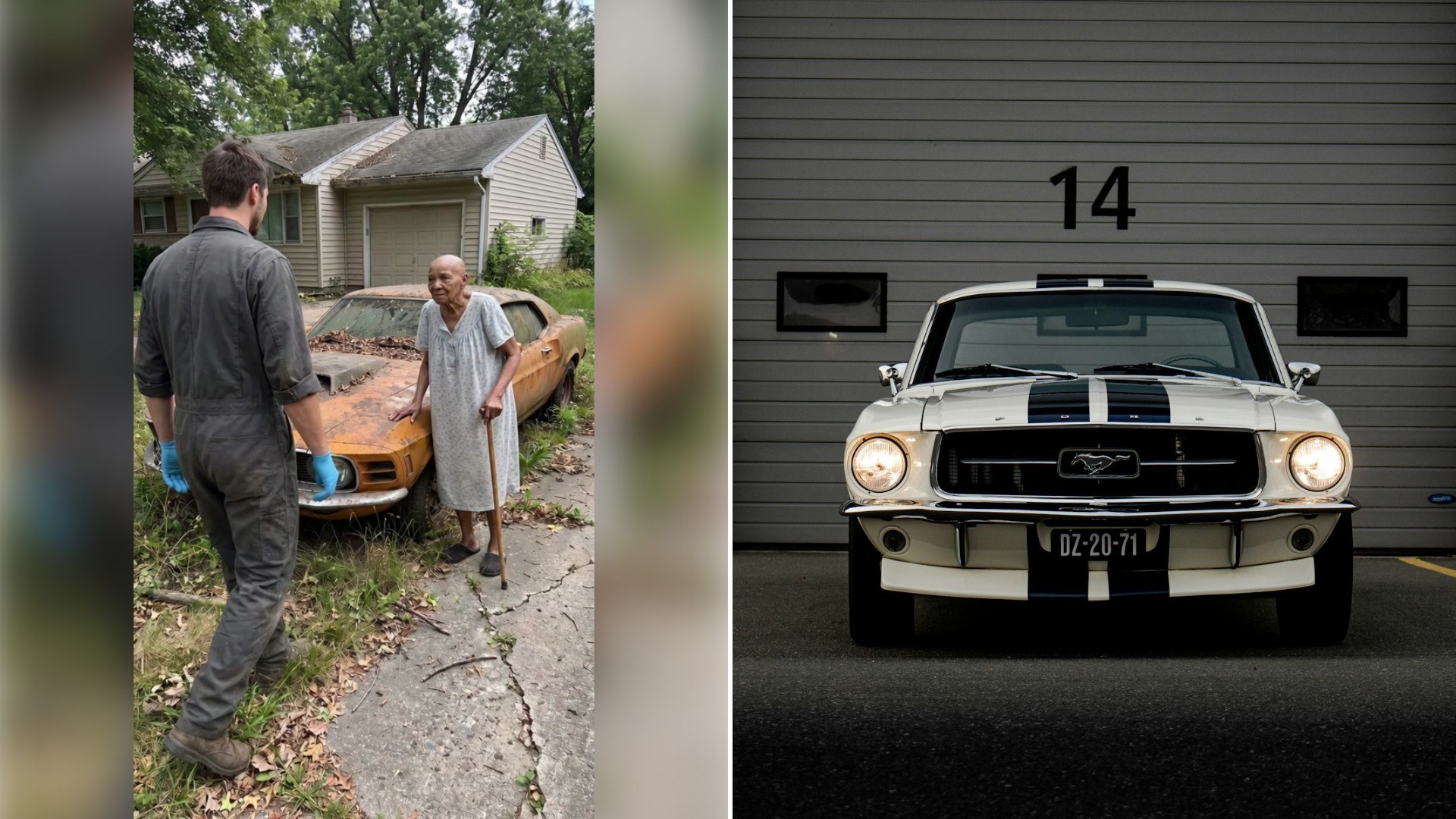
The video from @stories.tyler opens in a front yard, where a man in gray coveralls and blue gloves is talking to an elderly woman in a housedress who is leaning on a cane. Behind them sits an orange Mustang with a scooped hood, covered in leaves. “Ma’am, is this the Mustang you’re trying to sell?” he asks. “Yes,” she says. “I just got home from treatment. I can’t take care of it anymore.”
He asks how long it has been sitting. “Almost 18 years.” He asks whether it was her husband’s. “Yes. He bought it in 1970. He never let anyone repaint it.” His reply sets up everything that follows: “Before you let it go, let me show you what’s still underneath.”
@stories.tyler This 1970 Frod Mustang Boss 429 was about to be sold…until we uncovered what eighteen years had failed to take away#cardetailing #carwash #carcleaning #restoration #stories
The rest of the video is narrated over footage of the work. The narrator says the car is a 1970 Ford Mustang Boss 429 and that its owner is 79 and “could barely stand without her cane” when he met her. The leaves and dirt were recent, he explains. For most of those 18 years the car had been inside.
According to the narration, her late husband bought the Mustang in 1970, shortly after they married, “and promised himself he would keep it original.” He never repainted it and never replaced parts just because they looked old. “Every scratch and faded spot became part of their life together,” the narrator says. There were weekend drives and visits to family, and Sunday afternoons when he cleaned the car in the driveway. As the couple got older he drove it less, and eventually he parked it in the garage. It stayed there after he died. His wife, the narrator says, “couldn’t bring herself to move it.”
What put it outside was her health. The narrator says she became seriously ill, and her family needed to clear part of the garage to make safer access and room for her mobility equipment. The Mustang was rolled onto the driveway for what was meant to be a few days. Then another round of treatment sent her back to the hospital. “Days became weeks, then months.” Wind damaged the old cover, and the car sat exposed under the trees. By the time the detailer arrived, she was thinking of selling it because she no longer had the strength to protect it.
His inspection changed the plan. The car, he says, “had never been restored or repainted.” The original finish showed “oxidation, scratches, and honest patina.” The body and undercarriage had surface corrosion “but remained remarkably intact,” and the interior was “incredibly complete and well preserved.” He told her not to sell it yet. The goal he gives is the line the whole video hangs on: “We were going to preserve what survived.”
The footage shows what that meant in practice. A pressure washer strips the grime off orange paint. With the car up on a lift, the camera goes underneath to a rust-brown rear axle, and a label on screen reads “Laser cleaning” as a point of light moves across bare metal. The narrator says the underside was cleaned with dry ice blasting “to remove decades of contamination without damaging the original surfaces,” and that “selected corrosion on the chrome and undercarriage was treated with laser rust removal.” There is a look into the engine bay, a “Quick second wash,” and then a machine polisher working slowly across the fenders and around the rear window. Inside, a brush on a drill scrubs the carpet near the pedals, and a “Before” label sits over the seat upholstery. The interior, he says, was cleaned “without replacing original pieces simply because they showed their age.”
The finished car sits in a shop with a checkered floor, bright orange with a black hood scoop. “The scratches remained. The patina remained,” the narrator says.
Then he describes the owner seeing it. She walked slowly to the driver’s side, rested her hand on the paint, looked across the hood and whispered, “You didn’t make it new.” He told her he did not think her husband would have wanted him to. She smiled, he says, and told him her husband always believed “God gives something its original story only once, and making it perfect again couldn’t bring those years back.” The narrator adds that for the first time, “she wasn’t worried about what would happen to the car after she was gone.”
The video closes with a question for viewers: if the car were offered exactly as it sits after preservation, “what would you honestly pay for it?”
The first lesson here is about timing. The woman in the video was ready to sell because the car had become one more thing she could not manage. That is the worst moment to set a price. A car under leaves and a torn cover looks like a problem, and buyers pay for problems accordingly. If you or a relative are in that position, get the car cleaned and looked over before deciding anything. It costs far less than a restoration, and it tells you what you are really selling, or whether you want to sell at all.
The second is that original paint can only be lost once. The narrator’s argument, and the late owner’s, is that an unrestored car with its factory finish, a complete interior and honest wear has something a repainted one cannot get back. He says such a car “can be worth far more than an ordinary forgotten Mustang.” Whatever the number, the practical rule is to do the reversible things first. Washing, careful polishing and cleaning the underside can all be done without removing anything original. A repaint cannot be undone, so it should be the last decision, not the first.
The methods matter too. Dry ice blasting and laser rust removal, the two named in the video, are both ways of taking contamination and corrosion off metal without grinding into what is underneath. Anyone hiring out work on an original car should ask what method will be used on each surface, and ask to keep every part that comes off.
The last lesson is the one the family in this story learned the hard way. A garage-kept car that has to go outside “temporarily” needs a plan with an end date. In the video, a few days turned into months and a cover failed in the wind. If a car must leave its garage, check the cover regularly, keep leaves off it, and name one person who is responsible for moving it back in.