

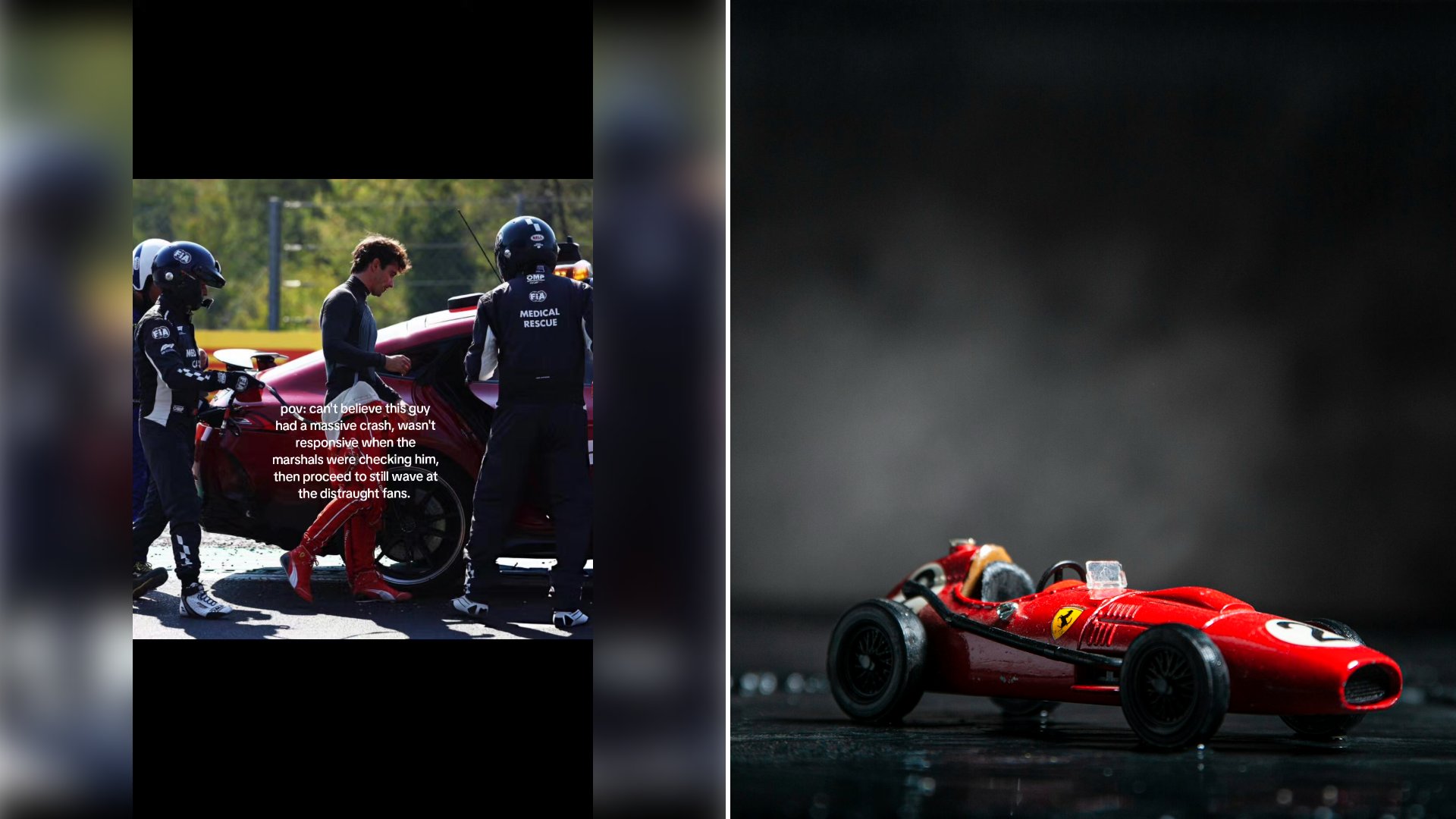
The clip opens on Charles Leclerc standing beside an open red car at the edge of the Monza track, a medical crew in white and blue jackets around him and a grandstand packed with fans in Ferrari red behind the fence. Two seconds later it cuts to the cause: his Ferrari sliding sideways off the circuit in a cloud of dust and burying its nose in a wall of tyres lined with yellow P Zero boards.
The eight second video was posted on September 6, 2026, the day of the Italian Grand Prix, by the TikTok fan account @leclercleclerccharleslec, which goes by Alexandramleuxcore. It is a fan edit of race footage, not something filmed by Leclerc or his team, and the account’s text over the clip reads: “pov: can’t believe this guy had a massive crash, wasn’t responsive when the marshals were checking him, then proceed to still wave at the distraught fans.”
Between those shots the edit shows two track marshals in orange kneeling in the grass beside the run off, with haze still hanging in the air. Then comes the spin itself: the red car snaps around on the exit of a corner edged with green, white and red kerbs, slides across the asphalt and into the gravel, and disappears behind the barrier in a wall of dust. A later shot shows the car pointed into the stacked tyres with its front end smashed, and Leclerc climbing out of the cockpit on his own in his red race suit. The last frames return to him standing with the medical team as the crowd watches from behind the fence.
The fan account’s caption adds what it presents as Leclerc’s own reply: “i am okay. i was a bit worried at first because my eyes didn’t feel particularly good but it’s good now.” The post does not say where that line came from, and the claim that he was unresponsive comes from the fan text only; the footage in the clip shows him getting out of the car and walking with the medical crew.
Formula 1’s own account of the race matches the footage. In its official highlight from September 6, 2026, Formula 1 says Leclerc was fighting for position with Oscar Piastri on the second lap at Monza when he lost control exiting the Parabolica, crashed heavily, and got out of the car himself as red flags stopped the race. A separate Formula 1 report the same afternoon says he had started third, went side by side with his Ferrari teammate Lewis Hamilton into Turn 2 at the start, and later described that fight as “way too close.” About the crash lap, he told the official site that on the first lap the car “felt kind of weird” and that on the second lap “it just felt a little bit weird, so we’ll look into it.”
Leclerc gave the fullest account of how he felt four days later, ahead of the Spanish Grand Prix in Madrid. In a Formula 1 article published September 10, 2026, he said that “right after the crash” he felt “a little bit dizzy,” that he improved from Monday afternoon, and that he had “quite a few treatments for the neck, because that’s where most of the shock went.” He added: “I did quite a lot of checks, and all checks were fully fine,” and the article says he was medically cleared to race.
That is the part the eight second clip cannot show. The man climbing out of the car and walking to the medical crew still had a dizzy spell and a sore neck to deal with in the days afterwards, and he went through repeated checks before he was allowed back in a car.
How Formula 1 Decides a Driver Gets Checked
Getting out unaided does not end the medical side of a crash in Formula 1. Under Article B1.1.5 of the FIA’s 2026 Formula 1 Sporting Regulations, if a car’s impact warning light comes on after an incident, the Race Director, the Chief Medical Officer or the FIA Medical Delegate can require the driver “to be examined by the Competition medical service without delay,” and the Medical Delegate decides when and where. The same rule lets those officials order a medical examination of a driver at any time during an event.
The red flag seen in the official account also follows a written procedure. The same regulations give the Race Director authority to suspend a session or race if it is judged unsafe to continue, and when red flags are shown at the marshal posts every driver must slow down immediately and return to the pit lane, which is what cleared the track so the marshals and medical crew in the clip could reach the car and the barrier.
What a Road Driver Can Take From Leclerc’s Account
Leclerc’s own words line up closely with what public health guidance says about head knocks. The U.S. Centers for Disease Control and Prevention’s concussion fact sheet lists dizziness, “fuzzy or blurry vision,” balance problems and headache among the symptoms, and says some symptoms “may not appear for hours or days after the injury.” If you are ever in a hard collision on the road, a few steps follow directly from that:
- Do not treat climbing out of the car on your own as proof you are fine. Leclerc walked away and still reported dizziness and neck treatment afterwards.
- Tell the responders about anything odd with your eyes, balance or head, even if it fades. The caption’s line about his eyes “not feeling particularly good” at first is exactly the kind of detail worth mentioning.
- Get checked by a doctor after a heavy impact, and say where the force went. Leclerc pointed to his neck as the place that took most of the shock.
- Watch yourself for the next few days. The CDC fact sheet says to tell your doctor if you are not improving or your symptoms are getting worse.
- Do not rush back behind the wheel. Even a Formula 1 driver went through repeated checks before he was cleared for the next race.
More from Steel Horse Rides
- Rider With a Helmet Camera Tells a Jeep Driver It Was Not Your Fault After a Bike From His Own Group Goes Down at Night, Then Helps Put the Jeep on Its Spare Before Leaving
- Car Spotter Asked Why Anyone Would Film Just an Old Porsche Answers With Close Up Footage of a Red Slant Nose Car Wearing a RUF RSR Plate, Vented Fenders and a Huge Rear Wing
- 12 Dashboard Warnings Drivers Regret Ignoring