

She was still sitting in her car when her phone started buzzing with family group texts. The airbag smell hadn’t even cleared, her hands were shaky on the steering wheel, and she kept replaying the sound of metal folding like a soda can. Across the intersection, her cousin’s SUV was angled up on the curb like it had tried to climb out of the situation.
The cousin—late twenties, always “between jobs,” always borrowing someone’s vehicle—kept insisting it was an accident, like saying the word enough times would rewind the last sixty seconds. He paced in front of the crumpled hood, checking his phone, checking her face, checking for witnesses. She could see his eyes snag on the police cruiser turning the corner, and something in him tightened.
By the time the officer walked up, the cousin had already shifted from panicked to strategic. He wasn’t asking if she was okay so much as he was asking what she was going to do. And when she said she needed to file a claim—because her bumper was in pieces and her neck was starting to throb—he hissed, “Can we not do this right now?” like she’d brought up politics at Thanksgiving.
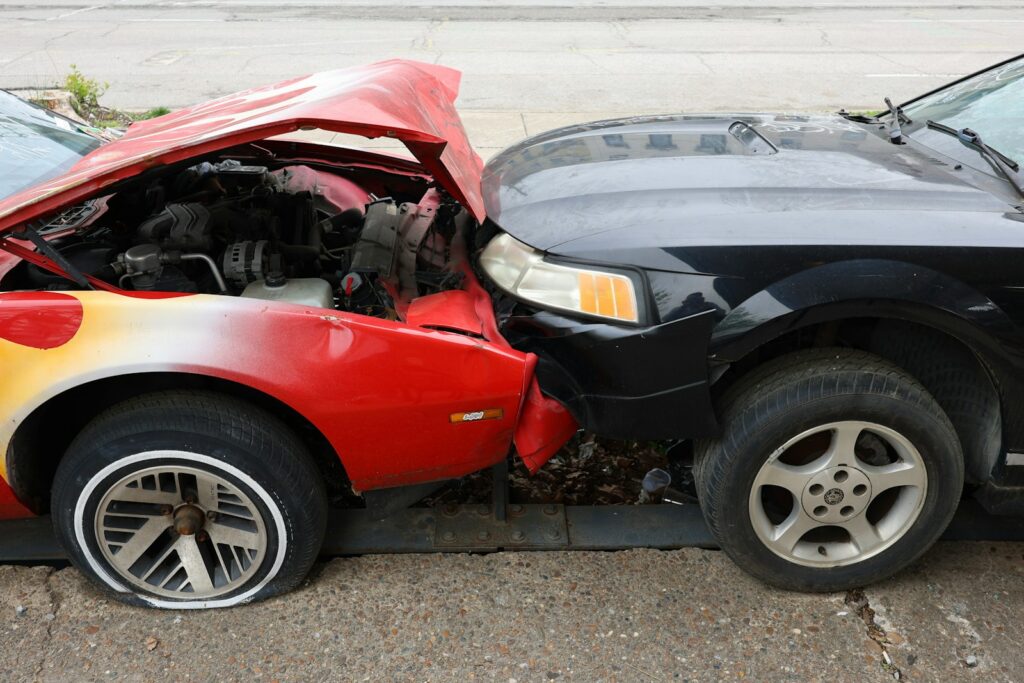
The crash nobody wanted on paper
It wasn’t some icy-road, unavoidable thing, either. The cousin had been trying to “make the light” while looking down at his phone for directions, blew through a red, and clipped her as she turned left. She had the green arrow, the right of way, and the sick realization that being correct doesn’t stop physics.
The officer separated them and did the routine questions, but it immediately got weird when the cousin started talking in vague circles. He didn’t have his insurance card, he couldn’t pull up an app, and every time the officer asked for proof, he tried to redirect to how “we’re family” and “we can handle it privately.” The officer’s expression didn’t change, but his pen stopped moving in that way that says, Okay, so that’s what this is.
Then came the real punchline: the cousin wasn’t insured at all. Not “my insurance lapsed last week,” not “I forgot my card,” just… nothing. The car was technically his, but it had been registered in his mom’s name at some point, and the paperwork was a mess he talked about like it was a relatable quirk.
When the officer told him he’d be cited, the cousin turned to her like it was her fault the law had shown up. “Do you really want to do this to me?” he asked, under his breath, like she’d called the cops on him for stealing. She stared at her broken headlight and the smear of paint along her driver-side door, and she couldn’t even find the energy to argue.
“Just let him pay you back”
Within an hour, the family network activated. Her aunt called first, voice soft in that fake-calm way that means she’d already decided what the correct outcome was. “Honey, he feels terrible,” she said, “but filing a claim is going to cause problems.”
Her mom called next, and she wasn’t mean—just frantic. She kept saying, “We can sort this out,” the way people say it when they want something to disappear. The cousin’s dad texted a long message about how “insurance companies are vultures” and how it was “better for everyone” if they handled it privately, as if she’d been itching to invite an adjuster into her life for fun.
She asked the obvious question: how were they planning to pay for it? Her car wasn’t fancy, but it was dependable, and now the trunk wouldn’t close and the rear quarter panel looked like it had been chewed. The cousin offered, through his mom, to “make payments” once he started working again, which was apparently going to be any day now.
When she pointed out she needed the car to get to work now, not after he found motivation, the tone shifted. They started talking about “family loyalty,” about how “people make mistakes,” about how she shouldn’t “ruin his life over a fender bender.” She could still taste adrenaline in her throat and they were already rewriting it into something small enough to guilt her over.
The embarrassment argument
The phrase that kept coming up wasn’t money. It was embarrassment. Her aunt said it straight: if she filed a claim or called her own insurance, it would “embarrass everyone,” because then it would be official that he’d been driving uninsured and got cited for it.
That’s when she realized what they were actually protecting. Not her cousin’s finances—because he didn’t have any to protect—but the family’s image of itself as respectable, close-knit, the kind of people who handle things “in-house.” In their heads, her bringing insurance into it wasn’t practical; it was disloyal.
Her cousin started calling her directly, which was new, because before the crash he was the type to respond to texts three days later with “my bad.” Now he was leaving voicemails with that aggressive sweetness people use when they want something. “I’m just saying,” he kept repeating, “you don’t want this to be a whole thing.”
He even said, out loud, that he couldn’t afford to get his license suspended. He had “stuff going on,” “appointments,” “looking at jobs,” the usual cloud of responsibilities that never seems to land on actual follow-through. The way he said it made it sound like she was personally trying to take his keys away rather than responding to him slamming into her car.
The practical reality they wouldn’t say
By the next morning, her neck was worse and her back had that stiff, hot ache that makes you move like an old person. She went to urgent care, got checked out, and left with paperwork and the kind of bill that makes your stomach drop even when nothing is broken. That was the moment the whole “let him pay you back” idea stopped being a family debate and started being an actual risk.
She called her insurance to ask what filing would do, and that’s when the knot tightened. Even if she used her own coverage, there was the deductible, the possibility of rate changes, and the fact that uninsured motorist coverage depended on the state and her policy details. It wasn’t as simple as “insurance handles it,” but it also wasn’t something she could ignore without eating the cost herself.
When she told her mom she’d called, her mom went quiet, then got that strained edge in her voice. “Why would you do that without talking to us?” she asked, like her daughter had taken out a loan. The implication wasn’t subtle: the family should get a vote, because the consequences would land on the cousin.
Her response was equally simple and equally unwelcome. “I didn’t hit myself,” she said. And for a second there was silence that felt like everyone collectively deciding whether her statement counted as betrayal.
The blow-up at the kitchen table
A few days later, they tried to stage-manage it in person. Her aunt invited her over, framing it like a “check-in,” but the cousin was there, plus his parents, plus her mom—an entire panel assembled to negotiate her into compliance. The living room had that tense politeness of a meeting where everyone’s pretending they’re not there to corner you.
The cousin started with an apology that sounded memorized. He said he was sorry, he “panicked,” he didn’t realize she was turning, he didn’t mean for anyone to get hurt. Then he pivoted immediately into how “claims follow you,” how it could “mess with his future,” how the ticket already “set him back.”
When she brought up her medical visit, her aunt frowned like she’d introduced an inconvenient detail. “You’re okay though, right?” she asked, and it wasn’t a question so much as a demand for a yes. They wanted the injury to be theoretical, because theoretical is easier to guilt someone out of.
The cousin’s dad started talking numbers he clearly hadn’t researched, throwing out a total he claimed the damage would cost if they “found a guy.” He wanted her to agree to a price while standing in a room full of people invested in paying as little as possible. She looked around and realized nobody had asked what her deductible was, what her rental coverage looked like, or how she was getting to work without a car.
Then the embarrassment line came back, louder this time. Her aunt said, “Do you want people to know he’s uninsured?” like the neighborhood was waiting with binoculars. Her mom said, “It’ll become a whole story,” and the cousin actually muttered, “You’re going to make me look like a criminal.”
That’s when she snapped—not screaming, not dramatic, just that steady, ice-cold tone people use when they’ve finally understood the rules of the room. “You made you look like a criminal,” she said, and stood up. She told them she wasn’t negotiating away her right to fix her car because they didn’t like how it reflected on them.
She left with her phone buzzing again as soon as she hit the driveway. Messages came in waves: some pleading, some accusatory, some passive-aggressive “I hope you can live with yourself.” The cousin sent one last text that said, “Wow. So that’s who you are,” as if her character had been revealed by refusing to fund his irresponsibility.
And that’s where it sat—her car still needing repairs, her body still sore, and her family acting like the real injury was to their reputation. The most twisted part was how quickly they’d rallied, not around the person who got hit, but around the person who caused it, like accountability was the one thing they couldn’t afford. She wasn’t just deciding what to do with an insurance claim anymore; she was staring straight at a family dynamic that preferred a quiet lie over an inconvenient truth, and now they all knew she’d noticed.
More from Steel Horse Rides: