

It started the way a lot of traffic-stop stories start: a guy in a regular car, a patrol car behind him, and that low-grade dread that comes with seeing flashing lights in the rearview. The driver—mid-30s, commuting home, nothing flashy about his sedan—said he wasn’t even sure the stop was meant for him at first. He’d been flowing with traffic on a multi-lane suburban highway, the kind with long on-ramps and people who treat the left lane like a suggestion.
When the lights finally pinned him, he pulled over fast, hands up on the wheel, trying to do everything “right” so the whole thing would be painless. The officer walked up looking already irritated, like the decision had been made before he even hit the window. The charge came out early and confident: “aggressive driving.” Not speeding. Not failure to signal. Aggressive driving—one of those broad labels that sounds like it should come with dashcam footage of a near-miss pileup.
The driver’s first reaction wasn’t anger, exactly. It was confusion, because in his head the last ten minutes had been boring. He asked what he’d done, and the officer rattled off a list: following too close, weaving, “cutting people off,” accelerating to intimidate, the whole set. The driver kept nodding and saying he didn’t think that was accurate, and the officer kept talking like he was reading a script he’d used a hundred times.
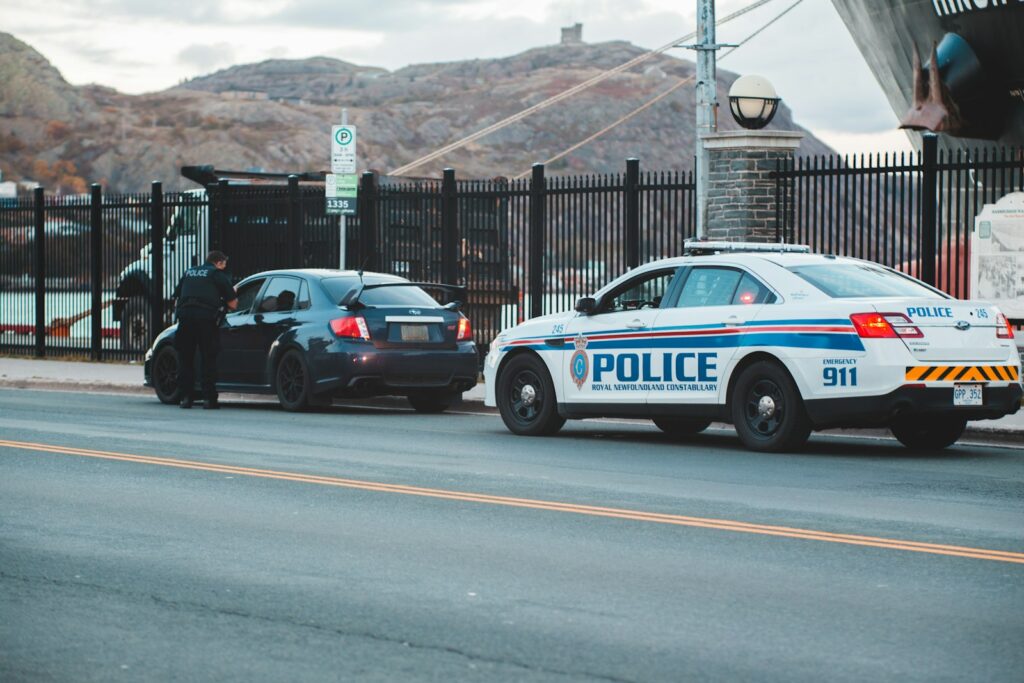
The stop that felt like an argument before it even started
From the start, the officer’s energy had that “don’t test me” edge, even though the driver was being polite. The driver tried to keep his voice level, asked if the officer could tell him which car he’d allegedly cut off, and got a sharp, vague answer about “multiple vehicles.” The officer pointed down the road like the evidence was just out of frame, like there were invisible witnesses lined up to testify.
And here’s where it got messy: the driver had a dashcam. He didn’t announce it in some confrontational way, but he did mention it—more like, “I’ve got video if that helps clear this up.” That didn’t calm anything down. If anything, it made the officer’s posture change, the way people do when they realize there’s a receipt.
The officer didn’t ask to see it. He didn’t say, “Great, let’s review.” He just leaned into the window, reiterated the charge, and went back to his patrol car to write the ticket like the conversation never happened. The driver sat there watching the officer’s silhouette through the rear glass, feeling that weird helplessness of being accused of a vibe.
What “aggressive driving” was supposed to mean
The ticket itself read like a character assessment more than a traffic citation. Not just that the driver committed a single violation, but that he’d been “operating in a manner intended to threaten or endanger.” In a lot of places, “aggressive driving” is a catch-all that stacks ordinary infractions into something heavier, with higher fines and sometimes points that hurt more.
The driver kept replaying his own memory: he’d merged, passed a slower car, and moved over. He remembered one moment where a pickup had been creeping into his lane and he’d tapped the brakes, but it hadn’t felt dramatic. If anything, he thought he’d been the one making room for other people’s bad decisions.
When the officer came back, he gave the usual lecture, but it had an almost personal undertone. The driver said he wasn’t trying to argue, he just didn’t understand the accusation. The officer’s response was basically, “I know what I saw,” and then, in that way some people do when they’re finished listening, he ended the conversation by ending the stop.
Then the patrol car video showed up, and it didn’t match the story
Afterward, the driver did what people do now when they feel steamrolled: he started gathering his own evidence. He saved his dashcam file, pulled the exact time stamps, and filed a request for the patrol car video. He expected it would take a while, and he expected at least some unflattering moments—maybe a quick lane change, maybe a hard brake, something he didn’t notice in the moment.
What came back was the officer’s dash video, and it was almost comically… normal. Traffic was moderate. The driver’s car is visible ahead, but not darting around like a pinball. No wild swerves, no rapid-fire passing, no episode where he charges up on someone’s bumper to bully them out of the way.
There’s one stretch where the driver changes lanes twice in a short span, but it’s with turn signals and plenty of space. Another moment shows him accelerating to pass a car that’s going under the flow, but he’s not rocketing off like he’s trying to race somebody. The most “aggressive” thing on the footage is the officer’s own driving—closing distance fast, sitting behind him, then pacing like he’s waiting for an excuse.
The weirdest part is how the patrol car video accidentally explains why the stop happened. You can see the officer come up behind the driver, and the driver—probably noticing the patrol car—is actually more cautious. He maintains his lane, leaves space, and then moves over to the right when he can, like a person trying not to look like a problem.
The uncomfortable gap between what was said and what was recorded
Once the driver had both videos—the officer’s and his own—the contradictions got specific. The officer had accused him of “cutting off multiple vehicles,” but in the footage, the closest lane change has a clear buffer and doesn’t force anyone to brake. The officer had mentioned “following too close,” but the driver’s car is consistently leaving a normal gap, especially considering highway traffic.
The driver’s dashcam audio also captured the officer’s tone: that confident, stacked list of allegations delivered without hesitation. Watching the patrol footage right after is unsettling because it turns the allegations into something else. Not a difference of opinion, not a gray-area call, but a narrative that simply isn’t supported.
It’s the kind of situation that makes people argue about motives. Was the officer mistaken? Did he mix up the driver’s car with another one and then commit to it? Or was “aggressive driving” just a convenient label for “I didn’t like how you were driving near me,” even if it wasn’t actually dangerous?
What really made the driver mad wasn’t even the money. It was how easy it looked—how quickly an official story can be spoken into existence, and how hard it is for a regular person to disprove it without tech and persistence. If he hadn’t had his own camera, he would’ve had nothing but his word against a uniform.
Trying to fight it without turning it into a bigger problem
The driver didn’t march into court like he was starring in a courtroom drama. He did the boring, stressful thing: organized files, labeled time stamps, printed stills, and wrote out a timeline so he wouldn’t get flustered. He also had to weigh a quiet fear a lot of people won’t say out loud—whether fighting a ticket like this makes you a target later.
When he reached out through official channels, he got the same sterile responses people always get: there’s a process, the officer stands by his decision, you can contest it on your court date. No one was interested in watching the video early, and no one was eager to explain how “aggressive driving” was determined when the footage showed standard highway behavior.
Meanwhile, the ticket sat there with its implications. Insurance doesn’t care about your tone of voice during the stop. Your job doesn’t care that the officer felt “disrespected” by a polite mention of dashcam footage. All anyone sees is a more serious label that can follow you around long after the actual drive is forgotten.
And the officer? In the only recorded interaction anyone can point to, he looks calm and authoritative, like he’s doing routine work. That’s part of what makes the gap so frustrating: to someone who doesn’t know the backstory, it’s just another stop. It’s only when you compare the claims to the video that the whole thing starts to feel off-kilter.
The driver ended up in that infuriating limbo where the evidence is clear, but the system isn’t built to reward clarity quickly. The footage doesn’t show a menace on the road; it shows a guy driving normally while an officer narrates a different reality over him. And the last, unresolved tension isn’t whether the video exists—it’s whether anyone with power will actually treat it as proof, or just as a nuisance that showed up after the story was already written.
More from Steel Horse Rides: