

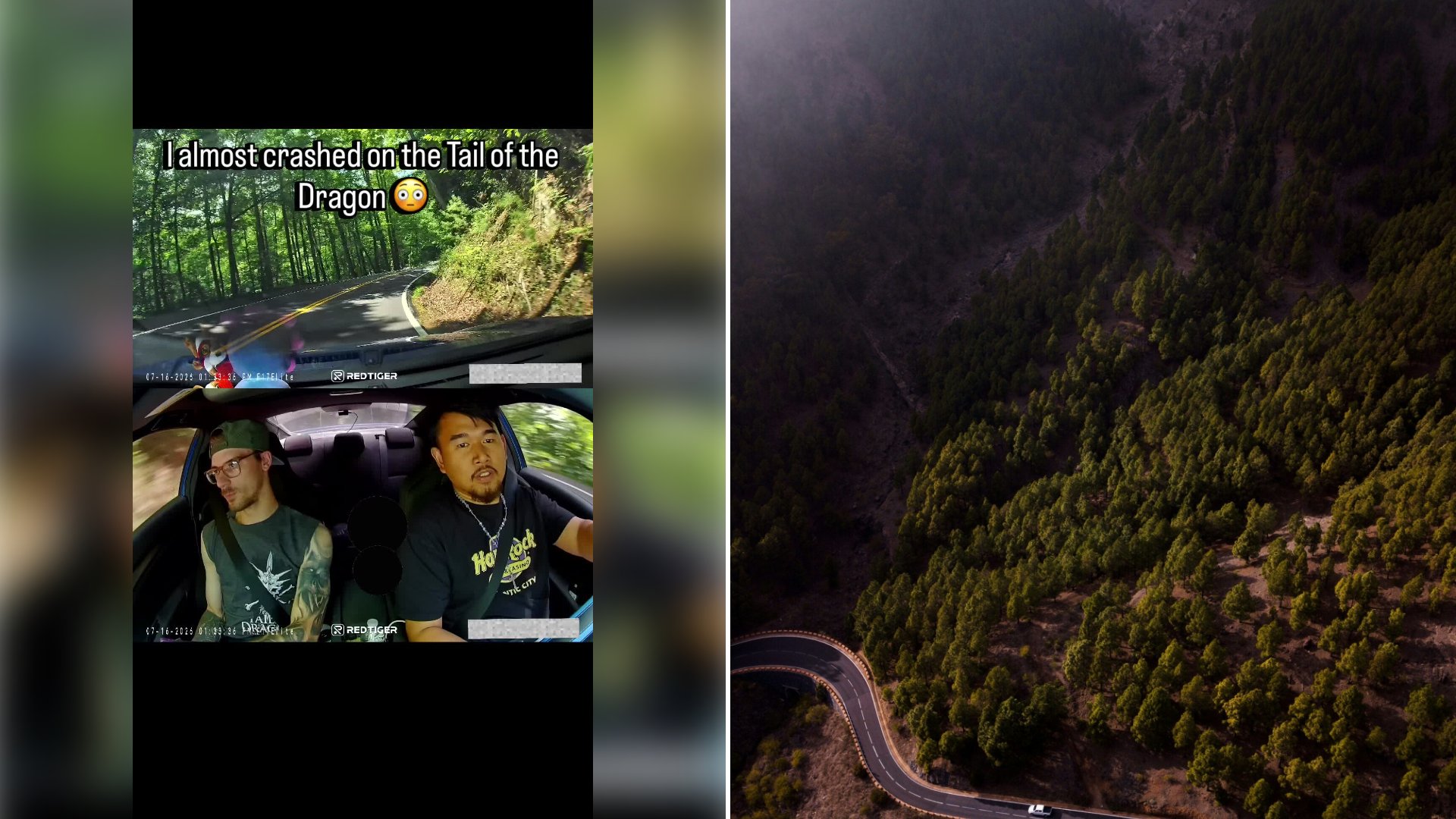
A dual view dashcam clip posted by @the_dan_m splits the screen in two. The top half shows the road through the windshield, a tight two lane curve with trees close on both sides and a yellow center line, and the bottom half shows the two men in the front seats. Text across the top reads “I almost crashed on the Tail of the Dragon,” and the caption calls it one of those “that could’ve been bad” moments.
The clip is only about twelve seconds long, and the first stretch is quiet. The man in the driver’s seat, in a navy shirt, steers through a series of bends while his passenger, in a green cap and a dark graphic shirt, looks ahead. Then the audio picks up. One of them reacts out loud to the near miss, and the other says, “We’re gonna relax. We’re gonna relax.” Then one of them says “Sorry, that was bad,” and the clip ends on the two of them repeating that it was bad.
What the clip does not give the viewer is a clear picture of the moment itself. The windshield view shows a bend, a stripe of yellow paint and trees, but no oncoming car, no skid, no tire squeal and no contact with anything. The only evidence of a scare is the men’s voices and faces, and the on screen text. The video does not say what went wrong, whether another vehicle was involved, or how fast the car was going.
The road is real, and it has a reputation. In a July 2024 release, North Carolina’s transportation department described the Dragon, a stretch of U.S. 129, as an 11 mile scenic and winding road and one of the nation’s most popular roads for motorcycle and sports car enthusiasts. The release announced a safe travel campaign launched by North Carolina and Tennessee officials that urged drivers to slow down, buckle up and remove distractions, and the director of the North Carolina Governor’s Highway Safety Program said travelers should know the roadway is “not for sightseeing.”
The states have tried enforcement before. A 2007 Tennessee release on a three month enforcement initiative, from July through September, reported a 53 percent decrease in crashes on the stretch. The release gave the percentage but not the crash counts, and it did not say what period the drop was measured against.
Those are the agencies’ own words about the road, and they say little about what happened in this particular car. It would be unfair to say the driver was speeding or passing, or that the road was to blame, because the clip does not show any of that. What it does show is how quickly a trip on a famous road can feel like a close call, and how the two men handle it, with a quick apology and a promise to settle down.
The accompanying text and caption are the only claims the video makes about the severity, and both are modest. It is a small, believable moment of two people catching their breath after something startled them, filmed by a camera that stays on during the whole drive. For viewers, the only plain takeaway is the one the agencies keep repeating, which is that the pace on a road like this is a choice.
More from Steel Horse Rides
- Son Takes His Dad for a Ride in His 1,000 Horsepower Hellcat Chrysler, and the Back Seat Camera Catches Dad Twisting Around Mid Ride to Look at Everyone Behind Him
- Motorcyclist Explains How Inductive Traffic Sensors at Stoplights Work and Why Some Bikes Never Trigger a Green Light and What Riders Can Do
- Drivers in Five Battered Race Cars Chase a Ford Super Duty Towing a Flatbed Around a Banked Oval, Trying to Drive Onto the Moving Trailer, in a Race Cleetus McFarland Fans Call Violent