

The Ford Coyote 5.0 has become one of the great bargain engines in American performance. Drop one into a car, add a handful of good parts, and four-digit horsepower is within reach. But every big-power build lives or dies on the same question: how strong is the block? The team at EngineLabs took that question to RPG Racing Engines in Madera, California, and sat down with Will, a builder who has been at it since he was a teenager tinkering with friends’ engines.
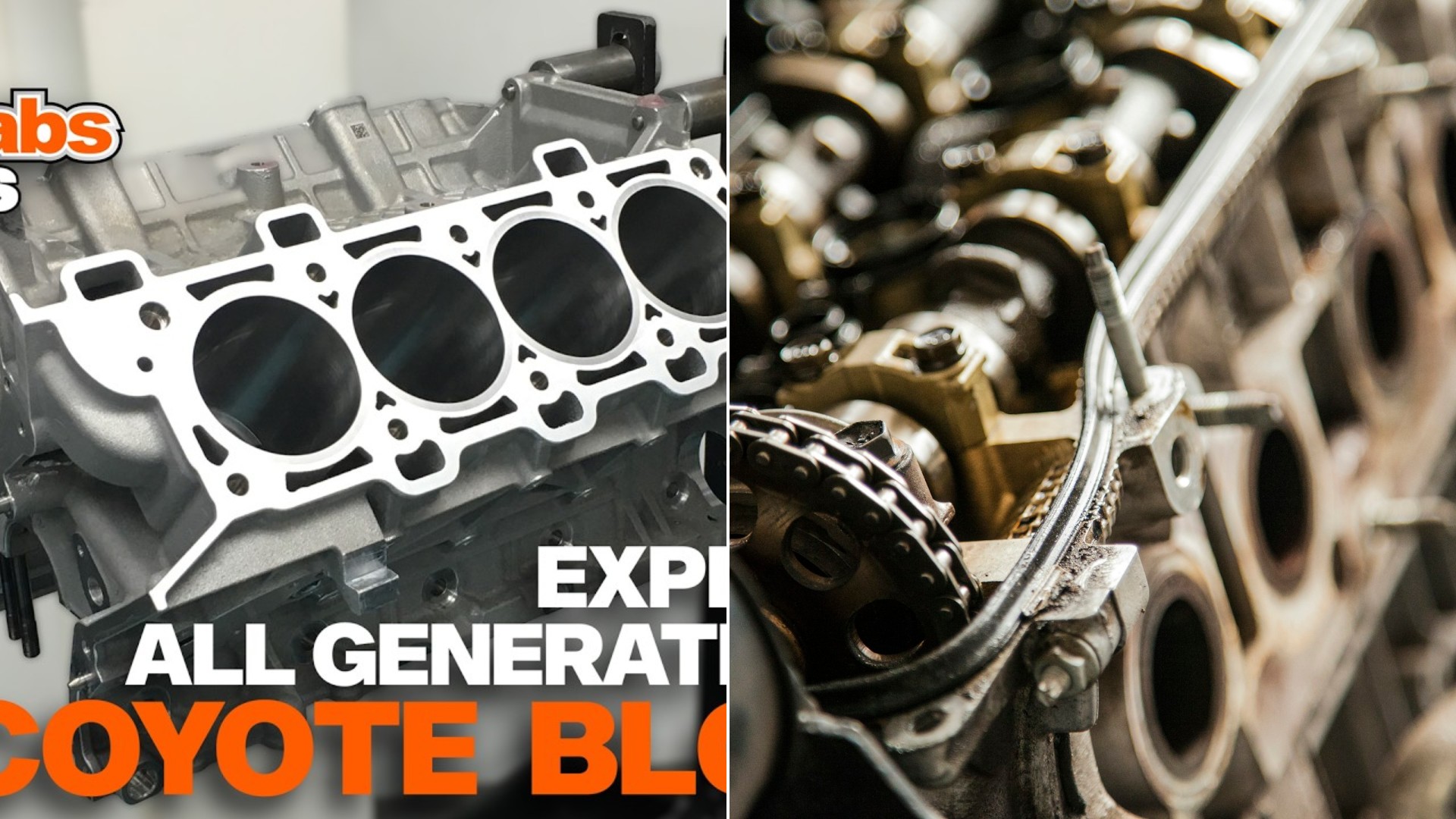
Will’s shop has been going full time since 2004. It started with basic 500-horsepower builds on the 4.6 engine and has since grown to Coyote builds that go as high as 3,000 horsepower. He says the shop turns out about 300 engines a year. That is the kind of résumé that makes his advice worth a listen, and his bottom line is blunt: if you plan to make big power, plan to sleeve the block ahead of time, because it is cheaper and smarter to do it once.
How the Generations Differ
The Coyote debuted in 2011 and brought back the 5.0 nameplate. Will walked through how the block changed over the years.
- Gen 1 (2011 to 2014) has the smallest bore, 3.630 inches, and Will calls it one of the weaker blocks. In Ford’s defense, he points out nobody expected people to make over 1,000 horsepower with it.
- Gen 2 keeps the same bore size, with slightly shorter head threads.
- Gen 3 5.0 moves to a 3.661-inch bore and a 12 mm head stud, which gives much better clamping force and a better block overall.
- Gen 4 5.2 steps up to a 3.700-inch bore, with far more structural strength in the valley and the back bracing near the transmission.
The deck design changed too. Gens 1 and 2 have a traditional large cooling jacket on top of the cylinder, while Gen 3 is an open deck design with good and bad points. The 5.2 is a closed deck, with small cooling jackets and a lot of support for power.
Which Block for Which Job?
Will gave quick answers when asked. For street use, he says the Gen 3 5.0 or Gen 4 5.2 all day long. For boost, a sleeved Gen 3 5.0, a 5.2, or a sleeved 5.2. For road racing, a Gen 3 5.0 or a Gen 3 5.2 are both good choices. For a fun street car with around 1,000 horsepower, he would pick an unsleeved 5.2 block with forged rods and pistons, Gen 3 heads and a good cam.
He also likes a hybrid for owners of older cars. Put a Gen 3 short block in a Gen 1 car, with Gen 2 heads and Gen 1 timing parts, and you get around 12 to 1 compression, a stronger block and roughly 500 horsepower all day long.
What about the truck version? F-150 Coyotes have a little less compression, different cams and a different firing order, because Ford wanted more towing torque. They are less powerful, but the architecture is the same. Will says a junkyard F-150 Gen 1 or 2 can be built the same way as a Mustang engine.
Iron Liners, Spray Liners and Sleeves
The press-in iron liners in Gen 1 and 2 blocks are not as durable as an aftermarket sleeve, so Will limits them to about 1,100 horsepower. The upside is that you can bore and hone them, going 10, 20 or 30 over.
The Gen 3 uses a plasma wire arc spray liner, a thermal process that sprays an alloy onto the aluminum bore. It is light and strong, and Will says it holds up surprisingly well, rating it at about 1,400 horsepower to the wheels. The drawback is that you cannot bore it oversize. The most that is done is a three- or four-tenths cleanup hone, so if something goes wrong, you sleeve the block or scrap it.
Sleeving means boring out the block, pressing in an oversize sleeve and heat cycling the block to seat it. Will says it is good for 1,800 to 2,500 horsepower, and he recommends it for anything over 1,500. His limits are about 1,600 for sleeved Gen 1 and 2 blocks, about 2,000 for Gen 3, and 2,500 to 3,000 safely for a 5.2, which has the most support around the sleeve.
What Breaks Next
After sleeving, the next weak points arrive at about 2,500 horsepower: a billet crankshaft and stronger rods. Beyond that, keep the heads down with a copper head gasket and a top fuel style ring, and the engine can handle over 50 pounds of boost. He also warned that gaskets are easy to ignore. At 20 to 30 pounds of boost, one failed spark plug can blow a head gasket.
For stock blocks, he said anything under about 1,500 horsepower is fine. Above 2,000, a better aftermarket block is worth a look. He also likes Ford’s cast iron block. It is about 90 pounds heavier than a sleeved aluminum 5.2, but it stays true, can be bored 10 over again and again, comes with billet main caps and ARP studs, and costs less than a sleeved 5.2. The shop has built about 12 of them in three to four years. A fully billet block is the top tier, and a dry deck block and heads are the choice above 30 pounds of boost.
Voodoo and Predator, Too
Will estimates about 25% of the shop’s work is Voodoo engines, with their flat plane crank, 12 to 1 compression and 526 horsepower at over 8,000 rpm. The GT500 Predator, by comparison, is a supercharged 9.5 to 1 engine with forged rods and 760 horsepower.
What a Car Owner Should Take Away
You do not need a 3,000-horsepower dream to learn from this. Buy the right generation for your goal, know your power ceiling before you spend, and budget for the strongest block you will eventually want. And for any engine you build, hire a shop with a track record, and ask for the specifics.
More Stories You May Like
- Ignoring The Check Engine Light Is Risky, But Paying For A Diagnostic You Could Skip Is Not Smart Either, So Here Is How Free Code Reading Works And When To Worry
- Mechanic Says a Chevy 5.3 Owner Was Already Pricing a Cam Actuator Job When Five Minutes of Diagnosis and One Cheap Part Had the Truck Starting on the First Try
- Crew Rescues A Yellow 1977 Porsche 911 Targa That Sat In The Woods For About Twenty Years Then Power Washes The Dirt Off And Polishes Faded Paint