

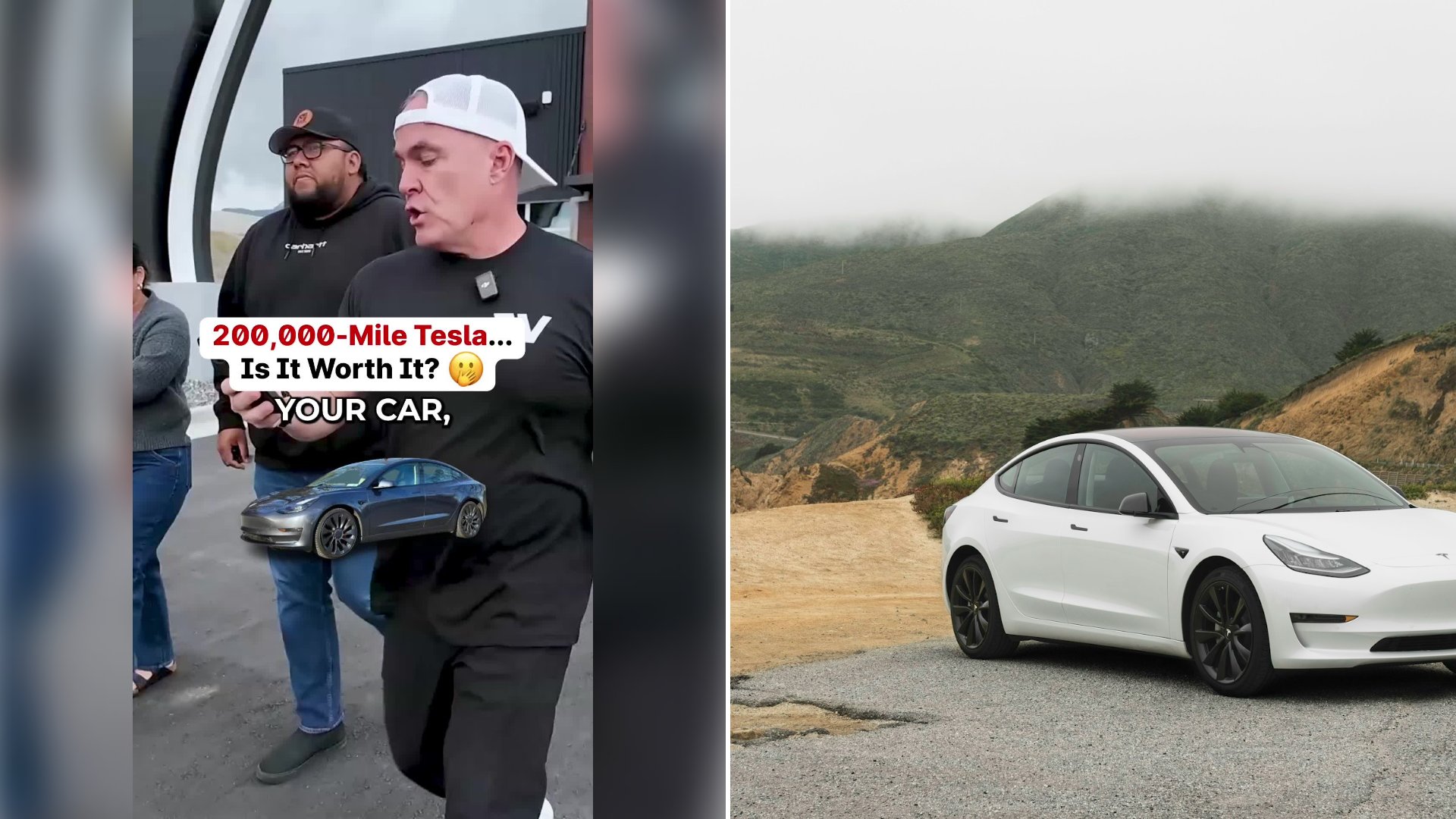
A man in a white cap and black company shirt stands in an electric car shop with a customer in a black hoodie and tells him he is having a hard time valuing his car with all those miles. The clip is from an electric car dealer’s TikTok account, the on screen text calls it a “200,000 Mile Tesla” and asks “Is It Worth It?”, and the caption says the miles put the battery to the test and that the warranty decision changes everything.
The car is a 2018 Tesla Model 3, long range, all wheel drive, with about 197,000 miles. The dealer says that is the kind of mileage that could be either good or bad for the battery, so before he gives a number he wants to plug into the car and test the pack. The customer agrees to the test.
The test itself is shown as a technician sitting in the driver’s seat with a small device connected to the car and a phone app on the screen. The dealer explains that it scores the battery down to the individual cell, and that the report also breaks out how much of the charging was done at a fast charging station and how much was slow. He says the split between the two can make all the difference.
Here is where the video turns on one number. A battery has to score at least 80 for the dealer’s warranty company to cover it, he says, and for a car this old that matters because the factory coverage is long gone. The result comes back as a 79. The report also shows about 17 percent of the car’s charging was done at fast chargers and 83 percent slow.
The dealer does not walk away and he does not accept the car. He says he has emailed the warranty company, which will sometimes make an exception when a score is that close. If it does, he says, he will take the car on trade for $8,000. If not, he will pass, because he is not comfortable selling a car this far out of warranty without being able to back the battery. He tells the customer he will hear from him in the next few days, and they shake hands.
That is the whole story, and its limits are clear. The video does not show the warranty company’s answer, does not show what the report said about the individual cells, and does not show the customer’s reaction beyond a friendly goodbye. The $8,000 is the dealer’s own number and it depends on a decision the clip never reaches.
Outside facts help explain why a dealer would care. Tesla’s own warranty page lists the Model 3 battery and drive unit as covered for eight years or 100,000 miles on the rear wheel drive version and eight years or 120,000 miles on the premium rear wheel drive, premium all wheel drive and performance versions, in both cases with a minimum of 70 percent battery capacity retention over the warranty period. The page’s FAQ says the new vehicle warranty follows the vehicle to a new owner when the transfer is done through Tesla. The page does not name the long range all wheel drive trim, so a buyer would need the paperwork for the car in question. Either way, a 2018 car with nearly 200,000 miles is far past those limits, which is why the dealer’s argument is about a separate warranty.
The video also leans on the fast charging split, and the research there is less clear than the cliche. A U.S. Department of Energy fact sheet describes a test of four 2012 Nissan Leaf electric cars, two charged only at Level 2 and two only with a 50 kilowatt DC fast charger. Its table lists pack capacity at 50,000 miles of about 17.5 and 17.8 kilowatt hours for the Level 2 cars and about 16.9 kilowatt hours for both fast charged cars, down from baselines of roughly 23 to 23.6 kilowatt hours. By that arithmetic the Level 2 cars lost about 25 percent and the fast charged cars about 27 percent. The fact sheet says testing will continue, and it covers one car model from 2012, so it is not proof for a different car a decade later.
For a viewer, the practical lesson is that a score near a cutoff can decide a trade offer. A buyer or seller who wants the number can ask for the report, ask which test produced it, and ask what the warranty actually promises and who stands behind it. The dealer in this clip is open about what he needs and what he will do if he does not get it, and that candor is what makes the video worth watching.
More from Steel Horse Rides
- Comedian Says Buying a Maserati Six Years Ago Was a Huge Mistake and the Depreciation Data Shows Exactly Why That Regret Makes Financial Sense
- Car Expert Lays Out the Most Reliable Used Cars To Buy at Every Budget From One Thousand Dollars Up To Twenty Five Thousand Dollars and Explains Why
- Creator Explains Why the Toyota Tacoma Holds Its Value So Well and Shares Independent Resale Data for the Tundra, Four Runner and Land Cruiser As Well