

Alexandria, Minnesota is not the first place most car fans would think of for world-class craftsmanship. But a crew from Hagerty went there to visit what the host calls a very unique, old-world craftsman shop, the kind of place car guys really dig. At the center of it is a father and son, Christopher and Finn, who work as coachbuilders, and a question that sounds a little crazy: could a flat-eight engine fit in a Porsche 911?
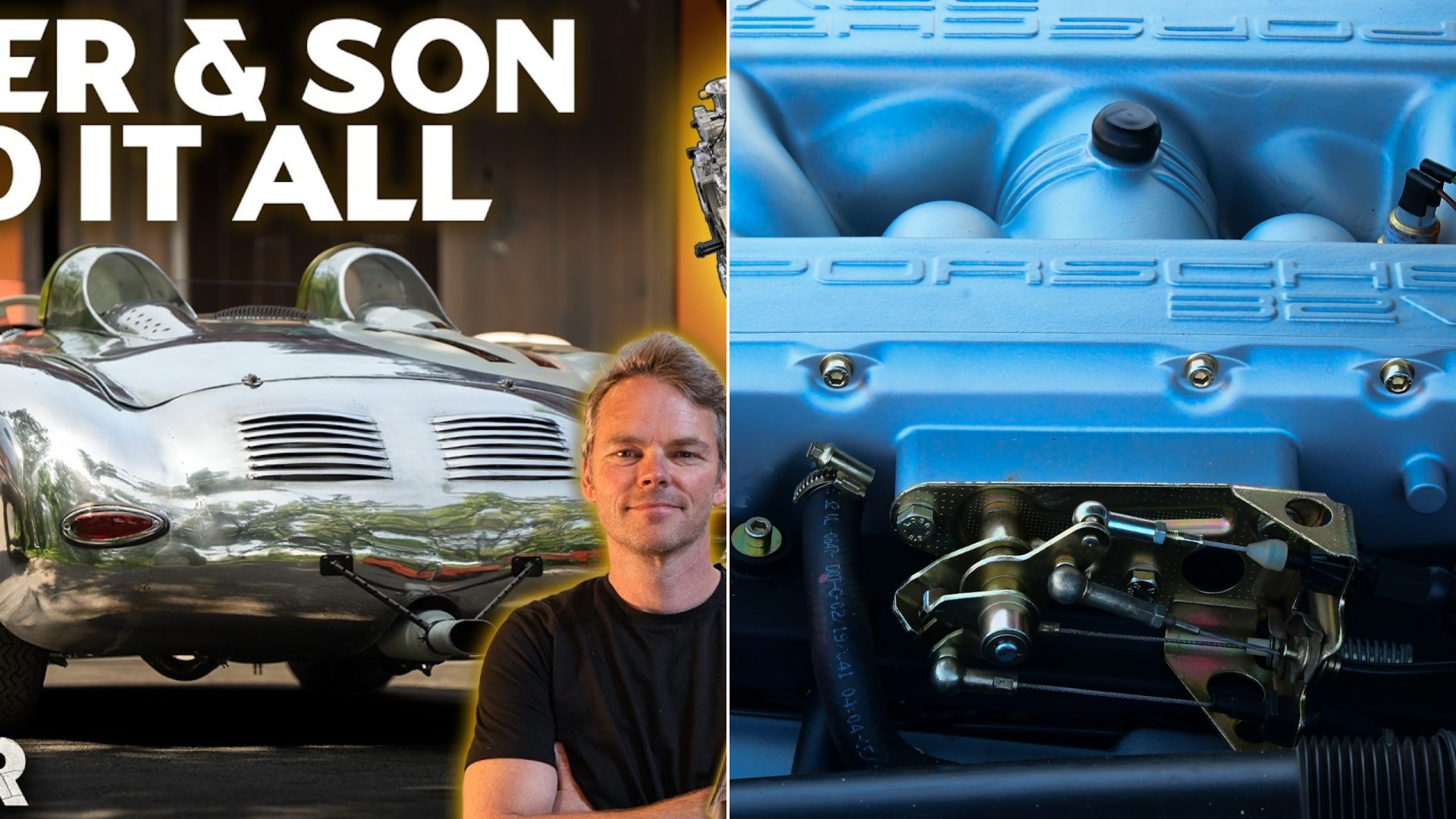
The host, who has spent eleven years on his barn find series chasing rust and dust, says this episode is not his usual fare. Instead of an ignored old car, he found a shop that produces what he calls rolling sculpture out of rural Minnesota, with aluminum bodies shaped by hand the way coachbuilders did before and after the war.
The story is worth telling for what it says about how big projects start. Most of them begin with someone asking what if, then finding out the answer takes a lot more work than expected.
It Started With a Barn Find
Christopher says his path into metalwork began with a barn find of his own. He grew up going to junkyards with a dad who loved treasure hunting, and in 2010 he found a 1967 Porsche 912 for sale in South Dakota. When he asked the seller what else she had, so he would know how big a trailer to bring, she told him her late husband’s barns were full, including some metal shaping tools.
That detail sparked something. As a teenager he had read about the hand-hammered, home-built post-war racers the Germans called Eigenbau, built from Volkswagen and Porsche parts under custom bodies. Seeing some of those cars at Amelia Island in his twenties made him think that building one someday would be the ultimate goal.
Teaching Himself Aluminum
He set up an English wheel on the family farm and spent about a year researching what would make a good chassis. The practical, budget-friendly answer was a Formula Vee race car, which he found for about $3,500 with a title. He learned to shape metal from a DVD on basic hand tools, polished the anvils on his English wheel to get a smoother finish, and learned to TIG weld when his first paid commission came in. He had the body on and the car moving within twelve months, then sold it to keep the lights on.
Today the shop is finishing car number 17. The customers, he says, are often art collectors who want to live the build experience, and they text and call throughout. Finn has even 3D scanned a customer in his driving position so the car can be tailored to him, while the old-school method of a wooden dummy still sits in the back.
An Orphaned Chassis and a Family’s Blessing
One of the most touching parts of the visit is a car built on a chassis that Christopher calls orphaned. It was the dream of a man named Ted Dunham, who worked for GM Aviation and had a hobby shop in Michigan. Ted planned an aluminum body, but according to his son Jim, the cost was not in the cards, and after Ted passed away the chassis sat in limbo.
It landed at the shop when a friend of the family needed storage, and it sat there for a couple of years until a customer saw the vision and cut the team loose on it. Christopher asked Jim whether it would be all right to continue the chassis, and Jim said his dad would be so proud. It became Finn’s first solo design, and the car runs a 911.4, a Porsche six-cylinder cut down to four cylinders, with about 220 horsepower and a curb weight of around 1,300 pounds.
The Flat Eight and the 911 Question
Then the host asks about something he has been dancing around all day, a full-scale 3D printed engine model with eight cylinders. Finn and Christopher explain that it is a flat-eight they are developing from the ground up with an engineering firm in the United Kingdom. They are not engineers themselves, Christopher admits, but they have big ideas and use experts where needed.
The question they took to the engineers was whether they could build a flat-eight, and when they saw the cost, whether they could make a flat-eight that fits in a 911. The engineers said they thought so. They are doing it in pieces, both financially and in design, and Christopher says it is built first for their own cars but will be offered to enthusiasts and engine builders who want to put one in a 911.
The idea goes back to 2016 and 2017, when Christopher wrote a proposal for a client with two options, twin 356 engines or a flat-eight. The project has been moving for about two and a half years. Finn printed the full-size model in more than eighty pieces over roughly ninety days, and the first long block is nearing completion, with three pre-production engines being built in England and a dyno test expected by late September 2026.
Why Nobody Has Done This Since the 1960s
Christopher explains that the air-cooled flat-eights from Germany in the 1960s were race engines, with two ending up in 914s toward the end, including one for Ferry Porsche’s personal car. What haunted those engines was harmonic vibration and heat, and those two problems are why no one has done it in a road car since. Their software says the new design solves the vibration, and the case, oil system and cooling were designed with heat in mind.
The vast majority of the engine, including the case, crank and cams, is specific to their design. There are no belts and pulleys, because the cooling fan is driven from inside the engine. The host also gets to hear the 911.4 car fire up, and Christopher warns that its gear-driven fan sounds like a supercharger.
Old Hands, New Tools
What stands out most is how the two generations work together. Christopher brought the old way of building cars, and Finn brought CAD, CNC cut bucks and 3D printing. Finn designed a chromoly chassis around the flat-eight, and parts come back from CNC cutting as flat sheets that are assembled like a puzzle.
The host says it plainly: this is a career that AI can never take away. Christopher has worked seven days a week for seven or eight years, but he says it would be fun to lean into the new engine and the car designed around it, while still picking where to do the handwork.
Lessons for Anyone With a Big Idea
You may never build a flat-eight, but the story offers some advice for any garage dreamer.
- Start with what you can afford. A $3,500 race car chassis was enough to begin a career.
- Teach yourself, then ask experts. Books and a DVD got Christopher started, and engineers in England are helping with the engine.
- Change the question when the budget says no. An aluminum body was too costly, so the shop built an engine instead.
- Honor the past. Asking Ted Dunham’s son for his blessing turned an orphaned chassis into a finished car.
For fans of Porsche, hot rods and custom work, a shop in a small Minnesota city that looks at a cost problem and answers with a flat-eight is worth knowing about. It is also a reminder that some of the best car stories come from places you would never expect.
More Stories You May Like
- Hybrid And EV Myths That Older Drivers Still Believe Could Cost You Money, So Here Is What Is True Before You Dismiss Or Buy One For Yourself
- Roots Grew Under The Wheel Of A Forgotten 1964 Impala SS 409 And Grandpa Got Emotional When It Fired Up Again After Eighteen Years Of Silence
- Car Buyer Stopped a Stranger and Offered to Buy His Nearly New Car Then Pointed Out One Tiny Chip and Tried to Knock Off $5,000