

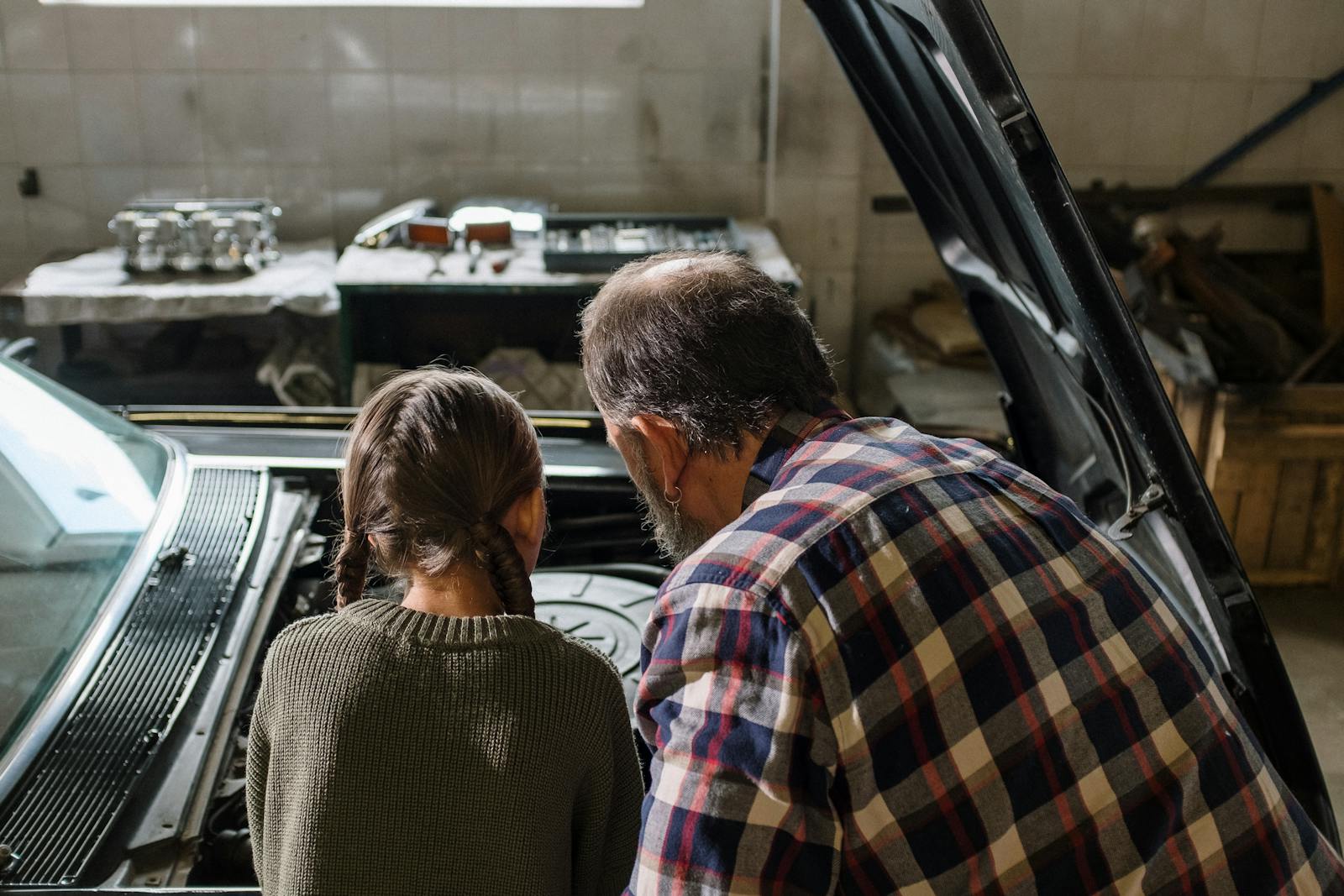
They’d been working toward this Saturday for months: the coupe finally straight, panel gaps decent, filler sanded until their hands ached, and every little trim clip bagged and labeled in a way that screamed “we are not doing this twice.” The father had turned the garage into a temporary paint booth with plastic sheeting and box fans, and the daughter had spent the week obsessively wiping down shelves and blowing dust out of corners like she could bully the air into behaving.
The plan was simple in the way only restoration plans ever are: single-stage paint, driver’s side first, then passenger, then the roof while they still had momentum. They weren’t chasing trophy-perfect, but they wanted clean, glossy, “we did this ourselves” respectable. And for a while, it looked like they were actually going to pull it off.
Then the driver’s door started to run. Not a cute little sag they could nibble down later, but a wet, slow, unmistakable curtain forming right in the middle of the panel—perfectly placed where you’d stare at it every time you walked up to the car. They both watched it happen like it was a science experiment turning ugly in real time, and the father said something under his breath that wasn’t a prayer.
The kind of prep that makes you overconfident
This project had been their thing—Sunday mornings, late-night parts orders, arguing about whether the car “needed” new weatherstripping when the old stuff technically still existed. The daughter was the one who’d pushed for the coupe in the first place, a little two-door they found half-sunk in weeds behind a shed. The father had hesitated, mostly because he knew exactly what “a quick restoration” turns into, but he liked the idea of having something that wasn’t just work and errands.
They got good at the rhythm: strip, label, sand, prime, block, repeat. The father had done some painting years ago, the kind of driveway jobs where you accept a few orange-peel freckles as part of the deal. The daughter learned fast and kept a notebook of what grit they’d used where, which spots were “iffy,” and which panels had needed the most filler to stop looking like a golf ball.
By the time the day came to spray color, they’d convinced themselves they were prepared. The car was masked, the floor was wetted down, and the lights were positioned like a low-budget operating room. They had mixing cups, strainers, clean guns, and that jittery excitement you get right before you do something you can’t undo with a quick reset.
Single-stage: one shot to look like you know what you’re doing
Single-stage paint has this seductive simplicity to it. No basecoat/clearcoat layering, no waiting for flash times between systems, no separate clear to bury your sins. You spray it, it’s glossy, and if you do it right, it looks deep and classic in a way that matches an old coupe perfectly.
The downside is that every mistake is right there in the color. Runs, trash, dry spray—whatever you put down is what you’re living with, and there’s no “we’ll bury it in clear later.” The father knew that in theory, but he also knew they weren’t building a Pebble Beach car. They just wanted it to look finished and not like a patchwork of primer and optimism.
They started on smaller parts first, which is always a confidence trap. A mirror bracket here, a little trim piece there—each one laid down surprisingly nice. The daughter kept peeking at the gloss with the same expression you see on people who can’t believe the cake rose in the oven without collapsing.
When they moved to the driver’s side, they had momentum and adrenaline. The father held the gun like it was muscle memory. The daughter stood a few feet back, watching angles and making sure the hose didn’t drag across anything, calling out little reminders like “keep it moving” and “watch the edge.”
The skipped tack rag pass they wouldn’t stop talking about later
Here’s the part that everyone who’s ever painted anything will recognize: they were in a hurry for no real reason. Not “the sun’s going down and we’ll lose light,” not “we’re racing weather,” just the gnawing impatience of a job that’s been nothing but prep and waiting. They’d wiped the panels down with cleaner earlier, they’d blown everything off with air, and the booth looked clean enough.
The tack rag was sitting right there, folded on the workbench. The daughter even reached for it at one point, then paused because the father was already mixing paint and talking about pot life and how they needed to shoot it before it started thickening up. He said something like, “We’re good, we already blew it off,” and she didn’t push because she didn’t want to be the person slowing down the moment.
That decision didn’t cause the run directly, but it mattered in a way that became obvious in the worst possible timing. A little dust, a tiny nib, a hair—anything that lands in single-stage changes how you react with the gun. You chase coverage around a speck, you slow down to “fix it,” you overlap a little too much in one spot. The door ended up becoming the panel where all their tiny compromises piled up at once.
When the father saw a piece of trash land near the middle of the driver’s door, he instinctively tried to fog it in and smooth it out. The gun lingered half a second too long, then another half-second to “even it.” The paint, already laying wet and heavy, did what gravity has always done, and started to sag.
Watching the run form is its own special kind of pain
At first it looked like a slightly darker stripe, which is the kind of thing you can talk yourself into ignoring. Then it gathered into a bead, and the bead started to move, slow and thick, like honey sliding down glass. The daughter made a small sound, not a scream, more like a throat-clearing that accidentally turned into panic.
The father froze for a second, gun still in his hand, as if stopping his body would stop physics. He leaned closer, which is the last thing you should do in a cloud of paint, and then snapped himself back because he knew he’d just risked dropping more trash on it. He tried to feather the area lightly to level it out, but that only made the wet edge larger and gave the run more paint to drink.
They did the thing people always do: they talked too much while staring at it. The father kept saying, “It might lay down,” and the daughter kept saying, “It’s moving,” like narrating it could change the outcome. The run got longer, the bottom of it fattened, and there was this awful moment where they both realized they weren’t looking at a fixable spot-sand situation.
Single-stage is forgiving in some ways, but a big run on a vertical panel, in a high-visibility spot, is a commitment. You can sand and buff a lot of sins, but if the paint is thick enough to wrinkle or if the run cures like a ridge, you’re sanding through before you ever get it flat. They stood there in their respirators, staring, each of them doing the mental math of hours and materials and whether they’d be able to match the blend later.
The door has to come off, and suddenly it isn’t about paint anymore
The father was the first one to say it out loud: the door had to come off and be redone. Not just scuffed and reshot in place, but pulled, stripped back to something reliable, re-prepped, and sprayed separately so they could control the angle and avoid dumping more paint into the run zone. He said it like a sentence, not a suggestion, and that tone landed hard.
The daughter didn’t argue about the technical part. She argued about the “why didn’t we just tack it” part, because once you see a mistake that obvious, the whole day replays in your head like a highlight reel you never asked for. She pointed at the bench where the tack rag still sat, untouched, and the father’s shoulders did this tiny drop that looked like exhaustion more than guilt.
They started picking at each other in that careful way people do when they’re trying not to blow up in a garage full of fumes. The father insisted the run came from going too wet on the second pass, from trying to make the single-stage look “show glossy” instead of just respectable. The daughter kept circling back to the moment they chose speed over one extra wipe-down, because it was the cleanest fork in the road to blame.
And underneath that was something heavier: the project wasn’t just a car anymore. It was their shared proof that they could finish something hard together, that the father could teach without controlling, that the daughter could learn without being treated like a kid. Having to unbolt the door, undo the careful masking, and admit the paint day had a major failure felt like watching that proof smear down the panel in slow motion.
They didn’t quit. They didn’t throw tools or storm off in a cinematic huff. But the air shifted—less excitement, more grim procedure—while they started talking about how to strip it without damaging the bodywork, how long they needed to let it cure before sanding, and whether they had enough paint left to reshoot the whole door without risking a mismatch.
The coupe sat there with one beautiful stretch of fresh color and one driver’s door that looked like it was melting, and they both kept glancing at it like it might change if they looked away. The father kept busy, making lists and checking bolts, because that’s what he does when he’s mad at himself. The daughter kept wiping her hands on her jeans and staring at the tack rag like it was an accusation, because now that they’d seen the run happen, they couldn’t unsee the moment they chose not to prevent it.