

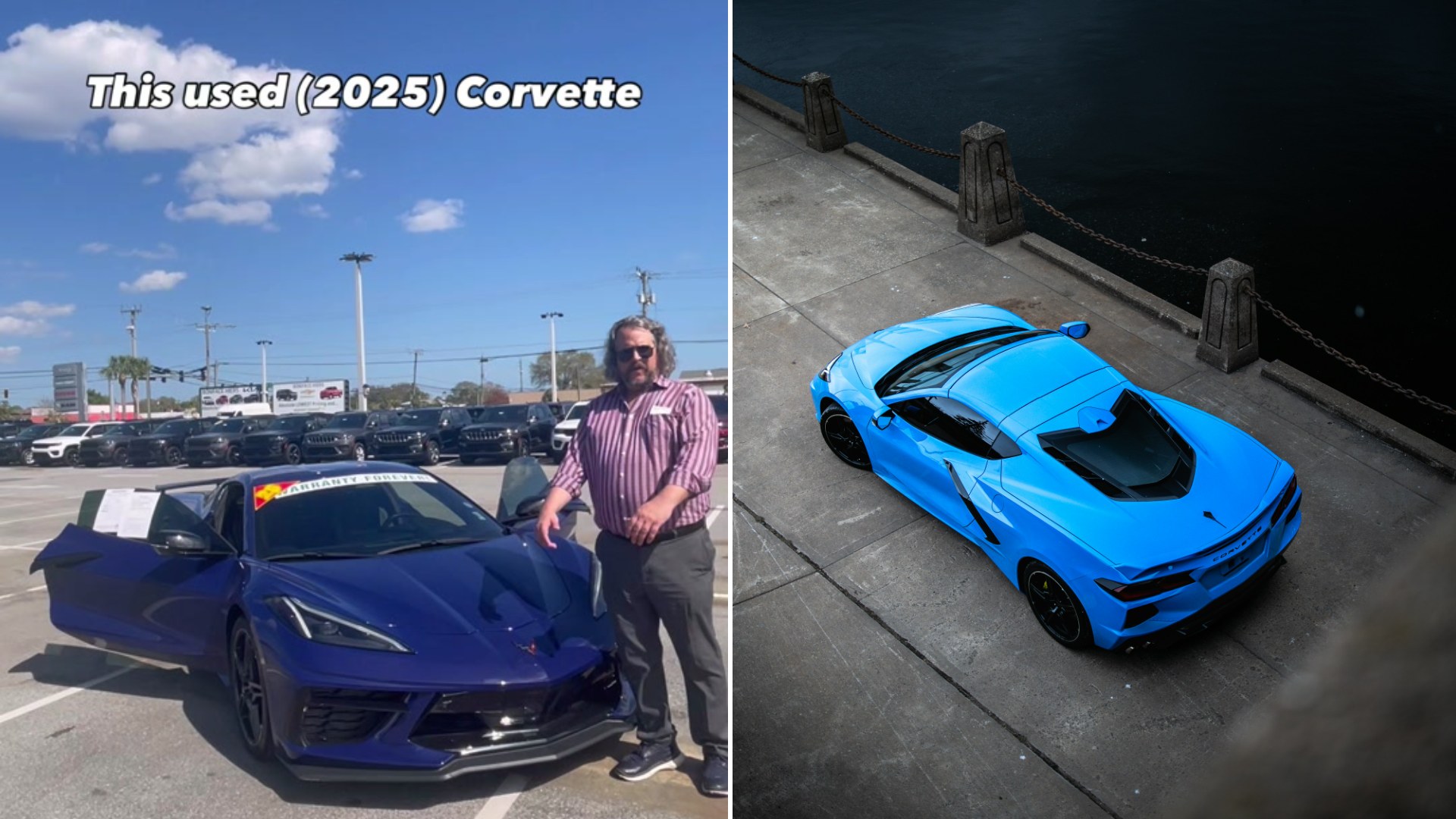
Most used car listings get a few photos and a price. Andrew Hiers gave his a vocal performance. In a 44-second video posted to @eldest_millennial, the self-described former opera singer turned car salesman stands in a dealership lot beside a 2025 Chevrolet Corvette Stingray and sings the entire pitch in a full operatic voice. Every detail a shopper would want, including the model year, the price and who to ask for, arrives as a lyric.
The clip opens with Hiers in a striped shirt and sunglasses next to the car, its driver’s door open and rows of other vehicles parked behind him under a blue sky. He gestures across the hood as he sings the first line, and the words appear on screen as he goes: “This used (2025) Corvette,” then “(Stingray),” then “it was a dream to drive.” There is no spoken introduction and no standard walkaround patter. The song is the walkaround.
@eldest_millennial
Eight seconds in, the camera cuts to the vehicle sheet posted on the car, and this is where the video stops being only a performance and becomes a real listing. The sheet names the seller as Boniface Hiers, at 2555 W King St in Cocoa, Florida, and identifies the car as a 2025 Chevrolet Corvette 2LT. It lists the color as purple, the transmission as automatic and the engine as a 6.2-liter gas V8. The stock number, DP8426, is visible too, which gives anyone interested a precise way to ask about this exact car.
From there the video moves around the outside of the Corvette while Hiers sings “It can be yours.” The shots show the rear of the car with a plate insert reading “WARRANTY FOREVER!”, the passenger door standing open, and a close look at the front left wheel, a black rim wrapped in a Michelin tire. The same “WARRANTY FOREVER” wording shows up again later on a banner across the windshield.
The interior gets the same quick treatment. Viewers see a black leather sport seat, a Stingray sill plate, the door panel with its speaker and controls, the steering wheel and instrument display, the center console, and the infotainment touchscreen, which shows the message “Bluetooth audio disconnected.” One shot catches the rearview mirror with the lot reflected behind the car. Over all of it, Hiers sings the line the whole pitch has been building toward: “For the small price.”
Then the number lands on screen: “$70k.” A second line follows right behind it: “(compared to $84k new).” That is the entire sales argument, delivered in two captions. By the video’s own figures, the used car is listed $14,000 below what a new one costs. Hiers does not sing through a list of options or horsepower figures. He gives the price, gives the comparison, and moves on to the close.
The close is simple. Back outside in front of the car, he sings “Come here now,” and the on-screen text adds a second option in parentheses: “(or message me).” Then comes the final line, “Ask for Andrew,” and he opens his arms wide and holds a long, high note on it.
What happens next gives the video its ending. As he finishes the note, Hiers turns toward the parking lot, where people off camera are reacting, and gives a thumbs-up. He waves in their direction and walks past the front of the Corvette while a choir on the backing track carries the music out. The caption explains the moment: “Some nice folks doing a test drive applauded.”
For anyone shopping for a used sports car, the video is a tidy model of what a listing should tell you before you ever call. In under a minute it gives the model year, the trim, the asking price, a new-car price to measure it against, the dealership’s name and address, and the name of the person to ask for. If a listing you are looking at leaves out any of those, ask for them before making the drive.
The vehicle sheet deserves a slower look than the two seconds it gets on screen. Pause the video, or stand at the window in person, and read every line. Here the sheet calls the color purple, though in the bright sun of the lot the car can read as dark blue, a reminder that the paperwork tells you more than a photo does. The mileage line on the sheet shows a 0 in the clip, while the caption calls the car used, so the actual odometer reading is a question to put to the salesman directly. Write down the stock number so that the car you discuss on the phone is the car you see when you arrive.
The price comparison is worth checking for yourself as well. The “$84k new” figure is the seller’s number, and what a new Corvette costs depends on trim and options, so ask what that figure is based on and compare the equipment on this car with a new 2LT. The same goes for “WARRANTY FOREVER.” It is printed on the car twice, but the video never says what it covers or what an owner has to do to keep it in force. Ask for those terms in writing.
Finally, take the invitation at face value. The video names a specific salesman and offers two ways to reach him, in person or by message. Sending a message first, with the stock number, lets you confirm that the car is still on the lot and that $70,000 is still the price before you plan a trip to Cocoa. And if you do go, you already know who to ask for. He will be the one who can hit the high note.