

Six years into living full time in an RV, the family behind @simply.scenic has a long list of things that have gone wrong on the road. Their own caption runs through it: “RV lemons, major repairs, and more than our fair share of unexpected setbacks over the years.” Even so, they say this summer was different. In a reel titled “Part 1 | Life Update,” they describe the past three months as “some of the craziest and most stressful we’ve experienced in our six years of full-time RV living.”
The story begins at the end of May, when they packed up and headed for their home state of Nebraska for what the caption calls “an exciting partnership.” Several RV air conditioners had been delivered to the narrator’s parents’ house, and the video shows a man and a woman carrying the large boxes down a driveway, stacking them in the bed of a white Ford pickup and cinching them down with orange straps. They drove the load to the RV and unloaded everything so it would be ready for installation.
A couple of days later, the truck went to a Ford dealership, which the video names, for its 100,000-mile maintenance. According to the captions on screen, the work included an oil change, a fuel filter replacement and other services. The written caption calls it “a routine 100,000-mile service.”
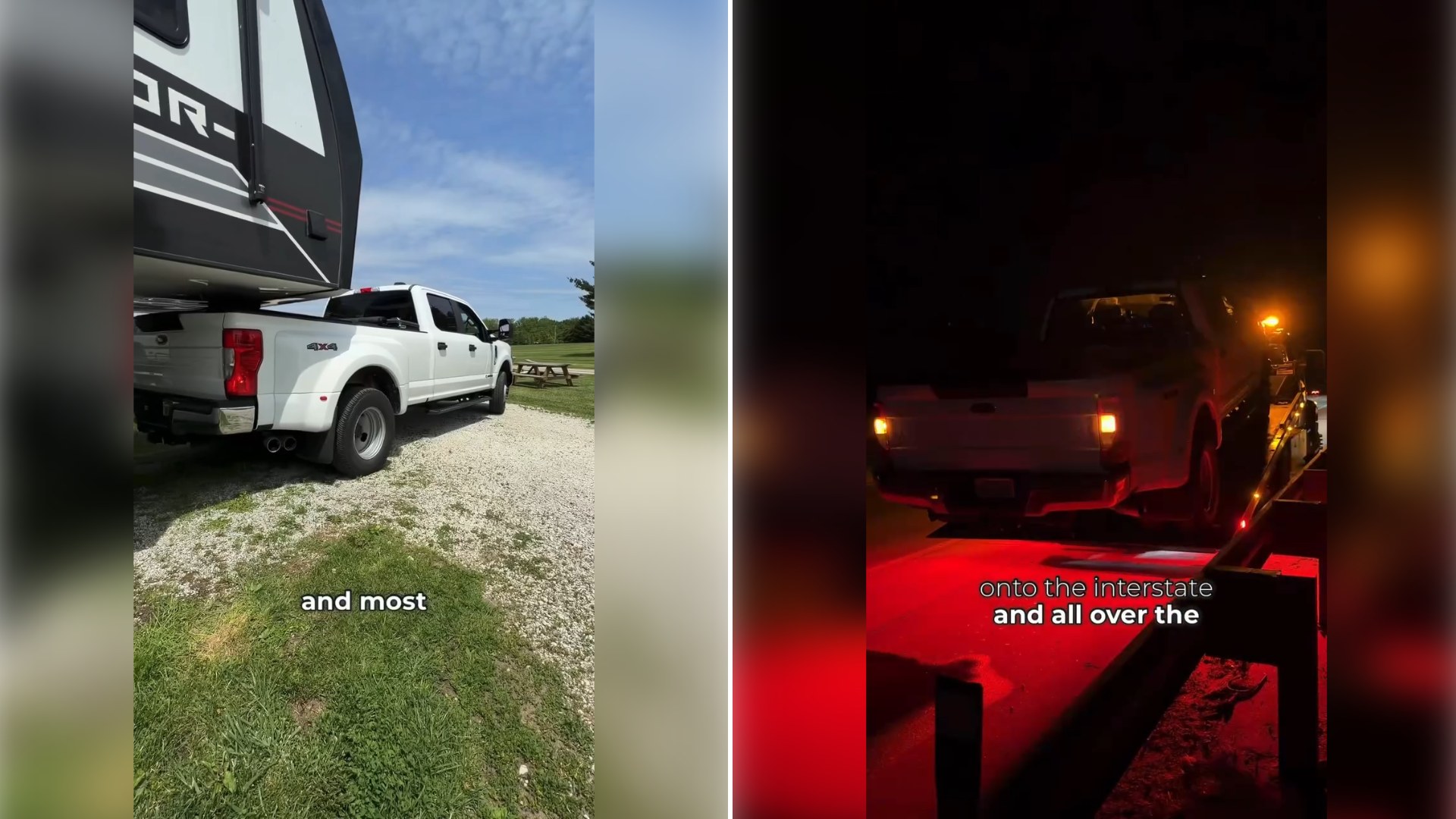
That evening, after picking the truck up from the dealership, the narrator loaded two daughters into the cab and got on the interstate. It did not take long for things to go wrong. “The truck filled with diesel smoke, warning lights started flashing, power disappeared, and I struggled to safely get us off the interstate,” the caption says.
The footage from the roadside is filmed from behind a guardrail at dusk. The white pickup sits on the shoulder with its lights flashing while traffic keeps moving past. In the next shots, emergency lights are strobing behind the truck, the hood is up and a group of responders is gathered at the front end. By the time it is fully dark, the pickup is being pulled onto a flatbed tow truck.
What the responders found is the center of the story. “The fire department later discovered that the fuel line had never been reconnected, resulting in 17 gallons of diesel being dumped onto the interstate,” the caption says. The video cuts to a close-up of the engine bay as the narration reaches that point, and later shots linger on the ground beneath the truck, which is wet and shining in the lights.
The relief is plain in the closing lines. “Looking back, I’m incredibly grateful that we were already in the right lane and that I was able to get my girls and myself safely to the shoulder,” the caption reads. Then comes the line that sets up the rest of the series: “And this was only the beginning.” More is promised over the next several weeks. “This is Part 1,” the family writes. “There’s a lot more to this story.”
One thing to keep in mind is that the reel is the family’s account. It does not include a response from the dealership, and Part 1 does not say how the repair, the tow or the spill were handled afterward.
For anyone who tows, hauls or simply relies on one vehicle to move a household, the reel is a useful prompt to treat the first few miles after a service as a test drive. A fuel filter change means the fuel system has been opened up, so it is worth a look before leaving the lot. Let the engine idle for a few minutes, walk around the truck, look underneath for drips and pay attention to any smell of diesel. If a warning light comes on in the parking lot, that is the place to deal with it, with the service desk a few steps away.
The detail the family keeps returning to is lane position. Being in the right lane already meant the shoulder was one move away when the power went. After any significant work, staying right and keeping speeds modest until the vehicle has proved itself costs nothing. If the engine does start losing power, the hazard lights go on, the vehicle goes as far onto the shoulder as it can, and passengers get out on the side away from traffic and stand behind the guardrail, which is where this video was filmed from. Smoke in the cab or fuel on the road is a reason to call 911, not to try to limp to the next exit.
Spilled diesel is also a hazard for everyone behind. It is slick, and for motorcyclists a diesel streak on the pavement is one of the worst surfaces to meet in a lane. Reporting a leak right away gets crews out to deal with the road as well as the vehicle.
Finally, the family filmed everything: the truck on the shoulder, the responders under the hood, the engine bay, the tow. That record, together with the service invoice listing the work done that day, the tow receipt and the fire department’s findings, is what a driver needs when taking a problem back to a service department. Asking the responding agency how to get a copy of its incident report, and putting the complaint to the service manager in writing instead of only by phone, keeps the facts straight while memories are fresh.
The family says the rest of the story is coming in installments. Part 1 ends with the tow truck pulling away into the dark, the white pickup riding on its back.