

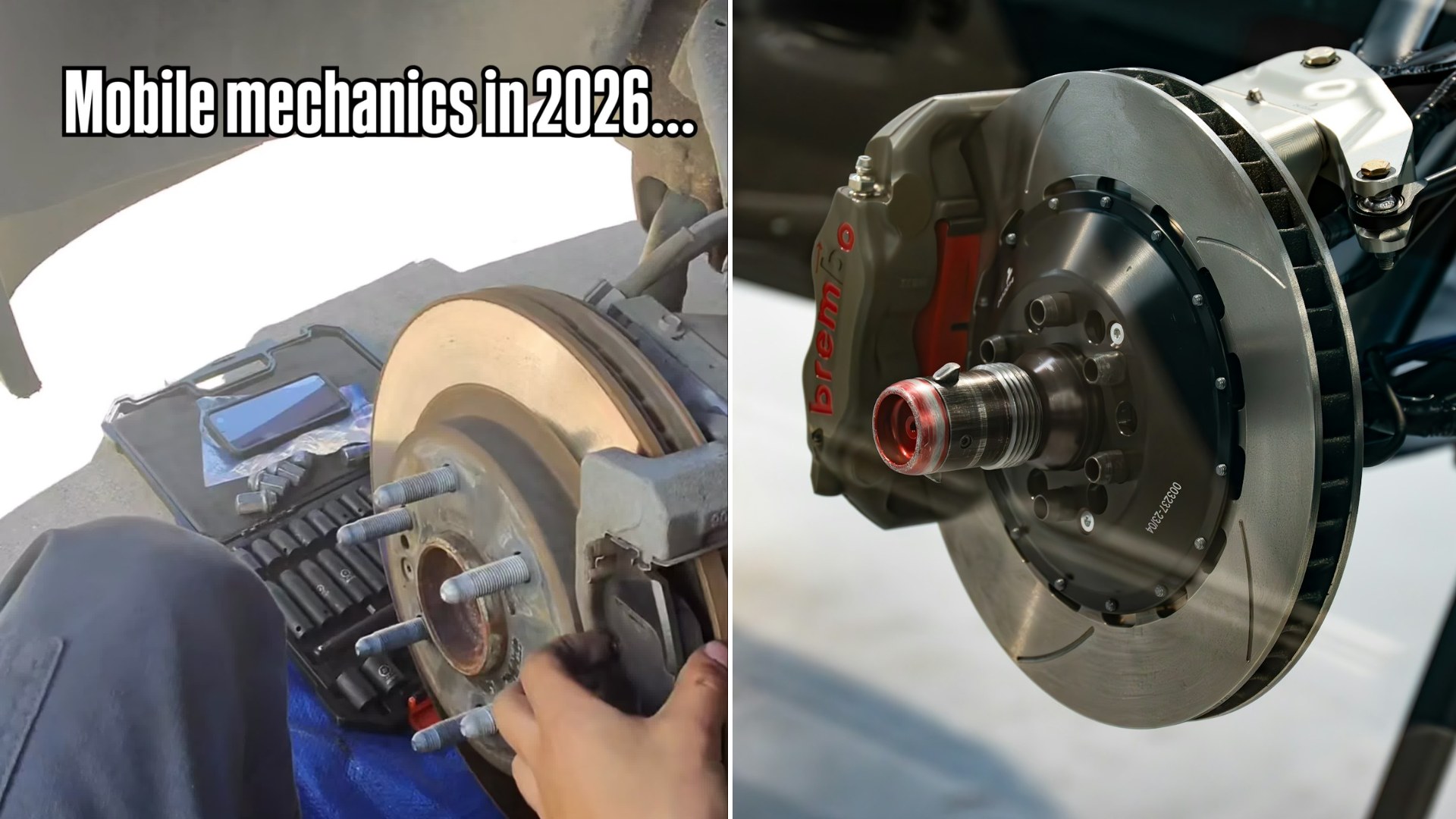
A Houston mobile mechanic is working on the brakes of a customer’s car in a driveway when she looks at the job and asks the question the whole video turns on: “That’s it?” In the clip posted by @mobilemechanichouston, she follows it with a second one, and it comes with a number: “You’re charging me $500 for that?” By the end of the 51 seconds she says she might just keep the squeaking, and he has told her to go find someone who will do the job for thirty bucks.
The video is shot from the mechanic’s point of view, looking down at a wheel hub and brake caliper, under on-screen text that reads “Mobile mechanics in 2026…” The camera tilts up long enough to show the customer, in grey sweatpants and a dark zip-up hoodie, standing nearby in the driveway. He gets as far as “Yeah, that’s…” before she finishes the thought for him: “…charging me $500 for this?”
@mobilemechanichouston
He does not argue the price right away. With an impact driver he starts unbolting the caliper and asks a diagnostic question instead: “Were your brakes grinding or squeaking?” Her answer is immediate. “Yeah, they were always squeaking.” He uses the answer to point her at the parts. “Oh okay, well yeah, I mean here you go, you know you can take a look at your pads right now,” he says, pulling the caliper assembly away so the brake pads sit exposed against the rotor. Then one word: “Look.”
She looks, and she is not persuaded. “That’s it? You’re charging me $500 for that?” What she has watched so far is one part coming off a wheel with a power tool. The mechanic tries to explain what she has not watched yet. “I mean yeah, but you know there’s more to it,” he says. “You have to take them out, calibrate the pistons, and then you have to lube up the rotors like…” He never finishes the sentence, because she is already back on the number: “Yeah, $500?” The same figure appears on screen as a text overlay.
At that point he stops explaining and offers her a choice. “Yeah, $500,” he says. “Do you want me to leave it like this and just walk away or…” She starts to answer, “I mean, the price was just…”, and he supplies the other option himself: “…take the squeaking?” She takes it. “I might just take the squeaking.”
The last thing the video shows is the mechanic fitting the caliper bracket and the other pieces back onto the assembly while he delivers his closing line. “Alright, alright. Yeah, take the squeaking, you know,” he says, and then: “Yeah, find a mechanic to do it for thirty bucks, yeah.” A DLC logo and the shop’s Instagram handle and web address appear on screen along the way. The clip never says what vehicle it is or how the visit ended.
The $500 argument is worth a closer look because both people are reacting to the same thing, which is how small the visible part of a brake job is. A caliper comes off with a power tool in a matter of seconds. What the customer is paying a mobile mechanic for is the rest: someone who brings the tools to the driveway, knows what to check once the brakes are apart and puts them back together correctly. Neither of them spells that out, and the conversation comes down to one number said four times.
The most useful thing a driver can take from the clip is about timing. This disagreement happens with the caliper already unbolted, which is the worst moment to find out that customer and mechanic have different ideas of what the price covers. Before anyone touches the car, ask for the quote in writing and ask what is in it: which axle, which parts are being replaced, and how much of the total is parts and how much is labor. A number with a list behind it is much harder to be shocked by in the driveway.
His first question, “grinding or squeaking,” is also the one to have an answer for before making the call. The two sounds point to different stages of wear. A steady squeak is often the wear indicator on the pads doing its job, while grinding usually means the pad material is gone and metal is rubbing on the rotor, which turns a pad job into a bigger one. And when a mechanic says “take a look at your pads right now,” take him up on it. Ask him to show you how much pad is left and what a new one looks like next to it.
One line in his explanation should not be read as instructions. Brake lubricant goes on the caliper slide pins and the points where the pads rest in the bracket. It never goes on the face of the rotor or the friction surface of a pad, where it would keep the brakes from gripping. The piston step he mentions does correspond to real work: on a pad replacement the caliper piston has to be pushed back in to make room for the thicker new pads.
As for taking the squeaking, that is the one choice in the video not to copy. If a quote feels too high, the answer is a second quote, not more miles on brakes that were always squeaking. Get the other price with the same list of parts and labor so the two numbers can be compared line by line. The mechanic’s thirty bucks was sarcasm, but checking the price with someone else is the right move for a customer who is unsure.