

The 265 That Started an Obsession
In 1955, Chevrolet dropped a 265 cubic-inch V8 into its full-size lineup and rated the base two-barrel version at 162 horsepower, with the Power Pack option — a four-barrel carburetor and dual exhaust — bumping that to 180. Those numbers look almost quaint next to what Dodge sells today, but the Chevrolet small-block that debuted that year set the template every muscle car engine since has chased: more displacement, more compression, more air, and more power, repeated in cycles for seven decades. Engineer Ed Cole’s team reportedly targeted a build cost under $2.30 per horsepower, and the resulting engine was light enough, and cheap enough, to eventually turn a family sedan into something that could embarrass a sports car.
The Big-Block Arms Race
By the mid-1960s, displacement had become the industry’s favorite marketing number. Chevrolet stretched its big-block into the 396 and then the 427. Ford answered with the 428 Cobra Jet and the exotic Boss 429, an engine so conservatively rated at 375 horsepower that period dyno pulls routinely showed closer to 500. Chrysler’s answer arrived in 1966: the 426 Hemi, officially rated at 425 horsepower and 490 lb-ft of torque, stuffed into everything from the Coronet to the ‘Cuda. The street Hemi was famously underrated by the factory to keep insurance premiums and NHRA sandbagging in check, and independent dyno testing regularly showed real output well north of the sticker figure. Chevrolet topped the era in 1970 with the LS6 454 in the Chevelle SS, gross-rated at 450 horsepower and 500 lb-ft, numbers that still stand as the high-water mark of the muscle car’s first golden age.

The Crash
That peak did not last. Insurance surcharges on high-output engines, tightening emissions rules, and a 1972 industrywide switch from optimistic SAE gross ratings to more honest SAE net ratings gutted the spec sheets almost overnight. Compression ratios dropped to run on unleaded fuel, catalytic converters choked exhaust flow, and by 1975 the Corvette’s optional L82 350 managed only 205 net horsepower, with the base engine at 165. A car that would have worn a 400-horsepower badge five years earlier was now lucky to clear half that. The muscle car did not disappear in the mid-1970s, but its engines spent most of a decade running on fumes.
Fuel Injection Brings the Comeback
Recovery came slowly and through better breathing rather than raw cubic inches. Turbocharging and electronic fuel injection let Buick’s 3.8-liter V6 Grand National hit 245 horsepower by 1987, genuinely quick for the era despite giving up two cylinders to its GM stablemates. Chevrolet’s LT1 pushed the Corvette and Camaro back to 300 horsepower by 1993, a threshold that had felt unreachable a decade earlier. The LS-based small-block family kept climbing through the 2000s, and by 2006 the Corvette Z06’s LS7 displaced 427 cubic inches, the same number Chevrolet racers chased in the 1960s, and made 505 horsepower naturally aspirated at 6,300 rpm. In between, the C5 Corvette Z06’s LS6 had already shown the direction of travel, climbing from 385 horsepower in 2001 to 405 by 2002 without any increase in displacement, proof that better cylinder heads and camshaft profiles could do what raw cubic inches once did alone. Displacement and horsepower had finally reconnected, this time with modern reliability attached.
Boost Rewrites the Ceiling
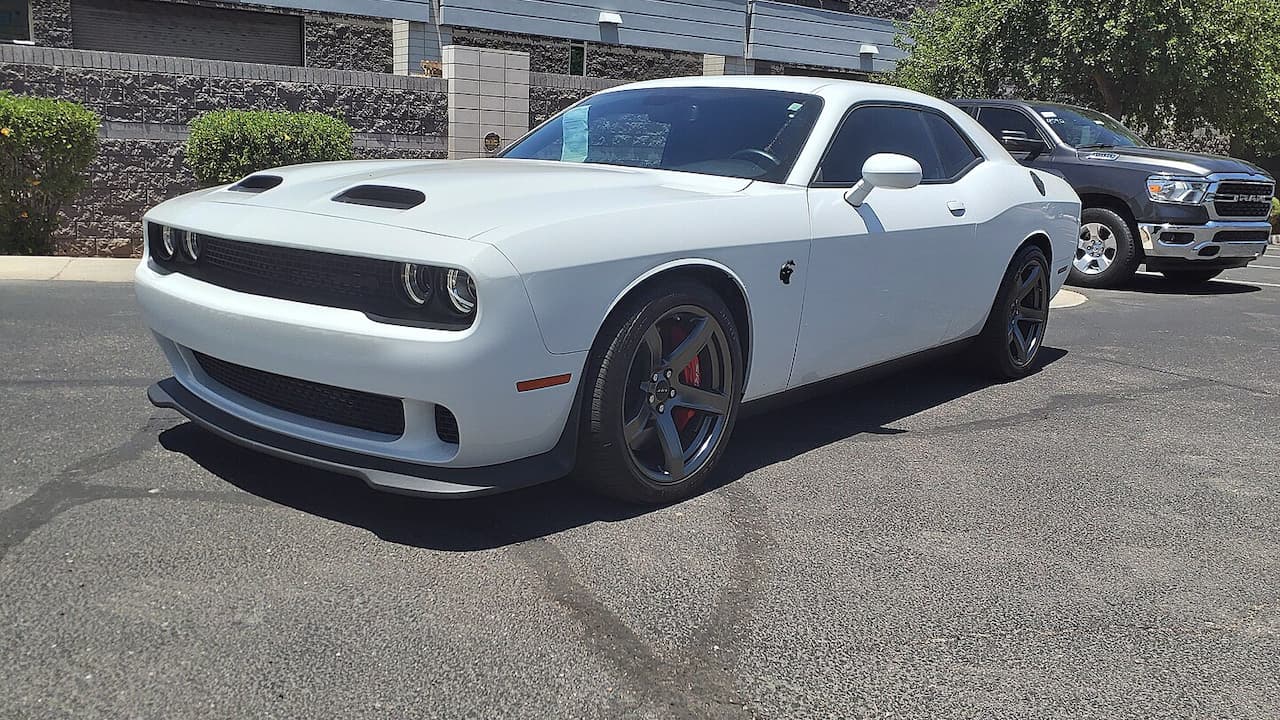
Then Dodge changed the conversation entirely. The 2015 Challenger SRT Hellcat bolted a 2.4-liter supercharger onto a 6.2-liter HEMI V8 and rated it at 707 horsepower, a figure that would have sounded like science fiction to a 1970 Hemi buyer. Three years later the Hellcat Redeye pushed a larger 2.7-liter supercharger and reinforced internals to 797 horsepower and 707 lb-ft, edging right up against the 800 mark. Dodge kept going anyway. The 2018 SRT Demon hit 840 horsepower on race fuel, and the 2023 Demon 170 send-off, running on E85, was factory-rated at 1,025 horsepower, the most powerful V8 ever installed in a production car.
Seven decades separate Chevrolet’s 162-horsepower 265 from Dodge’s 1,025-horsepower Hemi, and the gap says less about brute displacement than about how far metallurgy, fuel delivery, and forced induction have come. The muscle car that started as a cheap way to move a lot of cubic inches is now an exercise in squeezing absurd power from an engine architecture nobody in 1955 could have imagined surviving this long.