


More than 1 million vehicles were stolen in the U.S. in 2023 — 1,020,729, to be exact, up from 1,008,756 the year before — and the National Insurance Crime Bureau says one of the fastest-growing tools behind those thefts doesn’t involve breaking a window or hot-wiring anything. It involves stealing the invisible signal your own key fob broadcasts, from outside your house, without you ever knowing it happened. NICB’s own 2023 theft report puts it bluntly: thieves are increasingly using “keyless entry hacks to relay attacks on key fobs” to get into and start cars in under a minute.
Key Points
- Over 1 million vehicles were stolen nationwide in 2023, according to NICB — the second consecutive record year.
- NICB has physically tested commercially available relay attack devices and confirmed they unlock and start the majority of keyless vehicles tried.
- A relay attack requires no physical key, no broken glass, and leaves no obvious forced-entry evidence.
- California alone recorded 208,668 stolen vehicles in 2023, the highest volume of any state.
The mechanism itself is simple electronics, not hacking in the movie-villain sense. Every modern proximity key fob constantly emits a low-power radio signal so the car can sense when it’s nearby and unlock automatically. A relay attack uses two small devices working as a team: one held close to the fob — often just outside a house, near a doorway or window where the fob sits on a table — and a second held next to the target car. The first device captures the fob’s signal and the second rebroadcasts it to the car in real time, tricking the vehicle into thinking the actual key is sitting right next to it, close enough to unlock the doors and, on push-button-start cars, start the engine.
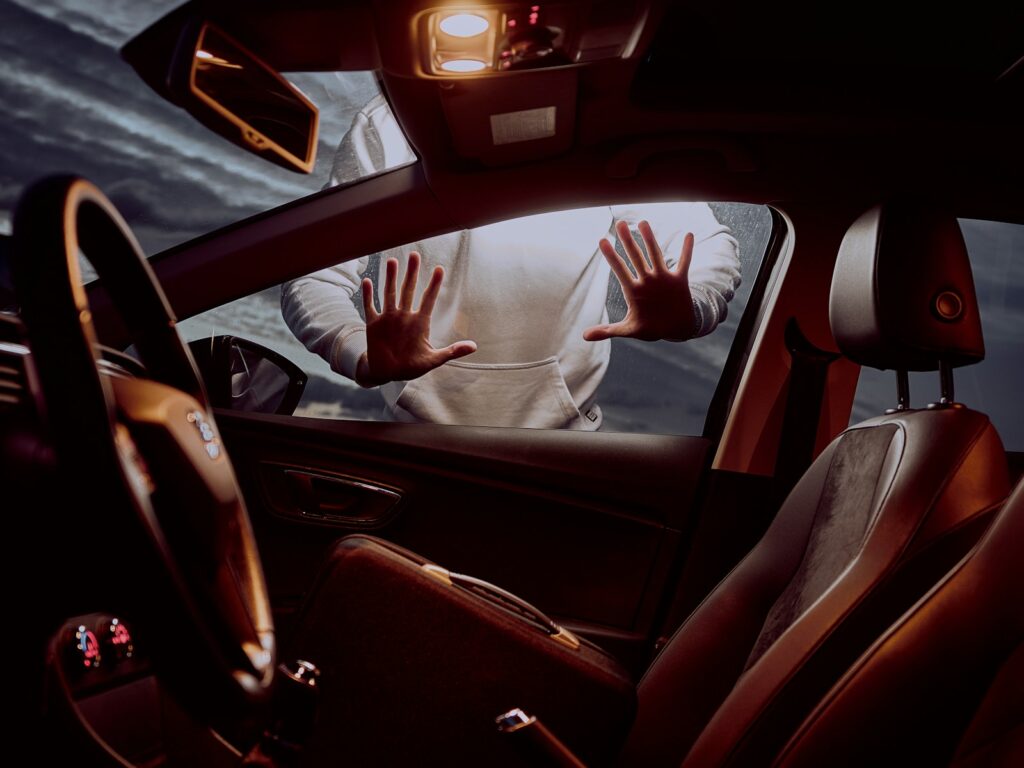
NICB tested this itself — and it worked
This isn’t theoretical. NICB has documented purchasing a commercially available relay attack unit and running it against a range of vehicles equipped with keyless entry and push-button ignition. The organization’s own findings state the device successfully unlocked the targeted vehicles and was able to start the engine in the majority of them — meaning a thief could, in principle, drive away without ever touching a physical key or leaving the kind of forced-entry damage an insurance adjuster or police report would normally flag. NICB has used that same testing to brief automakers directly on the vulnerability as manufacturers work on countermeasures like fobs that go dormant when motionless.
Why it’s hard to track how big the problem really is
One frustrating gap in the data: the industry doesn’t systematically log which stolen vehicles were taken via relay attack versus other methods, so there’s no single national percentage to point to. NICB does track a related, more visible risk factor — vehicles stolen with keys left inside them, which accounted for 287,024 thefts, or about 11%, of the 2.6 million total thefts recorded between 2019 and 2021. That’s a different crime than a relay attack (no signal interception needed if the key is already in the car), but it points to the same underlying reality: as vehicles have shifted away from physical, cut-metal keys toward keyless and proximity systems, the paths into a car have multiplied rather than shrunk.
The scale of the broader theft problem
Vehicle theft overall has been climbing for years — NICB’s data shows 2023’s total of just over 1 million thefts built on an already-elevated 2022, and California’s 208,668 stolen vehicles led every state by a wide margin, while Washington, D.C. posted the highest per-capita theft rate in the country at 1,149.71 per 100,000 residents. NICB President and CEO David Glawe said in the organization’s own statement on the report that criminals are “employing increasingly sophisticated methods to steal vehicles, including the use of advanced technology to bypass security systems” — and that keeping up requires manufacturers and law enforcement to “stay one step ahead” of tools like relay devices that are cheap, small, and increasingly easy to buy.
What actually blocks a relay attack
The fix doesn’t require replacing your car. A signal-blocking pouch or box — often sold as a “Faraday pouch” — stops a fob’s radio signal from being captured at all when the fob is stored inside one at home. Some newer fobs also include a motion-sensing sleep mode that stops broadcasting a signal after a period of stillness, closing the window a relay attack depends on. Given that NICB’s own testing found the majority of tested keyless vehicles vulnerable, and that the fix costs less than a tank of gas, it’s one of the cheapest insurance policies available against a theft method built entirely on exploiting a convenience feature most owners never think twice about.