

He’d been saying it the way people say “five more minutes” when they’re already late: the project car was “almost done.” Not done-done, obviously, but close enough that he talked like the finish line was visible if you squinted. Every time his wife asked how it was going, he had a new little milestone to report—parts cleaned, brackets fabricated, wiring “basically sorted,” the body “finally straight.”
The car itself sat in their garage like a promise that had started to curdle. It was a classic coupe he’d dragged home on a trailer a year and a half earlier, the kind of thing he’d wanted since he was a teenager. At first it felt almost wholesome: weekend sanding sessions, YouTube videos playing in the background, him excitedly explaining why some obscure part mattered. But “almost done” started stretching into seasons, and the garage stopped being a shared space and became his bunker.
She wasn’t anti-hobby, and she wasn’t even anti-car. What she was, increasingly, was anti the way it swallowed time, money, and any conversation that tried to approach reality. When she asked what “almost done” actually meant—like, could it start, could it drive, could it even roll without a neighbor helping—he’d give her the same calm smile and say the engine was “next,” like that was one simple checkmark away.
The “Almost Done” Routine
His routine was consistent enough to be comforting, if you ignored what it was doing to everything else. He’d get home from work, eat, and disappear into the garage in his old hoodie, the one with paint flecks and grease stains that never washed out. She’d hear music, the click of tools, the garage door rolling up and down like a heartbeat.
When she’d pop in, he always had something in his hands—a line he’d just run, a piece he’d just painted, a diagram on his phone he was “cross-referencing.” He’d talk fast, like if he kept the details flowing, she wouldn’t have space to ask the question he didn’t want to answer. The car looked different, sure, but not in a way that screamed “ready.” It looked like a disassembled museum exhibit with new shiny parts bolted to old problems.
There were small signs he was using “almost done” as a pressure release valve. If she brought up the budget, he’d say he was “done buying big stuff,” then a week later there’d be another box on the porch. If she asked about timelines, he’d say “a couple more weekends,” then suddenly the next weekend was “not a good one” because he needed to “wait on a part.”
The Receipts She Wasn’t Looking For
The blow-up didn’t start with her snooping or setting a trap. It started with something boring: sorting paperwork for taxes and trying to find a warranty statement for their dishwasher. Their filing system was a stack of envelopes in a drawer that only made sense to him, which meant it didn’t make sense at all.
She started opening envelopes to see what was what, tossing junk mail, making piles. Then she hit a thick packet—multiple receipts stapled together, with that familiar parts-store logo and handwritten notes in the margins. There were shipping confirmations too, the kind that come folded into a box and end up in a pocket, then the laundry, then the drawer.
At first it didn’t register as anything beyond “more car stuff.” Then she noticed the totals. Not $30 here or $80 there, but $600, $1,200, $2,300—numbers that made her sit down on the edge of the bed with the stack in her lap. She started adding them up, not because she wanted to, but because her brain wouldn’t let it go unfinished.
She got to $18,000 before she even felt confident she’d found everything. The receipts were spread across different stores and websites, some dated months ago, some from last week. A few were for tools—specialty tools—along with performance parts that sounded like they belonged on a track car, not a “family budget” conversation. And the detail that kept smacking her in the face was the same one she’d been gently asking about for months: the engine still wasn’t installed.
The Empty Engine Bay
That night, she didn’t lead with accusations. She asked him to show her the progress, like she was trying to walk herself back into believing his version of “almost done.” He lit up, happy to be asked, and led her out to the garage like a tour guide who’s been waiting all day for an audience.
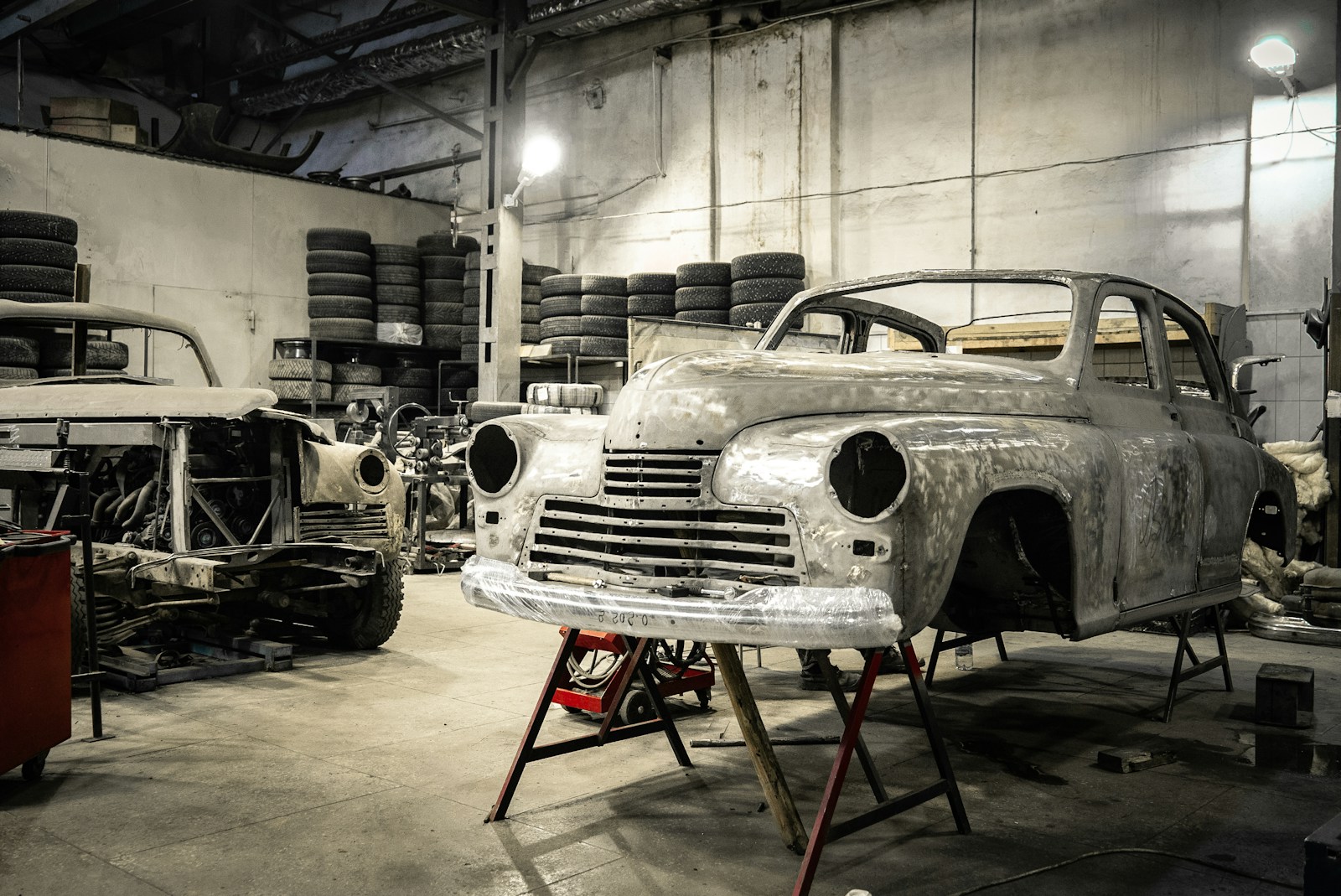
The car was on jack stands, bodywork half-finished in a patchwork of primer and bare metal. There were labeled zip-top bags in bins, wires looped neatly, new suspension components that did look genuinely clean and expensive. It was, in some ways, impressive—if you ignored the center of the room where the biggest piece of the puzzle should’ve been.
She walked around to the front and looked into the engine bay. It was empty. Not “engine is in but not hooked up,” not “we’re waiting on one last sensor,” but empty like a mouth with missing teeth.
When she asked him—quietly, almost politely—why the engine still wasn’t in, he started listing reasons like he’d rehearsed them. The mounts weren’t right. The wiring harness needed modification. He didn’t want to install it until the bay was “perfect,” because pulling it back out would be a nightmare. He said “it’s smarter this way,” as if this was a strategic choice, not a sign the whole thing had drifted out of control.
The Fight Where Everything Slips Out
She brought the receipts into the garage and set them on his workbench, right next to a torque wrench and a half-open energy drink. The paper looked innocent compared to the metal and grease, but it changed the air immediately. He didn’t touch them at first, just stared like they were evidence in a case he didn’t know he was in.
She didn’t yell right away. She asked him to explain the number, and the way she said it made it clear she’d already done the math. His first move was to shrink it: “That’s over time,” “it adds up,” “some of that’s tools,” “I’ll sell extra parts,” like the receipts were a misunderstanding created by their layout on paper.
Then he shifted to defense. He reminded her they’d talked about him restoring a car “someday,” as if that vague dream automatically approved every purchase. He said it was his stress relief, his “one thing,” and that she wouldn’t understand how close it actually was because she didn’t know what she was looking at. When she pointed out that “almost done” shouldn’t mean “no engine,” he got tight and snapped that she was focusing on the wrong detail.
That’s when the emotional stuff surfaced—the stuff that had been hiding under the language of parts and progress. She told him she felt lied to, not because he loved a project, but because he kept promising an endpoint he didn’t seem interested in reaching. She told him she’d been budgeting groceries and skipping small things without thinking twice, while he was ordering another box of shiny components like it didn’t touch the same bank account.
He accused her of making it about money when it was about his passion. She shot back that it became about money when the number hit $18,000 and he couldn’t even turn a key. He said he was building it “the right way,” and she said “the right way” looked a lot like never finishing, because finishing meant there’d be nothing left to buy, nothing left to tinker with, and nowhere left to hide.
Aftermath: The Garage Becomes a Border
The next few days were the kind of quiet that isn’t peaceful. He still went to the garage, but he did it more stiffly, like he was going to a job he resented. She stopped asking questions because every question felt like stepping on a landmine, and every silence felt like agreeing to something she didn’t agree to.
He tried small gestures that didn’t actually fix the core issue. He offered to “slow down on spending,” which wasn’t the same as telling her what had already been spent or why. He mentioned selling some parts, but not in a concrete way—more like a concept he hoped would calm her down.
She, meanwhile, couldn’t unsee the number. Eighteen thousand dollars didn’t just represent parts; it represented all the times he’d said “next month will be lighter” and “we’re past the expensive stage.” It made her replay every “almost done” conversation and notice how slippery it had been, how it always moved the finish line without announcing it.
The weirdest part was that the car looked better than it had at the start. He wasn’t doing nothing. He was doing a lot, constantly. But the work seemed to orbit the one thing that would make it real—an engine in the bay, a car that could actually be a car—and that orbit felt less like craftsmanship and more like avoidance.
By the time the story hit the point where other people were weighing in, the question wasn’t really “who’s right.” It was what happens when one person’s dream project becomes the third partner in a marriage, absorbing money and attention while promising a payoff that never arrives. The car sat there, clean parts gleaming under fluorescent lights, and the receipts sat in a neat stack inside the house—two different kinds of proof that “almost done” had stopped meaning progress and started meaning permission.