

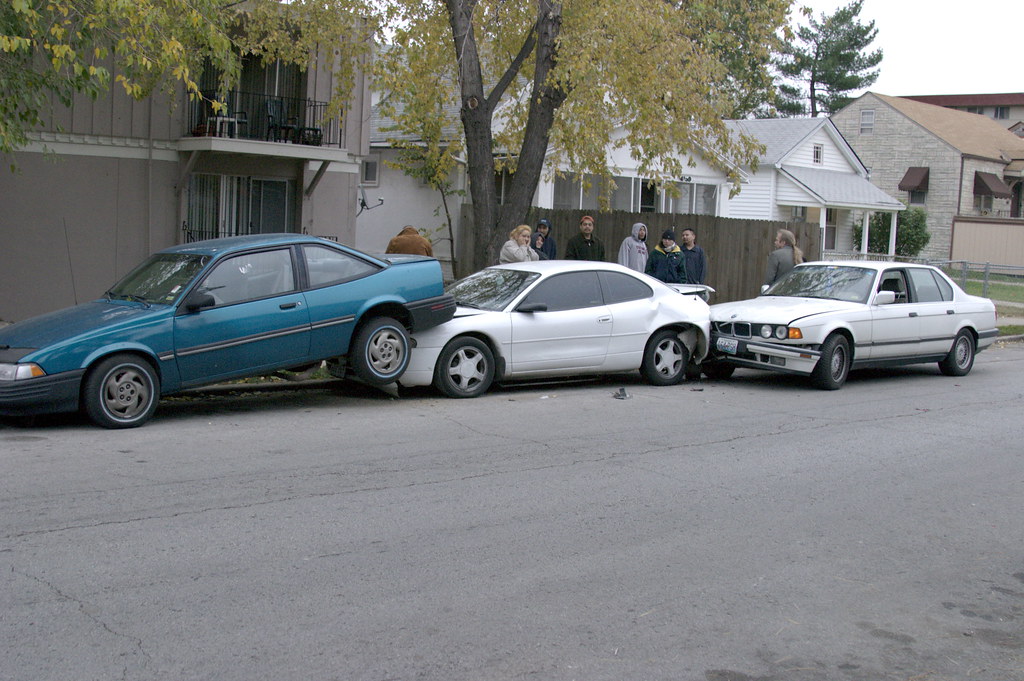
It started the way a lot of annoying, ordinary problems start: with someone walking out to their car in a half-awake rush, coffee in one hand, keys in the other, already thinking about the day ahead. The car was parked on the street in front of their apartment, where it had been the night before, exactly where they always left it.
Except this time the rear bumper was caved in like someone had taken a bite out of it. The paint had spiderwebbed, the plastic was hanging loose, and one taillight had that crunchy, glittery look broken lenses get in the morning sun. There was no note tucked under the wiper, no apologetic scrawl, no phone number—just a scatter of white plastic bits on the asphalt and a faint streak of someone else’s paint rubbed across the corner.
They did what you’re supposed to do when you’re the responsible one in a hit-and-run: took pictures from every angle, panned slowly for a video, grabbed shots of the debris, and called the non-emergency line. The police officer who eventually showed up was polite but blunt, the kind of tired helpful that comes from seeing the same thing a thousand times. “We’ll file it,” he said, “but without a plate or video, there’s not much we can do.”
The “Responsible Adult” Routine
The driver—let’s call them Alex—wasn’t new to insurance claims, but this was their first time dealing with a hit-and-run while the car was parked. Alex had decent coverage, the kind they’d been paying for automatically for years without thinking too hard about it. This felt like the exact scenario insurance was made for: unknown driver, clear damage, police report, done.
So Alex did the whole claim dance. They uploaded the photos, attached the police report number, and wrote out the timeline in that stiff, overly careful way people do when they’re afraid of saying the wrong thing: parked at 9:40 p.m., discovered damage at 7:10 a.m., no witnesses. They even included a photo showing the car nestled against the curb, like proof it hadn’t been moved and smashed elsewhere.
The first adjuster call was weirdly normal, almost reassuring. The adjuster asked a few boilerplate questions—anyone else drive the vehicle, any prior damage, any cameras nearby—and Alex answered like someone trying to get an A on a test. Alex admitted there were a couple of old scuffs on the front bumper from a parking garage incident years ago, but nothing like this, and not on the back.
The Repair Shop Adds a Twist
A couple days later, Alex took the car to a body shop recommended by the insurer’s network. The shop manager walked around it with the calm seriousness of someone who’s seen everything from “oops I nudged a pole” to “how did you even survive this.” He pressed the bumper, frowned at the taillight, and pointed out that the underlying bracket looked bent.
“This is a solid hit,” he said, and quoted a number that made Alex blink. Not catastrophic, but enough that you start doing math in your head: deductible, rental car, how long you can tolerate the bumper hanging off without looking like you live in a demolition derby.
Then came the part that made Alex’s stomach drop in a more specific way. The shop manager mentioned that for some claims, insurance likes “pre-loss condition” proof. He didn’t say it like a threat, more like a warning delivered with a shrug. “Sometimes they ask for photos from before,” he said, “like a recent walkaround or inspection. Just so they can’t argue it was already there.”
Alex laughed at that at first, because who takes casual, timestamped glamour shots of their rear bumper on a random Tuesday? Alex had selfies, pictures of a friend’s dog, one blurry photo of the car loaded with Ikea boxes from months ago where the bumper was technically visible in the background if you zoomed in. That was it.
The Denial That Didn’t Even Pretend
The denial didn’t arrive as a dramatic phone call. It came as a neat email with a PDF attachment, the kind that looks like a credit card statement: tidy fonts, bullet points, zero empathy. The subject line might as well have been “No.”
The reasoning was the part that made Alex reread it three times. The insurer wasn’t denying that the car was damaged. They weren’t even denying the possibility of a hit-and-run. They were denying the claim because Alex “couldn’t prove” the rear damage wasn’t pre-existing.
Not “we think it was pre-existing.” Not “our investigation indicates prior damage.” Just: you cannot prove it wasn’t already damaged, so we’re not paying. It was like being accused and convicted in the same sentence, with the burden of proof flipped onto the person standing there holding the broken taillight pieces.
Alex called immediately, the way people do when they think a human voice will fix what an automated system messed up. The adjuster sounded irritated in that corporate way that’s careful not to be rude but still manages to feel dismissive. Alex asked the obvious question: how do you prove a negative? How do you prove your car wasn’t damaged before someone smashed into it overnight?
The Moving Goalposts Phone Call
The adjuster’s answer wasn’t “we made a mistake,” it was a maze. He asked for maintenance records, as if an oil change receipt would confirm the bumper’s moral purity. He asked if there were any neighbors with doorbell cameras, any nearby businesses with parking lot footage, any city traffic cams that might’ve caught the impact.
Alex explained, again, that it happened in the middle of the night on a residential street. No businesses. No traffic camera. The one neighbor with a doorbell cam pointed mostly at their own porch, and the motion detection didn’t trigger. The police report didn’t help, because the police report was basically: vehicle was found damaged, suspected hit-and-run, no suspect.
Then the adjuster started circling the phrase “pre-existing.” He asked whether the bumper had ever been “loose” or “misaligned.” He asked if there had been any “minor contact incidents” in the past. It felt less like an investigation and more like a fishing trip where any tiny admission could become a loophole.
Alex tried to keep it factual, but you could hear the frustration creeping in. The car was fine yesterday. It wasn’t fine today. Isn’t that the whole point? The adjuster didn’t budge; he repeated the same line about insufficient evidence, like it was printed on a card in front of him.
At some point Alex asked, “So what would have counted as proof?” And the adjuster—this is the part that stuck with Alex—mentioned an “inspection” or “recent photos.” He said it casually, like it was normal for people to conduct periodic documentation of their car’s body panels to prepare for a stranger’s future crime.
Trying to Build a Case Out of Nothing
Alex did what people do when they feel cornered: started assembling scraps of proof like it was a murder board. They dug through their phone for any photo where the rear of the car showed up by accident. There was one from a camping trip where the hatch was open and you could see the bumper, but it was taken months earlier and the lighting was terrible.
They asked friends if anyone had taken pictures near the car recently. They checked old group photos, holiday shots, anything taken in the parking area behind the building. One friend found a picture from a week earlier where the car was behind them in the background, mostly blocked by a trash bin, but you could sort of see the corner of the bumper intact.
Alex forwarded what they had anyway, along with a written statement: no prior rear damage, no previous claims, no repairs on that area. The response took days, which felt like the insurer understood that time itself was a pressure tactic. When the email finally came, it was another polite wall: the photos weren’t clear enough, the dates weren’t definitive, and the company was “unable to verify the loss occurred as reported.”
That wording hit harder than the original denial. It wasn’t just “we won’t pay,” it was “we don’t believe you,” dressed up in formal language. Alex wasn’t trying to scam anyone; they were trying to get their car fixed after someone literally fled the scene.
The body shop called with its own awkward update. They couldn’t start repairs without approval unless Alex wanted to pay out of pocket, and the shop manager sounded genuinely sympathetic but helpless. “I’ve seen them do this,” he said, and that sentence landed like a weight—like this wasn’t an anomaly, just another technique that works because most people don’t have the time to fight.
The Fallout: Pay, Fight, or Drive a Wreck
Alex escalated, because what else do you do when someone says your reality isn’t verifiable? They asked for a supervisor, filed an internal appeal, and started reading their policy like it was a hostile contract from a fantasy novel. The policy language was dense, full of “at our discretion” and “subject to investigation,” the kind of phrasing that sounds neutral until you’re the one being denied.
They considered filing a complaint with the state insurance department, but even that felt like another part-time job. Meanwhile, the car was still sitting there with a half-detached bumper, a constant reminder every time Alex walked outside. Driving it felt embarrassing and slightly unsafe; not driving it meant rideshares, borrowing a friend’s car, or rearranging work and life around a damaged piece of property that wasn’t their fault.
And the worst part wasn’t even the money, though the money obviously mattered. It was the feeling of being told, in effect, that unless Alex had been documenting their car like a rental company employee, the default assumption was suspicion. Someone else had hit them and run, and somehow Alex was the one being asked to prove they didn’t already deserve it.
By the time the appeal was “under review,” the story had turned into a slow-burn standoff: Alex versus an insurance company that could wait forever, and a damaged car that couldn’t. There wasn’t a neat resolution yet—just that gnawing, infuriating tension of paying every month for protection, then finding out the protection comes with an invisible requirement: you have to be ready to prove your innocence on demand, even when the only thing you did was park and go to sleep.