


The Same Star Count, Different Numbers
Three stars. That’s the rollover resistance rating NHTSA assigns to both the Jeep Wrangler and the Ford Bronco, and on paper that looks like a wash. It isn’t. Buried in the agency’s own safety ratings data for the 2023 Jeep Wrangler is a rollover possibility figure of 27.9 percent. Run the same query on the 2024 Ford Bronco four-door and the number drops to 25.6 percent. Same star badge, a 2.3-point gap in modeled risk. If you’ve ever assumed the National Highway Traffic Safety Administration’s five-star system tells the whole story in one glance, these two off-roaders are the exhibit that proves it doesn’t.
What the Star Rating Actually Measures
NHTSA’s rollover resistance rating isn’t a crash test in the way most people picture one. It’s a blend of two separate exercises. The first is the Static Stability Factor, a geometry calculation that compares a vehicle’s track width to the height of its center of gravity, essentially a measure of how top-heavy the vehicle sits before it ever turns a wheel. The second is a dynamic evaluation, a sharp steering maneuver conducted at highway speed designed to see whether the vehicle tips onto two wheels when a driver overcorrects. NHTSA’s ratings program describes this as simulating a driver who enters a curve too fast, loses control, and jerks the wheel to recover, the scenario responsible for a disproportionate share of real-world single-vehicle rollover deaths.
Those two inputs get combined into a rollover probability, expressed as a percentage, which NHTSA then buckets into a one-to-five star scale. A tall, narrow, high-clearance vehicle, which describes almost every serious off-roader ever built, will nearly always land in the three-star range, because the physics of ground clearance work against rollover resistance no matter how good the chassis tuning is. Both the Wrangler and Bronco recorded “No Tip” results in the dynamic phase of testing, meaning neither vehicle actually rolled over during NHTSA’s fishhook maneuver. The star rating is a statistical estimate of risk, not a record of vehicles flipping in a lab.
Wrangler vs. Bronco, Door for Door
NHTSA’s public database lists a 2023 Jeep Wrangler SUV 4WD at three stars for rollover, a 27.9 percent modeled rollover possibility, and a four-star front-crash rating with no side-impact data on file. The agency has not yet published rollover figures for a newer Wrangler model year, so this remains the most current government test data available for the JL-generation Wrangler as of this writing, a detail worth flagging rather than papering over.
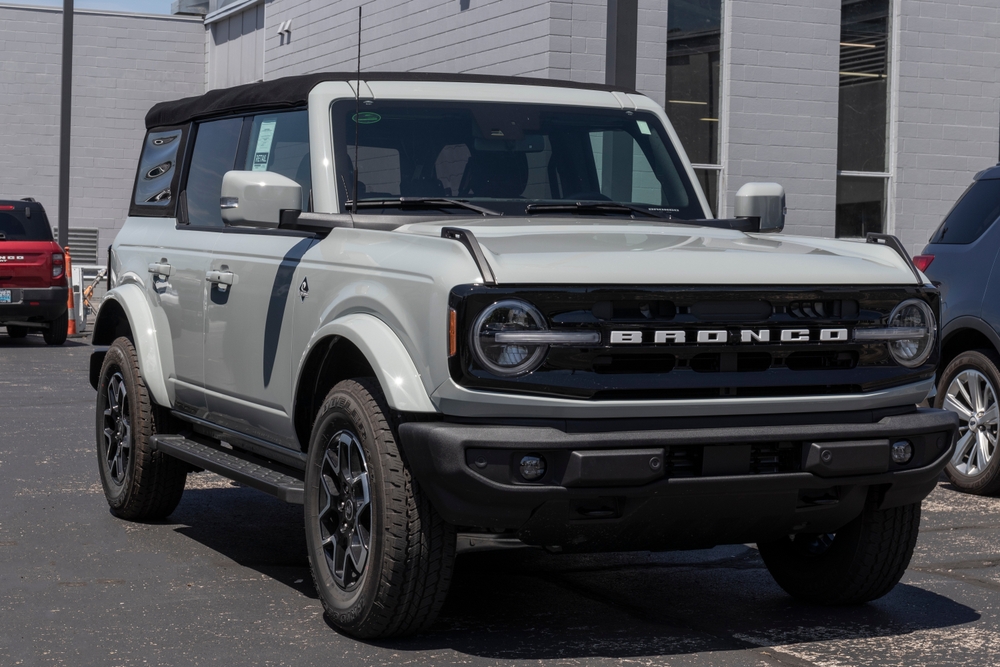
The Bronco data is more granular because Ford submitted both body styles for separate evaluation. The 2024 Ford Bronco four-door and the 2024 Ford Bronco two-door both landed at three stars for rollover with an identical 25.6 percent rollover possibility, despite the wheelbase difference between the two body styles. Front-crash results split slightly (the four-door scored five stars on the passenger side and four on the driver side, while the two-door flipped that split), but the rollover math came out the same for both. Whatever Ford did with track width and suspension geometry across the two Bronco variants, it produced a rollover profile that doesn’t care how many doors the vehicle has.
Independent reporting lines up with the government numbers. J.D. Power’s coverage of the Wrangler’s NHTSA results confirms the three-star rollover figure and notes it sits alongside a “Marginal” small-overlap frontal rating from the Insurance Institute for Highway Safety, a separate, nonprofit-run test that grades structural crash performance rather than rollover physics, and one NHTSA doesn’t run itself.
Why the Gap Exists at All
Neither vehicle is going to out-handle a Miata, and nobody cross-shopping a solid-front-axle rock crawler expects it to. But the 2.3-percentage-point gap between Wrangler and Bronco is real enough to have a mechanical explanation. Ford built the current Bronco with a fully boxed frame and wider standard track than Jeep uses on the Wrangler, and that extra width lowers the geometric rollover threshold NHTSA’s Static Stability Factor calculation is built around. Jeep’s Wrangler, meanwhile, carries forward solid axles front and rear, excellent for articulation on the trail but less favorable for the center-of-gravity math that feeds into a rollover score on pavement.
None of this means either truck is dangerous by the standards NHTSA applies to the rest of the market; three stars is a common, almost expected outcome for body-on-frame off-roaders with real ground clearance, and plenty of popular midsize trucks land in the same band. What it means is that the identical star badge on a Monroney sticker is compressing a meaningful difference into a rounding error. A buyer cross-shopping these two rigs who cares specifically about rollover risk on the highway commute rather than the trail is better served reading the underlying percentage than the star count alone, and on that measure, the Bronco currently holds a real, government-measured edge over the Wrangler.