

The job site was one of those half-finished commercial builds where everything looks temporary: plywood walkways, orange fencing, toolboxes balanced on tailgates, and guys yelling measurements over the beep-beep of a reversing forklift. Around mid-morning, when everyone’s coffee had worn off and patience was thinning, Kyle decided it was time to remind the world he was winning.
Kyle was the loud one. Not the funny-loud, either—more like the guy who can’t let silence exist without filling it with a story about himself. He’d rolled in that day in his black lifted truck, the kind with spotless wheels that never seemed to see mud even though he worked construction, and he’d parked it right up by the conex like he owned the place.
He’d been on a tear all week about how “payments are for suckers,” how he’d “done it right,” how it “feels different when you don’t owe anybody a dime.” By the time lunch break hit, half the crew had heard the paid-off-truck speech twice, and the other half were pretending they hadn’t.
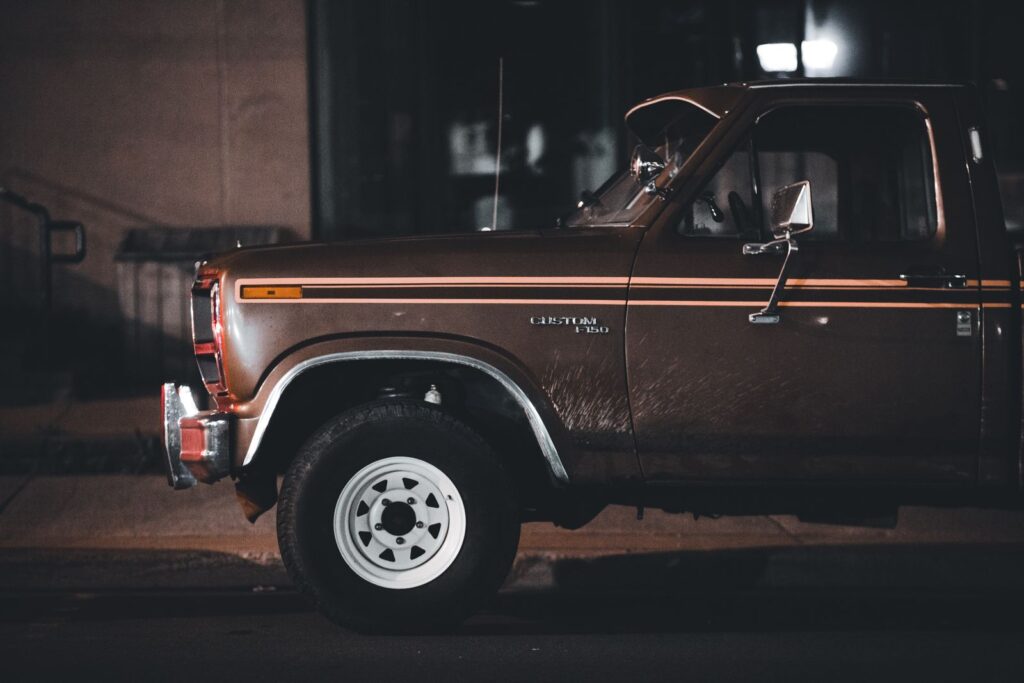
“Paid off, bro. Clean title.”
It started the way a lot of job site drama starts: somebody harmlessly poking the bear. One of the younger guys—new, still optimistic—asked Kyle if the lift and tires were expensive. Kyle lit up, because it gave him an opening.
He leaned against the bed like he was filming a commercial and said, loud enough for anyone within forty feet, that he didn’t mind spending because he wasn’t “bleeding money on a note.” Then came the line he loved most: “Truck’s paid off, bro. Clean title. No bank owns me.”
He made sure the foreman heard it too, because Kyle liked any moment that felt like dominance. A couple guys gave the polite half-laugh you give when you’re stuck somewhere and can’t just walk away. Somebody muttered, “Must be nice,” and Kyle took that as applause.
For the next ten minutes he did the full tour: how he’d “stacked checks,” how he’d “made sacrifices,” how he’d “never miss a bill.” It was the kind of brag that tries to shame everyone else for not being him, even though nobody asked. A few guys drifted off to their trucks to eat in peace, and Kyle stayed standing there, king of the gravel lot.
The unfamiliar tow truck rolling in
That’s when a white repo truck turned into the site like it belonged there. Not one of the company’s flatbeds, not a delivery truck, not a subcontractor. It was a wrecker with a stinger setup, slow and deliberate, creeping past the gate with the kind of confidence that says the driver already knows exactly what he’s there for.
At first, nobody clocked it as a problem. Job sites get random vehicles all day—inspectors, suppliers, some guy’s cousin who “just needs to talk for a second.” But this one didn’t head toward the trailers. It aimed straight for Kyle’s black truck.
Two guys watching from the shade did that thing where they pause mid-bite. Someone said, “Is that for one of us?” Another guy, seeing the angle, started grinning like he’d been handed free entertainment. Kyle noticed the tow truck about five seconds later, and his face did a quick flicker—confusion first, then annoyance, like the driver was daring to inconvenience him.
He waved at the repo driver with the casual authority of a man who thinks he can redirect the universe. Like, hey buddy, wrong place, keep it moving. The repo truck didn’t slow down.
Kyle tries to big-dog the wrong person
Kyle marched over, chest out, and you could tell he was already rehearsing the story he’d tell afterward. Something about “idiot tow truck” and “people can’t read.” He got within a few feet of the repo driver’s window and threw his hands out like a traffic cop.
The driver didn’t match his energy. He was calm in that slightly tired way—ball cap, clipboard, sunburned forearms, looking like a guy who’d dealt with every flavor of denial. He didn’t hop out swinging; he didn’t start yelling. He just rolled down the window a crack and asked, “Kyle M.?”
Kyle’s bravado hit a speed bump. “Yeah, what’s up?” he said, but it came out less confident than he meant. He glanced back toward the crew, checking his audience, because Kyle never did anything without one.
The driver tapped the clipboard and said, still level, “I’m here for the 2019—black, lifted, plate ending in 4-7.” Kyle smirked like it was a prank. “That’s my truck,” he said. “And it’s paid off.”
The driver didn’t laugh. He just said, “Not according to the lienholder.”
The correction, delivered at full volume
Kyle’s voice went up. “Dude, you’ve got the wrong guy. I don’t have a payment. I don’t owe on it.” The foreman, who’d been half-listening from the trailer steps, straightened up like he’d smelled smoke.
The repo driver finally stepped out, and he did it slowly, like he had all day. He glanced at the VIN on his sheet, then at the dash through the windshield, confirming it with an almost boring precision. No drama, no taunting—just procedure.
Kyle kept talking, trying to bulldoze reality into changing. “I have the title,” he said, which was a weird flex because nobody else had asked. The driver, without raising his voice, replied, “If you had the title free and clear, I wouldn’t be here.”
That’s the moment the whole job site started paying attention. Conversations stopped the way they do when an argument in public becomes better than whatever you were doing. Guys drifted closer with lunch in hand, pretending they were just “walking by” while they locked in for the show.
Kyle tried a different angle: intimidation. He puffed up, pointed a finger, told the driver he couldn’t touch the truck, that he’d “call the cops,” that this was “illegal.” The repo driver didn’t flinch. He said, “You can call whoever you want. I’m contracted. If you want to stop it, you need to settle the account with them.”
Then he looked past Kyle, right at the cluster of coworkers, and asked, “Can someone move that blue Tacoma? I need a straight shot.” It wasn’t meant to be a roast, but it landed like one because it assumed the repo was happening. It assumed Kyle was just background noise.
The foreman muttered something like, “Are you serious?” and Kyle snapped his head around, suddenly realizing his bragging had bought him a front-row seat to his own humiliation. His face went red in that specific way where it’s not just embarrassment—it’s betrayal, like the universe broke a rule.
Watching a man lose his truck in real time
Kyle started spiraling through excuses fast, tossing out details nobody asked for. He said the bank “messed up,” that he’d “been trying to fix it,” that he’d “already paid.” He talked like if he said enough words, the repo driver would get bored and leave.
The driver didn’t argue. He just began setting up, walking around the truck with a practiced routine, checking clearances, eyeing the wheels. That calm made Kyle look even more frantic, like two different realities were colliding and only one of them had paperwork.
Somebody offered Kyle a face-saving off-ramp—quietly said, “Maybe you can call and handle it, man.” Kyle snapped at him, hard, like the suggestion was an insult. That’s when the crew’s sympathy evaporated, because nobody likes being yelled at for standing near you when you’re on fire.
Then Kyle did the thing everybody does right before consequences hit: he tried to get in the truck. He lunged for the driver’s door, keys in hand, like he could just hop in and relocate the problem. The repo driver stepped between him and the door, not aggressive, just firm, and said, “Sir. Don’t.”
For a second it looked like Kyle might actually shove him, and the air got sharp. The foreman took a few quick steps forward, because whatever this was, it couldn’t turn into a fight on site. Kyle hesitated, looked around at all the eyes on him, and you could practically hear him calculating how it would look to swing on a repo guy in front of his boss.
He backed off, but he didn’t get quieter. He kept announcing that he’d “handle it,” that he “wasn’t worried,” that the driver was “gonna feel stupid.” The repo driver finished the hookup and climbed back into his truck like he was clocking out at the end of a normal day.
The black lifted truck rolled a few inches, then a few feet. The suspension bounced once, and the whole thing looked suddenly less impressive—just an object being moved by someone else. Kyle stood there with his hands on his hips, watching it go like he couldn’t believe something he considered part of his identity could be taken with a winch and a signature.
The part that didn’t get to be a punchline
The repo driver didn’t do a victory lap or say anything cinematic. He just eased out, careful not to clip the gate, and disappeared down the road with Kyle’s truck trailing behind like a trophy nobody wanted. The site got noisy again, but it wasn’t normal noise—it was that slightly manic chatter people do when they’ve witnessed a public implosion and aren’t sure what the rules are now.
Kyle stayed planted for a minute, then stormed toward the trailer, phone already out, trying to make calls with sweaty hands. The foreman watched him go with the expression of a man doing math in his head—how much of today just got derailed, how much of Kyle’s mess was about to spill into scheduling, and whether this was going to turn into a bigger pattern.
What made it stick wasn’t just the irony of the “paid off” speech getting corrected in front of everyone. It was how fast Kyle’s confidence turned into rage, and how quickly the crew adjusted their distance from him, like they’d all just learned something important about who he was when things didn’t go his way.
By the end of the day, Kyle was still there, still working, but he wasn’t giving speeches anymore. He was quiet in the way people get when they know the story will follow them even if nobody mentions it. And the most uncomfortable part was that it didn’t feel finished—just paused—like tomorrow he’d show up in some other vehicle and try to act like none of it happened, while everyone else kept remembering the moment the repo driver said, calmly and in full view of the entire site, “Not according to the lienholder.”
More from Steel Horse Rides: