

A 1958 Chevy Bel Air sat under a carport at an estate auction, and it had not run in 30 years. Its last registration was in 1996, and the folks running the auction wanted everything gone, fast.
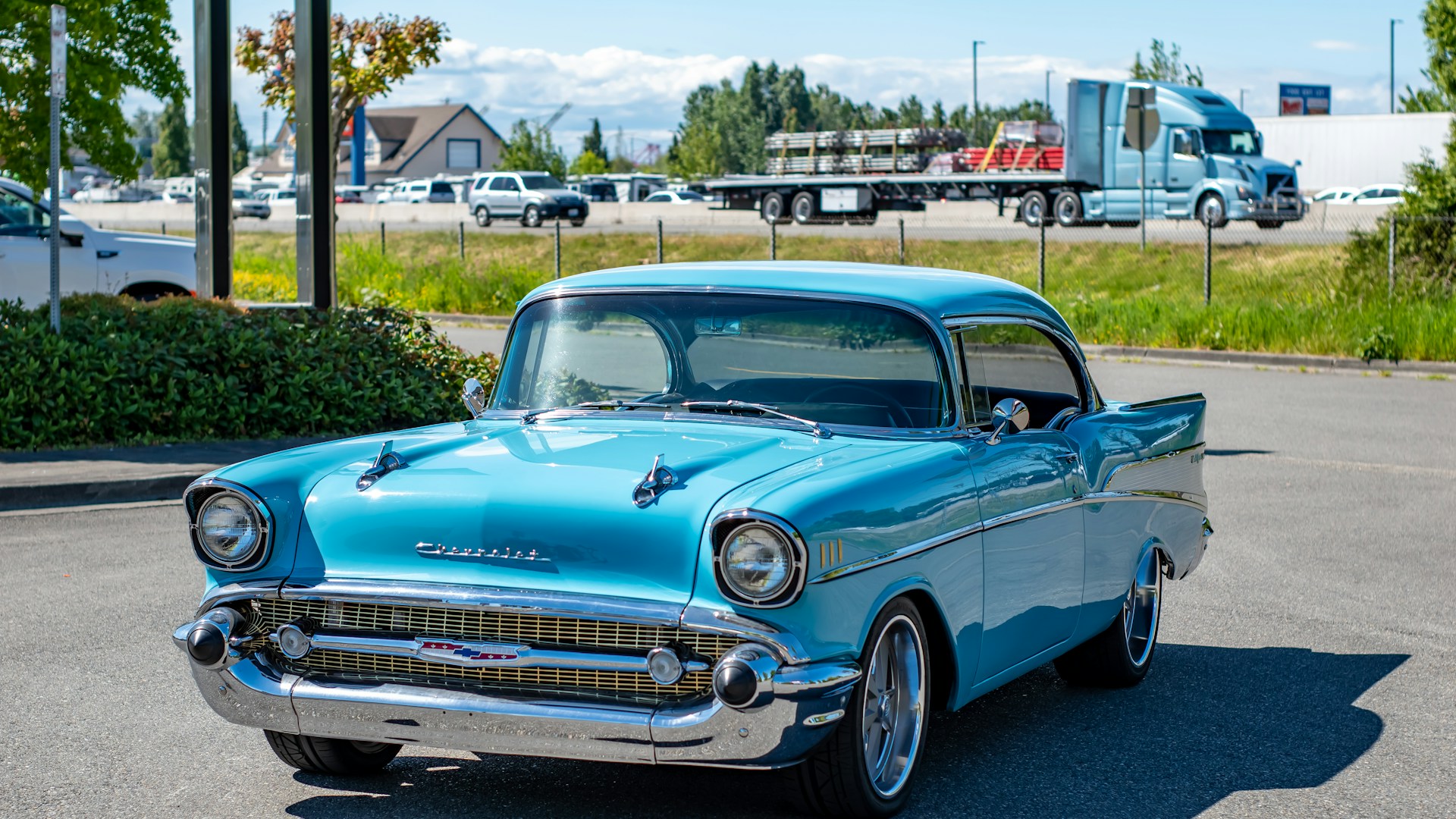
Travis, the car guy behind the Theetravisb channel, bought it anyway. He had a trailer, his dad, and a plan to wake it up and drive it home on its own wheels.
“Look At All The Door Stickers” As Original Paint And A 1996 Inspection Tag Turn Up
The first problem was simple: the doors were locked and nobody had a key. Getting the car onto the trailer meant dragging it out of a crowded auction lot while everyone else was hauling away their own buys.
It landed at his friend Kevin’s place in Arkansas, where the tires were another headache. Only some of them held air, so Travis found a set of 14-inch tires at Walmart. The only ones in that size were trailer tires, which he admits is “not something I like to do,” but “there’s not many people that stock 14-inch car tires anymore.”
Then he got his first good look inside, and he could hardly contain himself. “This car is unrestored, original, like day one immaculate,” he says. The door panels, the carpet, the paint on the dash, even the headliner were all still there.
The paperwork on the glass told the story of its last years. An oil change sticker showed 49,544 miles, the odometer read 49,674, and the inspection sticker was from 1996. In other words, somebody drove it home from that final oil change and barely used it again.
Soft Door Rubber After 70 Years Proves The Car Never Baked In Arizona Sun
Travis pressed on the rubber around the door and was amazed at how soft it still felt. “Touch that rubber on that door. See how soft it still is after 70 years?” he says. Out in the Arizona sun, he figures, “there wouldn’t have been nothing left of that.”
The car had spent its life under cover, and it showed. Under the rusty-looking surface, the paint on the car was factory original, because directly beneath the green was the red lead primer used back then, with no other color under it.
It was not a loaded car. It had manual windows, manual seats, manual brakes, no power steering and no air conditioning. It did have a radio and a clock, which Travis called important.
Under the hood sat what he believed was a 283 V8 with a two-speed Powerglide. The oil was right up to the full mark, and the engine bay still had its original squeeze-style hose clamps.
“Okay, Problem Solved” Is Not Quite What The First Start Sounded Like
With no keys, Travis and his dad hot-wired it. The dome light came on, the turn signals worked, and one headlight was out. A master key set for old GM cars, with 62 keys on the ring, got a try too. Travis worked through every one of them without luck, then handed it to his dad, who got it done.
It would not run at first because the points were filthy. Once they were cleaned, the engine caught, the oil light went out, and the old Chevy ran for the first time in decades. The fuel gauge just pegged to full, so they put some gas in and carried on.
The car was not done teaching lessons, though. Travis and his dad took the generator off because a brush spring was broken and it would not charge. A new spring went in, along with a light going-over with sandpaper to make the contacts shiny.
The spring was a big part of this story for a reason. Travis had been burned before on an earlier car, where a broken generator brush spring forced him to hunt down a spring at a hardware store just before closing. This time he had ordered a spring kit ahead of time.
A Half Day Lost To A Fuel Pump That “Should Take Maybe 20, 30 Minutes”
Anyone who has bought a cheap replacement part will know the next part. A fuel pump swap should be two bolts and done, but the new pump was thicker, so the bolts were too short. The fittings were a different thread size, and they sat crooked enough to hit the radiator hose.
“What should take maybe 20, 30 minutes is like we’re in this for a half a day,” Travis says. The fix meant longer bolts, new brass fittings and taking the diaphragm apart to twist it into place.
Dad rebuilt the carburetor, which was filthy inside, with a new accelerator pump, a needle seat and gaskets. Travis changed the oil, then put in a new set of points, a condenser and spark plugs, which he called “good insurance.”
A cracked radiator hose got replaced, an exhaust hanger was added so the pipe would not rattle next to the gas tank, and the brakes got a full redo. New brake hoses, wheel cylinders and shoes went on, and the front wheel cylinders had to be rebuilt right on the backing plate.
Then came the discovery he calls a secret killer. The two-piece drive shaft has a carrier bearing in the middle, and the rubber on this one was shot. “See that? It’s absolutely torched,” his dad says. “You would have got partway home and you’d have had to do this on a rest stop.”
Heading Home On Route 66 In A Car That Had Been Asleep Since The Clinton Era
With the car sorted, Travis and his dad pointed it back toward Tucson. They rolled through Santa Rosa, New Mexico, on Route 66, which Travis could hardly believe: “Cruising a 58 Chevy on Route 66. What do you know about that?”
The weather helped. It was a cloudy, rainy day with the windows down, and he said the temperature was just perfect. Dad was riding along in the second car, and neither of them was in any hurry.
At a fuel stop in Alamogordo, the numbers came in. Dad got 14.8 miles to the gallon and Travis got 14.5, the best the pair had seen so far. Along the way the engine used about two and a half quarts of oil, and the lifters quieted down.
The dirt dobber nests packed under the car were the only drama. Every so often a clump fell off and a puff of dust blew out the back, and for a second Travis thought something was smoking. Mostly it was just the old Chevy shaking out its decades of dirt.
“Not One Problem. Nothing” As A 35-Year Nap Ends In A Triumphant Interstate Run
When they got to the end of the trip, Travis summed it up with obvious pride. “I’m real proud of this car. It got woke up after a 35 year slumber,” he says. It “screamed out on the interstate” and “didn’t get one problem. Not one problem. Nothing.”
He said they were never stuck on the side of the road working on it. “It’s just like driving a brand new car,” he says. Dad agreed that the old 283 is a great engine and the two-speed Powerglide is tough as well.
There were a few other stops on the journey. The two ate at Swadley’s Barbecue in Oklahoma City, which they rated a 10 out of 10 for food and service, and they thanked their host Kevin, of the Cruising with Kevin channel, for letting them use his shop and his family’s hospitality.
What To Check Before You Wake Up A Car That Has Been Parked For Decades
Few of us will ever buy a 1958 Bel Air at an estate sale. But the lessons from this one apply to anyone who inherits, buys or finds an old car that has been sitting.
- Check the fluids first. Travis found good oil, but brake fluid was in the master cylinder and the hoses were old. Brakes are the first thing to rebuild.
- Do not trust old rubber. Fuel hoses, radiator hoses, brake hoses and drive shaft carrier bearings all age out whether or not the car moved.
- Clean the points and replace the condenser and plugs. Cheap parts, big payoff.
- Buy the right parts kit in advance. A generator spring kit saved a repeat of an earlier headache.
- Expect new parts not to fit. Budget half a day for jobs that look like 30 minutes.
- Keep the old belt when you fit a new one. Travis kept his because cheap new belts can stretch and snap.
Travis also learned the lesson the hard way on the road. On the same trip, the belt tensioner bolt on his diesel truck snapped and left them stranded until his mom came to pull them out, so he replaced it with a stronger bolt and a fresh belt.
It is a good reminder that even a car with just 49,000 miles deserves a careful once-over before the long drive. Do that, and your own barn find might just float down the interstate like this one did.
More Stories You May Like
- Ford Racing Turned A 1966 Mustang Fastback Into A 347 Stroker Five Speed Restomod To Mark 125 Years Since Henry Ford Won A 1901 Race That Helped Lead To Ford Motor Company
- Wife Tracks Down A Rare 1979 Dodge Magnum GT With 48,599 Original Miles Through A Former Classmate, And Only 1,674 Of Them Were Built
- Classic 1988 To 2000 Chevy Pickups Slid 11% After Doubling In Value To About $30,000, And The 1992 To 1996 Ford Bronco Fell From $61,000 To $58,000