

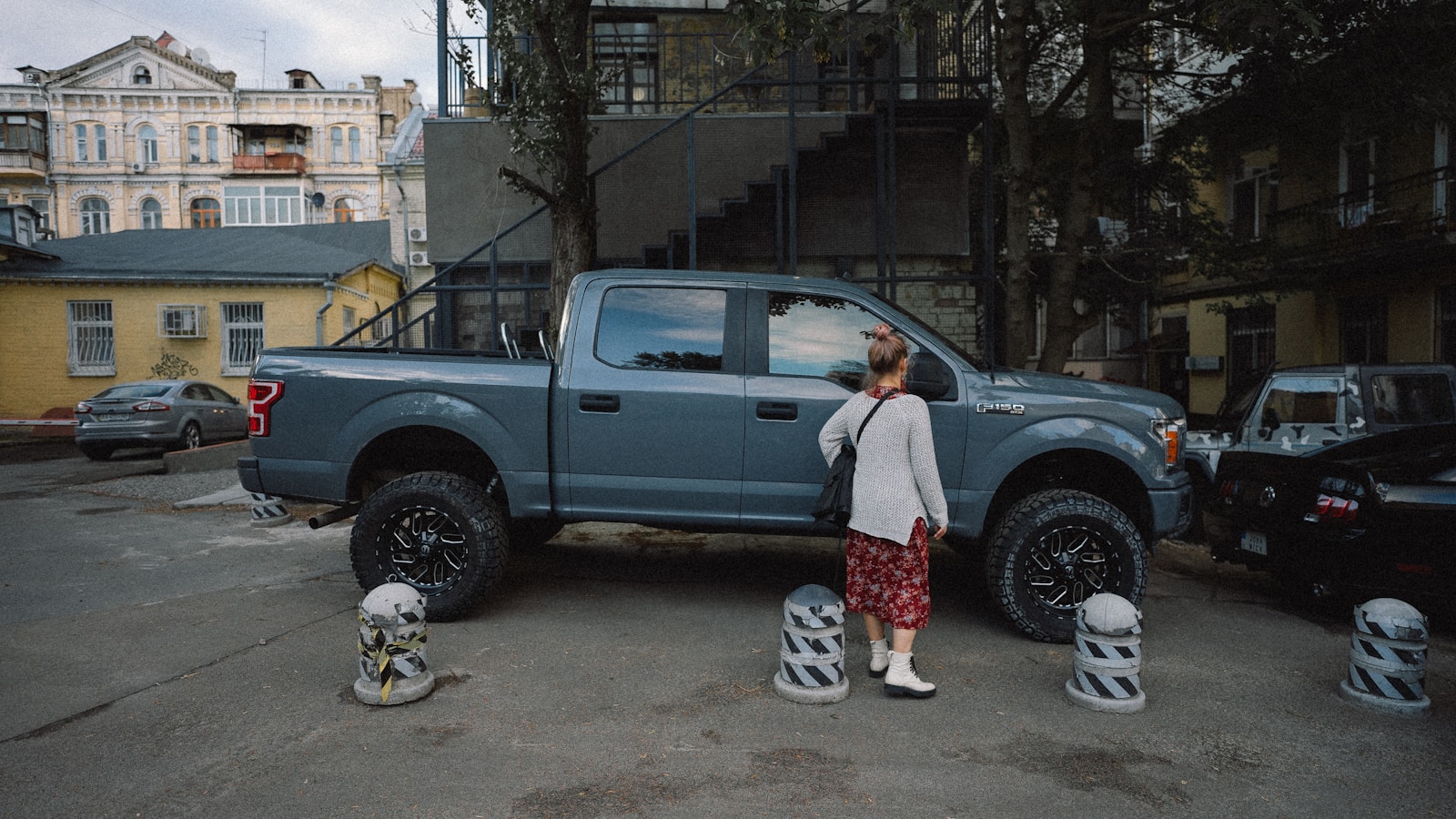
He’d been talking about this truck the way some people talk about a lake house. Not as a “maybe someday” thing, but like it was an inevitability—one good bonus, one decent trade-in, one lucky deal away. Every time one rumbled past their driveway, he’d do that little neck-crane thing, like the sound alone was proof he was meant to have one.
So when he pulled into the cul-de-sac on a random Tuesday evening in a brand-new, graphite-gray, lifted monster with tires that looked like they belonged on construction equipment, he expected the moment to land like a movie scene. He’d timed it for when his wife would be home, because the reveal was part of the fantasy. She stepped out onto the porch, squinted at the truck, and her face did that careful, slow shift from confusion to a smile that didn’t quite know where to sit.
He hopped out grinning, already mid-sentence—heated seats, tow package, the “technology package” that seemed to include half a Best Buy. She walked around it once, hand brushing the fender like she was checking if it was real, and asked the first question anyone reasonable would ask. “So… what’s the payment?”
The reveal he planned vs. the question he dreaded
He tried to keep it light. He said something about “less than you’d think” and “interest rates being weird right now,” the kind of vague talk that’s supposed to make numbers feel optional. She didn’t take the bait and asked again, slower this time, like she was talking to someone who’d just claimed the dog could drive.
He finally gave a number, but it came out fast, almost swallowed. She made him repeat it, and when he did, her eyebrows rose and stayed there. The payment wasn’t just high—it was higher than their mortgage.
That’s when the air changed. Not yelling yet, not even anger in the dramatic sense, just that sudden quiet where a person is doing math in their head and doesn’t like what it’s showing them. He kept talking, filling space with horsepower and resale value, while she stood at the edge of the driveway staring at the truck like it had personally offended her.
Inside, he tried to keep the momentum going, like if he acted normal enough she’d get swept along. He offered to take her for a ride and pointed out the panoramic camera feature, like the ability to see the curb from five different angles could justify anything. She said she didn’t want a ride and asked where the paperwork was.
How “I handled it” turned into “I didn’t tell you”
The papers were in a thick dealership folder he’d set on the kitchen counter like a trophy. She opened it with the kind of care people use around medical results. The more she read, the more her mouth tightened—not just at the monthly payment, but at the term length, the add-ons, the service plan, and the insurance estimate tucked into a separate sheet.
He kept saying he’d “handled it,” which turned out to mean he’d done the entire thing without a real conversation. He’d mentioned wanting to upgrade. He’d joked about it. He’d shown her photos and asked if she liked the color. But he hadn’t said, “I’m about to commit us to a four-figure payment every month for the next several years.”
When she asked how he thought this was okay, he started building a case like he’d been waiting for cross-examination. He talked about his raise, his commission checks, how he’d cut back on lunches, how they could “tighten up” for a while. She asked if “tighten up” meant canceling their vacation, pausing retirement contributions, and pushing off home repairs they’d already been delaying.
He said he deserved something nice, and that was the spark. Not because she didn’t think he worked hard, but because “something nice” had just walked into their finances and started eating like a second mortgage. She wasn’t screaming; she was doing that terrifying calm voice people use when they’re trying not to cry and not to explode at the same time.
The numbers he didn’t mention, and the trust she couldn’t ignore
He tried to frame it like a passion purchase, like a hobby with wheels. He mentioned how it would be useful for hauling, for road trips, for “when we get a camper,” a plan that sounded suspiciously like it was being invented on the spot. She reminded him that they didn’t own a camper, didn’t have plans to buy one, and hadn’t even priced one out.
Then she found the part that really made her sit down. It wasn’t just the payment; it was the amount financed and what the interest would cost over the life of the loan. He’d rolled in taxes, fees, and a bunch of dealership extras that sounded harmless until they were attached to a number with commas.
He started bargaining emotionally. He said this was his dream, that he’d wanted it since he was a kid, that he’d never buy himself anything. She stared at him and said, “Do you hear yourself?” like she couldn’t believe she had to explain that adulthood doesn’t come with a “dream truck” exemption clause.
At some point she asked the question that hit harder than any lecture. “When were you going to tell me?” He said he thought she’d be excited, and she said that wasn’t an answer. That was the moment it stopped being about the truck and became about the kind of decisions he was willing to make alone.
The dealership call, the return window, and the panic math
He insisted returning it would be impossible, because dealerships “don’t do that.” She picked up the folder again, flipped through it, and found the section about cancellations and cooling-off policies—if not a full return, then at least some wiggle room on the add-ons. Watching her read the fine print while he hovered behind her was like watching someone try to defuse a bomb while the person who built it kept insisting the wires were probably fine.
She told him to call the dealership. He said it would be humiliating, like the salesperson would laugh or call him irresponsible. She looked at him like, yes, that is the point, and told him she wasn’t paying for his pride. He called, tried to keep his voice casual, and quickly realized the dealership was very practiced at sounding sympathetic while not actually offering much.
They did offer to cancel a couple of the extras. The warranties and protection packages suddenly became “optional” in a way they hadn’t been during the signing. It shaved the payment down a bit, but not enough to change the basic reality: the truck was still costing them more each month than the house they lived in.
After the call, he paced. She sat with a notepad and started listing bills like she was preparing for a storm. She asked to see his bank app, because she wanted to know whether the “raise” he’d mentioned was real money or the kind of optimistic math people do when they assume every month will be their best month.
Sleeping arrangements, silent mornings, and the truck in the driveway
That night, he slept on the couch, not in a dramatic “fine, I’ll go” way, but because she went to bed without saying goodnight and closed the door like she meant it. The truck sat outside under the streetlight, still spotless, still smelling like plastic and dealership air freshener. He checked on it twice, like it was a pet he was worried might run away.
The next morning was worse because it was normal. Coffee brewed, kids’ lunches got packed, and they moved around each other like coworkers who’d had a disagreement in a meeting. The truck keys stayed on the counter, untouched, because nobody wanted to be the one who used it and made it real.
He tried to make jokes—something about “at least it’s safe” and “we could rent it out for weddings.” She didn’t laugh. She asked what the plan was and said she wasn’t interested in brainstorming around a mistake he’d already decided they’d live with.
He started mentioning selling it, then balked at the idea of taking a loss. She pointed out that the loss would happen either way; the only question was whether it would be a one-time hit or a slow bleed that would drag through their monthly budget. He got defensive and said she was acting like he’d cheated, and she said, quietly, “This feels like you did.”
By the end of the week, the truck was still there, looming at the end of the driveway like a dare. He was oscillating between frantic problem-solving and stubborn attachment, like he couldn’t decide whether to fix it or justify it. She was doing something more dangerous than yelling: she was watching him, taking notes in her head about what he’d chosen, what he’d hidden, and how quickly “our money” had turned into “my decision.”
There wasn’t a clean ending, just a household now living with a very large, very loud reminder of a private choice made inside a marriage. The truck didn’t just change their budget; it changed how every future plan sounded when it came out of his mouth. And every time it started up, it wasn’t just an engine— it was the sound of trust trying to figure out whether it could afford the payment, too.