

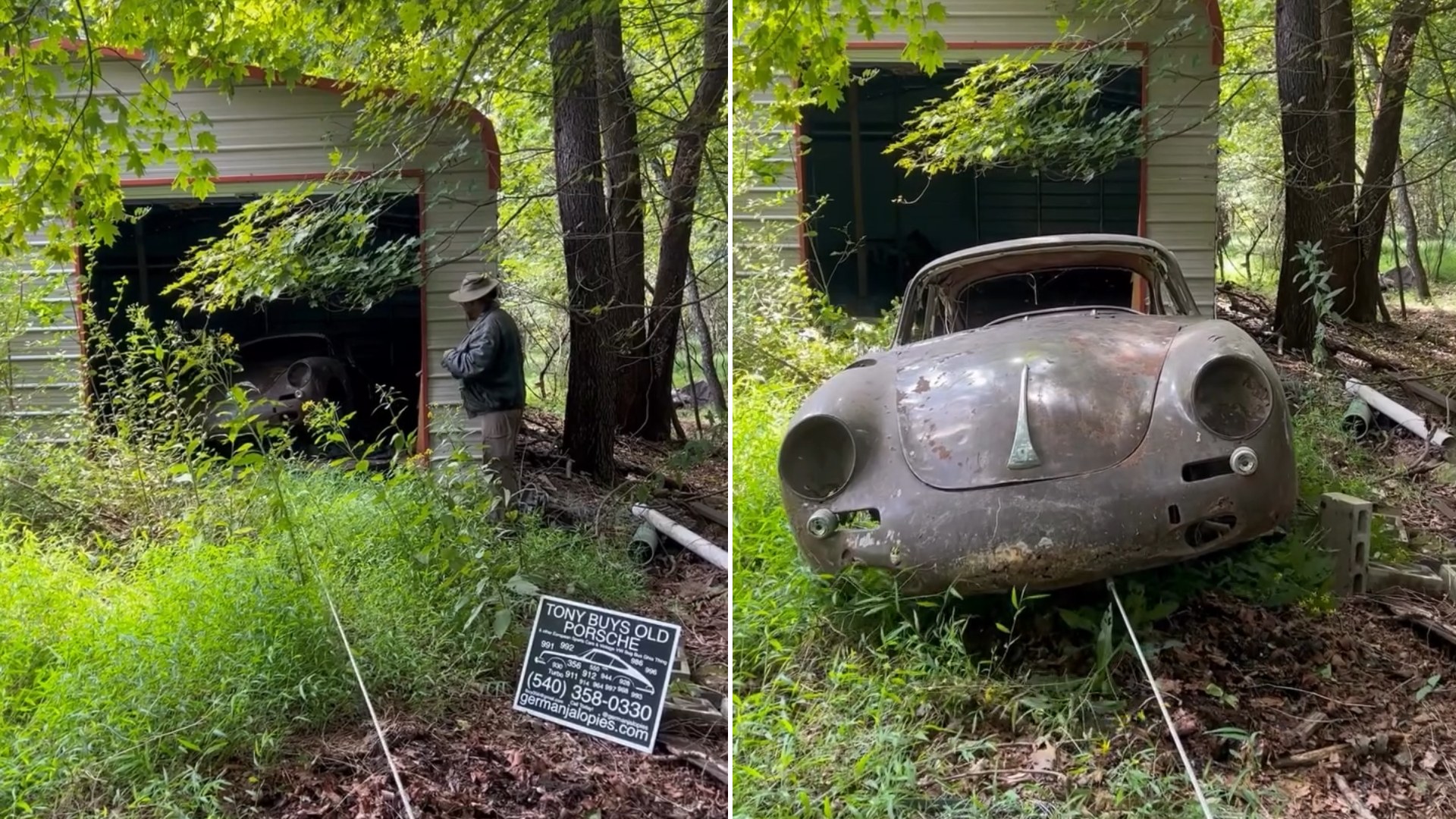
Barn find stories are a staple of automotive content, but few of them come with a motto as fitting as this one. An Instagram creator behind @germanjalopies used a portable winch to pull a rusty, long-abandoned vintage Porsche out of a shed, crediting the technique to a saying his brother used to repeat: “pull and pray.”
“As my brother used to say, pull and pray,” the caption reads, tagged alongside hashtags identifying the car as a Porsche 356, one of the earliest and most historically significant models the German manufacturer ever produced. The vehicle, according to the post, had been sitting rusty and abandoned in a shed — the kind of forgotten storage spot where classic cars sometimes sit undisturbed for years or even decades, slowly becoming more myth than machine until someone finally decides to see what’s actually still there.
Extracting a vehicle that has been parked in one place for a long stretch of time is rarely as simple as starting it up and driving it out. Tires go flat or rot through entirely. Brakes seize. In many cases, the vehicle itself becomes wedged in place by debris, collapsed shelving, or simply the accumulated grime of neglect. A portable winch offers a practical solution for exactly this kind of situation — slow, controlled pulling force that can extract a car without needing it to move under its own power, which is often the only realistic option when a vehicle’s mechanical condition is a complete unknown.
The “pull and pray” framing captures something true about this kind of work that more polished restoration content sometimes glosses over: there’s real uncertainty involved. Pulling a decades-old car out of a structure it’s been sitting in risks further damaging bodywork that rust has already compromised, catching on unseen obstructions, or discovering mid-pull that the car is more structurally fragile than it looked from the outside. The motto isn’t just a catchy phrase — it’s an honest acknowledgment that once the winch starts pulling, there’s a genuine element of hoping for the best.
The Porsche 356 holds a particular significance in automotive history that makes a barn find like this one especially compelling to enthusiasts. It was the company’s first production model, the car that essentially launched Porsche as a manufacturer of sports cars rather than just an engineering consultancy. Finding one abandoned and rusting in a shed, rather than already restored and catalogued in a collector’s garage, taps into a fantasy that drives much of the barn find genre: the idea that somewhere out there, forgotten and undervalued, sit vehicles of real historical weight, just waiting for the right person to rediscover them.
The mention of his brother’s old motto also gives the moment a personal, almost sentimental dimension that separates it from a purely mechanical extraction video. Sayings like “pull and pray” tend to get passed down within families or between friends who work on cars together, becoming shorthand for a particular kind of calculated risk-taking that anyone who has ever attempted a DIY recovery will recognize immediately. Invoking it here suggests this isn’t the creator’s first rodeo with a stubborn, rusted vehicle — just the latest chapter in an ongoing relationship with cars that don’t come easy.
Whatever condition the Porsche 356 is in beneath its rust, getting it out of the shed is only the first step of what is likely to be a much longer process. But for a car that history, extraction is often the hardest and most nerve-wracking part — the moment when a project either survives its first real test, or reveals just how much work truly lies ahead.
Takeaway: Recovering a Vehicle From Long-Term Storage
When extracting a vehicle that’s been stored for years, go slow and inspect as you go — a portable winch gives you control, but rushing the pull is how additional damage happens to bodywork already weakened by rust. Check for obstructions, loose debris, and structural soft spots before applying steady tension, and be prepared to stop and reassess if something doesn’t move as expected. Beyond the mechanics of it, there’s real value in these rescue missions beyond resale price: pulling a historically significant car out of decades of obscurity, even one that needs years of work ahead, keeps a small piece of automotive history from disappearing for good.