

Some people collect stamps. The man behind Roadtrip Revival collects tiny cars that most of us would not recognize as cars at all. In this episode, he opens with a confession: he has done it again, he admits he has a problem, and he blames Marketplace. This time it is another Belier Veloto, a French microcar, much like the green frog car he fixed in an earlier video. The difference is that this one has been highly, highly modified.
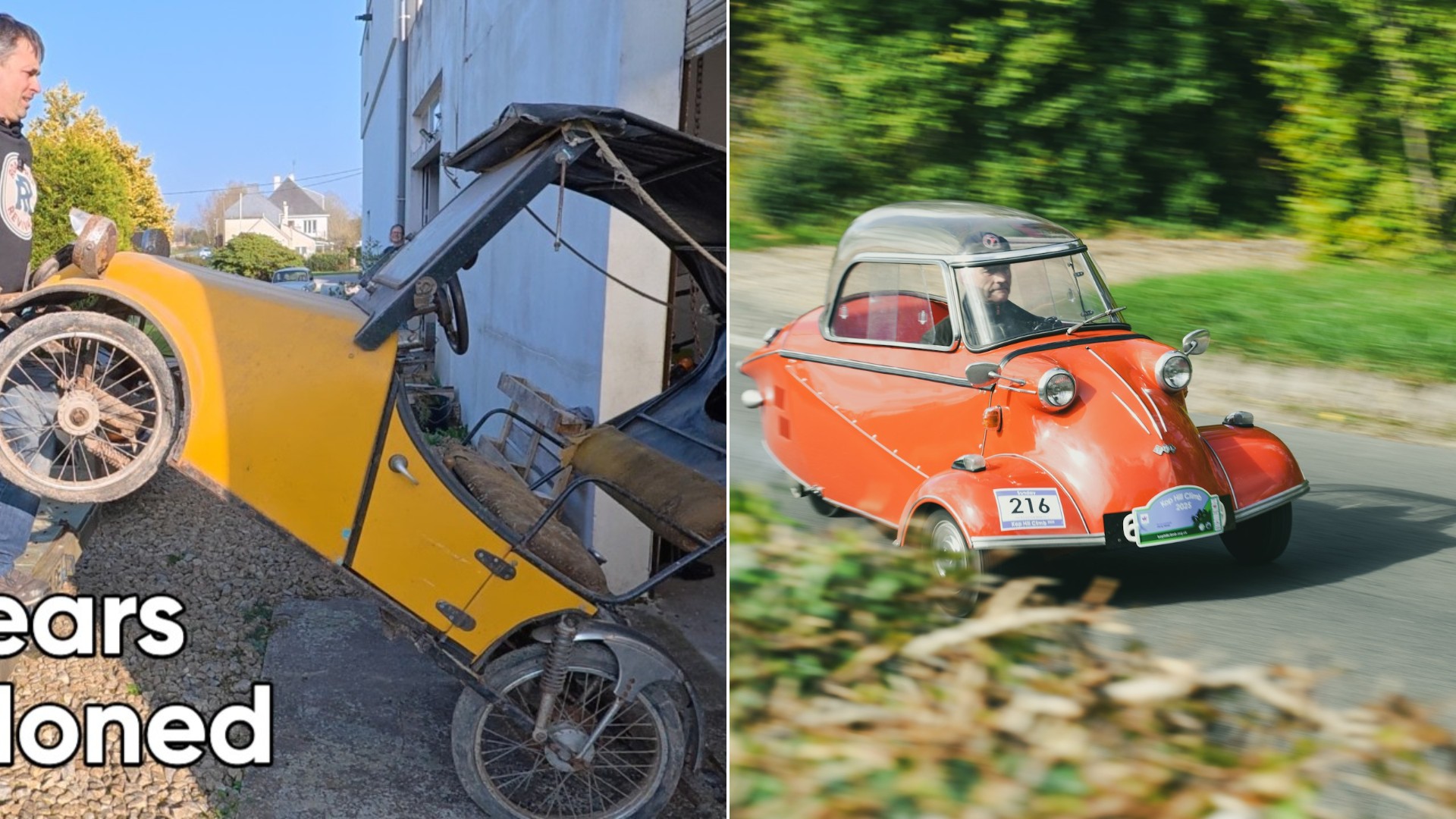
How or why anyone did this to it, he says, is a mystery. He calls the whole thing automotive archaeology. He knew only that it had not run in at least 35 years, and that the tires were turning to dust. Whether it would ever move under its own power was an open question.
A Home Brew Special
The walk-around is half the fun. The nose cone resembles the frog car but was added later. The bumpers probably are not original, there is a big horn up front, and the doors were clearly fabricated by someone, who did a nice job of it even though the doors are completely pointless. The dashboard has been dressed up with wood and fitted with a fuel gauge, a voltmeter and a clock, and the speedometer reads 7,400 km. The seat is almost as good as new, and the screen and canopy are what the green car should have had.
The controls are odd. Steering is very direct. There is a throttle, a brake pedal, a handbrake and a hand throttle that pulls a cable down to the foot throttle, which he calls the cruise control. At first he wondered whether it was an early prototype, but the more he looked the more it seemed like a home brew construction. Someone appears to have cut the body in the middle and narrowed it so it fits inside the wheels. The rear end has been converted to independent suspension using motorcycle shocks, with homemade driveshafts that look like steering column joints, running to a chain and sprocket. He found that a crazy amount of work for what it would achieve.
The engine is another mystery. It is probably bigger than the original 50 cc, has electric start, and was locked up tight. The drive is still a belt-driven continuously variable setup, but someone added a forward and reverse gearbox that the car never had. The exhaust is gone, the carburetor was open to the elements, and mice had moved in. Everything looks fragile, and he worried it might fold in half when he strapped it to the trailer.
Bringing the Engine Back
This is where the tips come in. For days he dripped an oily petrol mix into the plug hole to loosen the piston. When he finally turned it over, it was hardly stuck at all, and there was compression. The starter was free too. But there was no spark.
He pulled the flywheel, which came off without a puller, and found the ignition points were not opening and closing. He cleaned and adjusted them, only to find they were not working reliably, with no continuity where there should have been. He wriggled them out, fixed them, and finally got a spark. A squirt of brake cleaner and the engine fired, which proved it could run, though the plug was fouled with oily gunk and the engine flooded.
He declared the engine sound, but the fuel tank was full of rust and a write-off. The tires were next. The old ones were three different sizes, none of them good. New tires cost between 10 and 15 euros each, so he ordered four, with new inner tubes. The wheels got rust converter and primer, the bent axle got grease, and the stuck rear wheel was freed, though the chain had to be disconnected first. The tiny brake drum, about 60 mm across, was freed up as well, and he declared the brakes good enough.
The Garden Test Drive
After the carb was cleaned and a sticking throttle cable lubed, he rigged a temporary fuel tank held on with a cable tie, with a filter recycled from another car. Time passed, and a drought turned into the rainy season. The shifter had to be bent a little so the car could go into forward gear. For exhaust he fitted a silencer from what he thinks is a Chinese diesel heater. When it fired up, he drove it around the garden, which he reminds us is not a garden but a micro car test track. He called the result a grand success, but warned that the car is flimsy, the wheel flexes, and the brakes, well, not really. He named it the Busy Bee.
Lessons for Your Own Long-Sleeping Project
Few of us will tackle a French micro car, but the steps from this rescue apply to any engine that has been sitting for decades.
- Soak, do not force. Penetrating oil or an oil and petrol mix in the cylinder, applied over days, can free a stuck piston.
- Check compression before spending big money. It is the quickest way to know whether an engine is worth saving.
- Test spark separately from fuel. Here, old points were the culprit.
- Replace the tires and tubes first. Rotten rubber is unsafe even at garden speeds.
- Do not trust an old fuel tank. Rust will clog the carburetor again and again.
- Check brakes honestly. Even a low-speed machine needs a way to stop.
For him, this machine deserved to live, in one form or another. That is the spirit of a good revival.
More Stories You May Like
- Barn Find 2002 Pontiac Trans Am WS6 With A Six Speed And A Hurst Shifter Gets Pulled Out Of A Shed After Years Of Sitting And Starts Right Up
- Tesla Model Y Owner Drove Around With a Buckled Dented Panel for Two Years Before Finally Calling a Repair Man and Hears Why the Fix Will Not Look Perfect
- Mechanic Was Left Speechless by the Gas Problem in Two Kias and Then Learned Kia Will Not Be Buying Them Back