

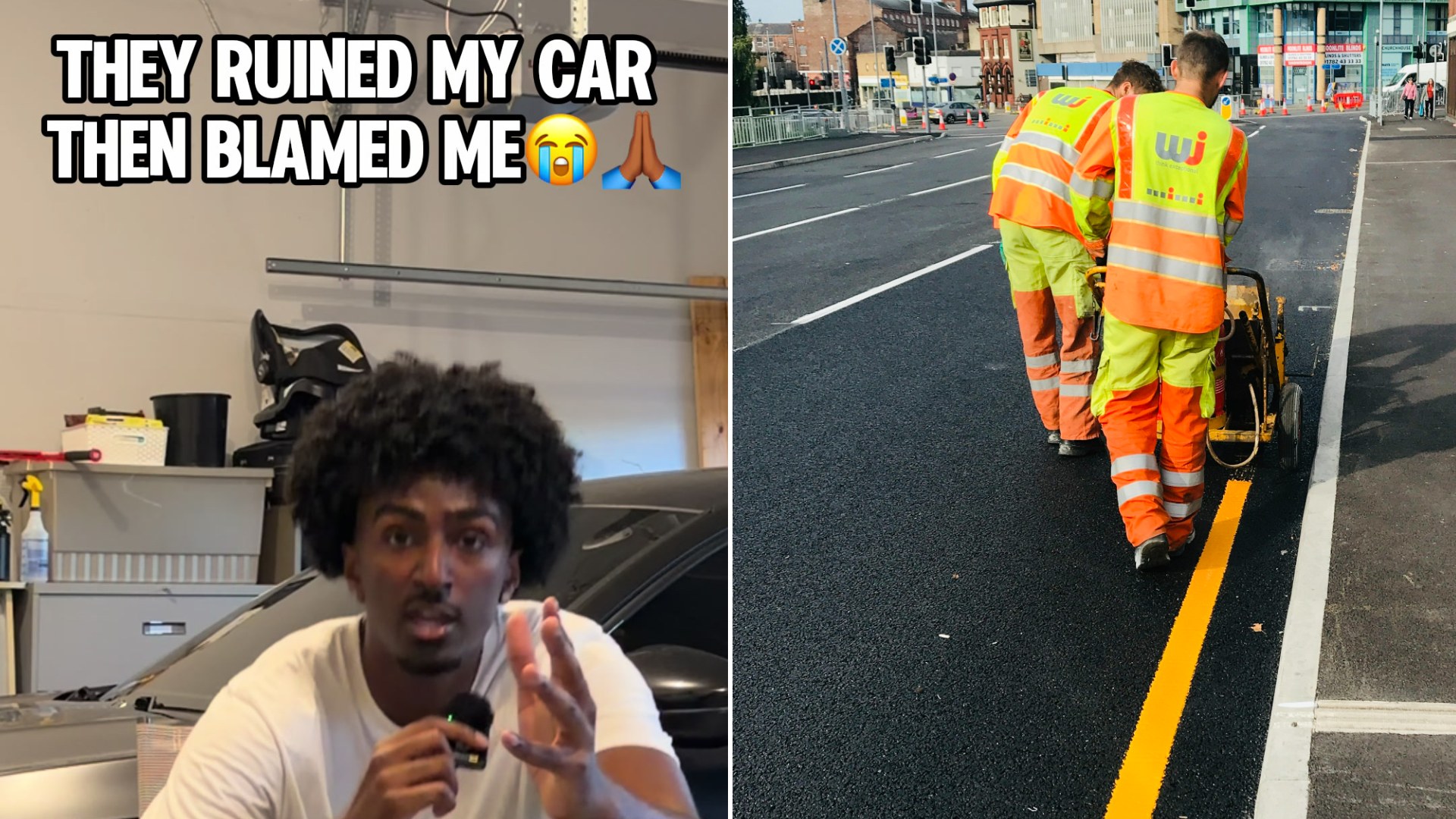
“Sir Lines A Lot, I’m coming for y’all,” the creator behind @saintzabi opens, picking up where an earlier video left off. A road-painting crew, he says, had been working a striping project on his route — and in the process, his car ended up running straight through wet paint he had no way of knowing was there.
“This is a road paint company, and they were doing a project, and they completely screwed over my car while I was running on it,” he explains. He pulls up his own dash cam footage as proof: “There was no point in the video in which it was obvious that I crossed over the white line,” he says — no warning sign, nothing indicating fresh paint. After hours spent trying to fix the damage themselves and getting nowhere, he says they realized “I needed to rewrap half of my car” just to undo it. Before going further, he’s careful to frame his intent: “I’m not in any way, shape or form trying to defame this company. I’m just simply sharing my experience.”
He calls the company’s claims line and gets transferred to Joe, who handles paint claims. Joe asks for the location, the time, and promises to pull the crew’s own camera footage and investigate — as long as the cones were properly placed with wet paint signage. “Pull the cameras, make sure that there were cones out,” Joe tells him, laying out exactly what would need to be true for the claim to hold up. Not even ten minutes after sending over everything Joe asked for, including his dash cam clip, the claim gets denied: the cones were placed fine, Joe says, and Zabi crossed the line regardless.
Going back through his own footage, Zabi finds the gap in that explanation. “The only cone I will give to you is the one at the start,” he says. “At the bottom of the right cone, it says wet paint in very small lettering. But the one on the left says nothing.” Other cones further down the stretch carry no warning at all, and parts of the road have no cones whatsoever. When he raises that discrepancy, Joe pivots — accusing him of fabricating or editing the footage to leave out the part where he supposedly crossed the line on purpose, then goes quiet entirely when Zabi asks for his full name.
So he goes around Joe. Some digging turns up Genevieve, the city’s point of contact for the project, who tells him he’s not the first person to call about a paint incident from this same job — and that liability rests with the subcontractor, Sir Lines A Lot, not the city. She sends over the official traffic control plan, which spells out that this exact stretch of road was supposed to have more than 30 cones posted on the right side alone between 2 and 6 PM. Zabi’s own dash cam shows only three.
What to Do If Wet Paint or Road Work Damages Your Car
This kind of dispute comes down almost entirely to documentation, and this video is a solid roadmap for handling one. A dash cam is the single most useful piece of evidence in a case like this — it captures not just the moment of contact but everything around it, including whether warning signage and cones were actually visible and adequately placed, which is exactly what let Zabi challenge the contractor’s initial denial instead of just accepting it. When a claim gets denied, it’s worth asking the company directly for their own internal documentation — in this case, dash cam footage from their own trucks — rather than taking their investigator’s word for it, since companies aren’t always eager to volunteer footage that contradicts their conclusion. Going beyond the contractor to the actual project owner, in this case the city department that hired the subcontractor, can also surface information the contractor won’t — including official traffic control plans that spell out exactly how many warning devices were legally required, which is often public record and can be requested directly. And a contractor’s insurance rating and prior complaint history, both of which Zabi found once he started digging, are worth checking before a claim ever gets filed, since a pattern of similar incidents strengthens an individual case considerably. Filing with your own auto insurer as a backup, rather than waiting indefinitely on a third-party company’s internal review, is also worth doing early — subrogation lets your insurer pursue reimbursement from the at-fault party later, without leaving repairs on hold in the meantime.
You can watch the full video and follow @saintzabi on TikTok for more.