
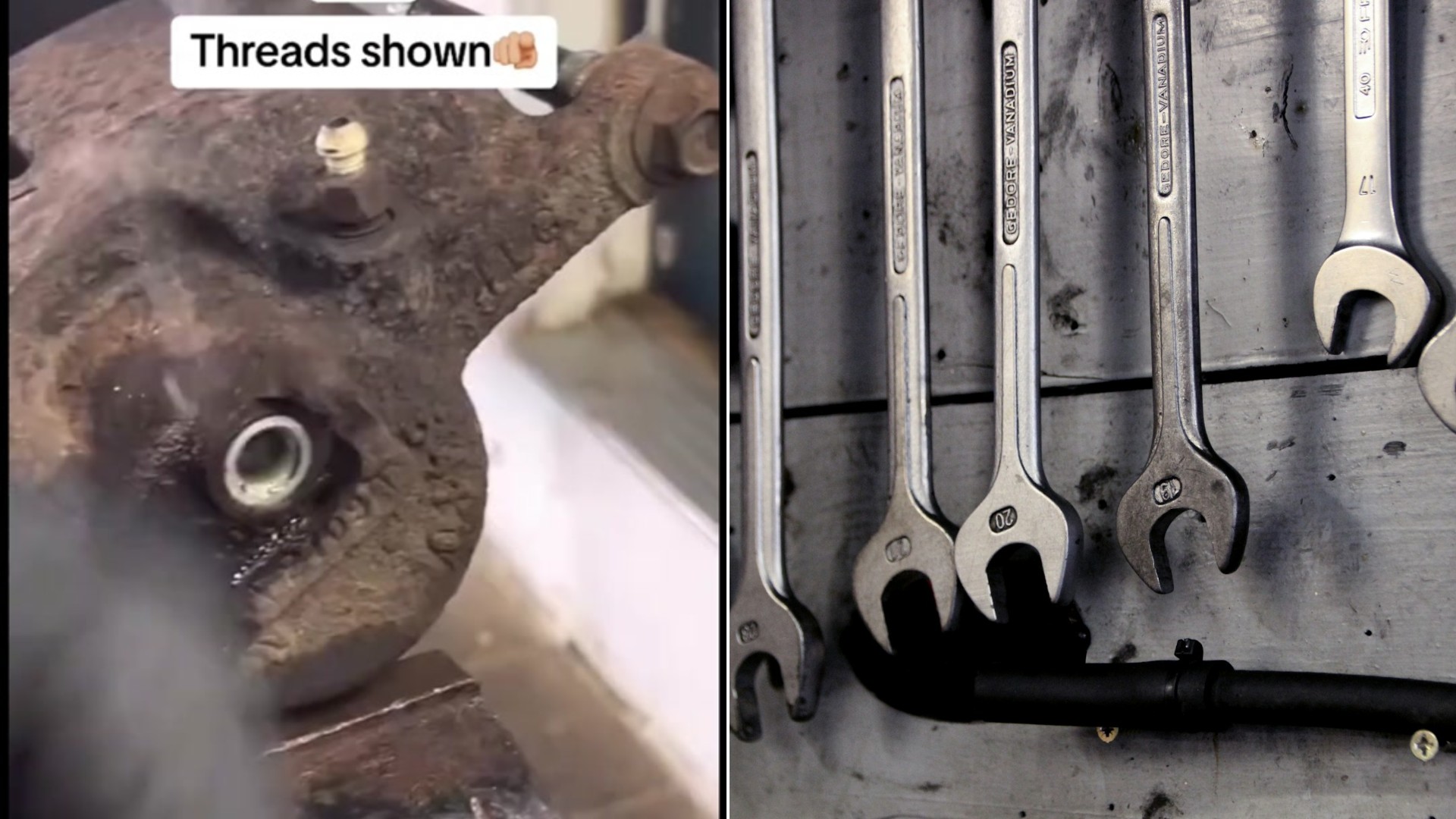

Every home mechanic knows the sinking feeling. You crack open a brake job, reach for the bleeder screw, and it is rusted solid. A mobile mechanic working in a parking lot shows a fix that sounds like a joke: a plain wax crayon.
The mechanic, @ronif662, walks through the trick on camera before a second, much more stubborn problem tries to wreck his day. “And this is how you remove a bleeder with a crayon,” he says as he gets started.
The idea is simple. Heat the threads first, then feed the crayon into them so the wax melts and seeps in.
@ronif662
The Wax Melts Into The Threads Like A Candle And Lubricates The Seized Bleeder
When he heats the metal, the crayon behaves like a candle. “Oh look, it’s a candle now,” he jokes. As he feeds the crayon into the threads, the wax seeps in and lubricates them.
The bleeder was stuck and was already starting to strip. That is the moment most people reach for a bigger wrench and make things worse.
This time, he says, the wax does the work. When the moment of truth comes, the screw moves and he tells the crowd, “Freaking crayon works.” He adds a dig at the keyboard mechanics who doubted him.
Then A Nightmare Set Screw Refuses To Budge
The next problem on the job is a set screw that is not coming out. First he tries to shock it, which typically works. Not this time.
So he shows a second trick. He grabs a pointed punch and a hammer, goes right to the corner of the screw and makes a notch. That notch gives him a place to get the screw moving.
It works, and he says that if you do it just like that, your life is going to be a whole lot easier. He also reminds viewers not to forget to clean the hub.
Running Short On Time In A Parking Lot With No Power
This is a live brake job, and things go sideways in public. He says he would normally use a magnetic induction heater, but with no access to power in a parking lot he has to go with the next best thing.
He asks the audience to say a prayer, because he is running behind and the last thing he wants is a five-mile run to the hardware store. At one point he worries something has broken, and he checks, hoping it has not.
It had not. But his ratchet then gets stuck, which he calls embarrassing, and the job slows to a crawl.
Anyone who has worked on brakes knows the feeling of a job turning into a puzzle. A task that should take a few minutes stretches into an hour because one rusty part will not move, and every attempt risks breaking something expensive. That is why shortcuts like the wax trick travel so fast among mechanics and weekend wrenchers alike.
Wheel Bearing Grease Turns Into Glue
The cause of the stuck parts, he explains, is something many do-it-yourselfers get wrong. “This is what happens when you guys use wheel bearing grease,” he says. Out in the weather, the grease becomes a sticky, disgusting glue.
His advice is to use something superior on the hub and the parts that have to come apart again. Do that, he says, and this will not happen to you.
He cleans the pin with a rag, services the area and says this is why a brake job like this costs about $200 from a mobile mechanic. The work he does is not just swapping pads, it is prying apart parts that fight back.
How To Free A Seized Bleeder Without Making It Worse
If you try the crayon trick, a few precautions help. Brake fluid and heat do not mix, so keep the heat small and never apply it near a fluid-filled line. Let the part cool a moment before you try to turn it.
Use a six-point wrench or a flare-nut style wrench that grips the bleeder on all sides. Cheap open-end wrenches slip and round off the corners, and that is how a stuck bleeder becomes a stripped one.
A penetrating oil soak the day before can also help, and gentle tapping around the bleeder can break the rust bond. Work slowly. Turn it a little tighter first, then back it out, and repeat. Small back-and-forth motions usually beat one hard pull.
For a stuck set screw, the notch trick is worth remembering. Use a sharp punch and a hammer at the edge of the screw head, and tap in the direction that loosens it. That small notch gives the punch something to bite.
Finally, put the right anti-seize or a suitable lubricant on hubs and threads when you put things back together. Ten minutes of care during assembly can save an hour of fighting the next time. The lesson from a parking lot in the middle of a busy day is that a crayon, a punch and a little patience can solve problems that make people reach for a torch.
More Stories You May Like
- The Only One In The World 1975 Ferrari 365 GT4 2+2 Was Built By A Crazy Guy For His Kid, With A Back Seat Television And Two Antennas To Prove It
- Broad Arrow Zurich Sale Totals CHF 24,723,338 With A 2015 LaFerrari Bringing CHF 5,856,250, Then A Veyron Grand Sport Vitesse At CHF 2,368,750
- Only 7 Koenigsegg CC850 Hypercars Are Covered By A Recall Because The Parking Brake May Not Engage In Reverse, And The Fix Can Arrive Over The Air For Free