
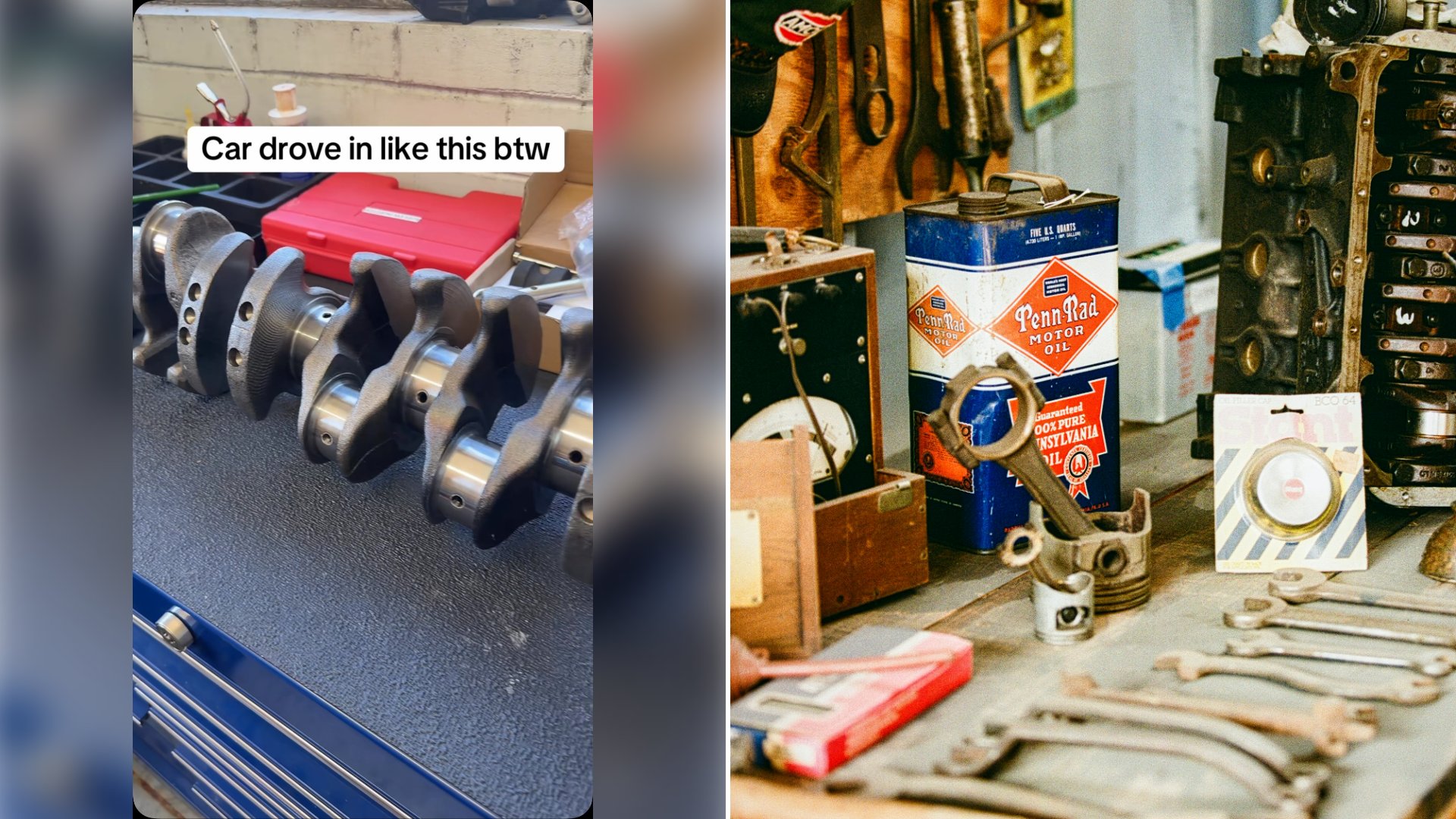

The crankshaft lies across a workbench on top of a blue tool chest, its journals and counterweights lined up as if nothing is wrong. Then a hand takes hold of the end of it and simply lifts that section away. The shaft has broken clean through, and the two halves come apart to show a rough, grey fracture face where solid steel should be.
The clip, posted by the workshop account @md.autotech (MD Autotech), runs about ten seconds. Across the top of every frame sits one line of text: “Car drove in like this btw.” The final seconds cut to a meme image of a skeleton, and the caption plays it for laughs, with an imagined customer insisting they only wanted the oil change, “no extras thank you.” That line is a joke in a meme format, not a record of anything a customer said.
What the shop is claiming is the striking part. According to its on screen text, the car arrived under its own power with the crankshaft already in two pieces. Neither the clip nor the caption says what car or engine it came from or what caused the break.
In the comments, viewers offered their own theories for how a car could still move like that. One wrote that there was “nothing but the coefficient of friction holding that thing together,” and another argued that if the bearings are tight enough the broken halves will not have much room to move. A third, who says they have seen many engines in this state, wrote that they can keep running as if nothing happened. Those are the commenters’ own views, not findings from the shop.
Why a crankshaft breaks at all is well documented. In a study of crankshaft failures published in the MATEC Web of Conferences, researchers from Yuri Gagarin State Technical University of Saratov identify fatigue as the main failure mechanism. They report that fatigue cracks start at stress concentrators such as the fillets where a journal meets the crank web and the oil holes, and that bending loads, rather than torque, are the dominant force behind these failures. They found a crack can reach 15 to 20 mm deep, taking up 55 to 75 percent of the area of the shaft’s most stressed section.
Mazda’s owner’s manual guidance on the engine oil warning light, for one, tells drivers to pull over safely, switch off, wait about five minutes, check the oil level and top it up if it is low. If the light stays on with the level normal, the manual says to stop the engine immediately and have the car towed, warning: “Do not run the engine if the oil pressure is low.”
What to Do If Your Engine Starts Knocking or Shaking
Do not drive it to the shop if you can avoid it. The car in the MD Autotech clip made it in, according to the shop, but the manual’s advice is to stop and tow when oil pressure is in doubt.
Note the symptoms before you call. Write down when a knock or vibration started, whether it changes with engine speed, whether the oil light flickered, and when the oil was last changed. A shop can narrow things down faster with that information.
Check the oil the way the manual describes, on level ground, after the engine has been off for a few minutes. Low oil or a light that will not go out after topping up is a reason to stop, not to keep driving.
Ask to see the failed parts. If an engine is opened up, ask the shop to keep the crankshaft and bearings for you, so you can see the break for yourself or show it to a second shop.
Get the repair options in writing. If the crankshaft has failed, ask for a rebuild, a replacement engine and any other option the shop offers to be priced separately so you can weigh them against what the car is worth.
More from Steel Horse Rides
- Owner Bolts Amazon’s Cheapest Turbos Onto His V10 Audi R8 in About an Hour, Starts It With No Oil in Them and Finds Metal Shards in the Exhaust After Trying to Build Boost
- Owner Who Paid $2,000 for a Ford Powerstroke 4×4 With Milky Oil in the Coolant Rules Out Head Gaskets With a Glove, Then Spends Eight Hours Digging Out a Blown Oil Cooler Seal
- Car Flipper Tells the Owner of a Smoking BMW 5 Series He Might Not Even Make an Offer, Buys It for $600 Against a $3,500 Ask, and Sells It Days Later for $5,000 in Cash